
Modular Content Reuse: Scale Approved Work Without Losing Control
Five controls make content genuinely reusable: identity, provenance, variation rules, ownership, and retirement. Without them, reuse becomes copying, and every copied claim, asset, or module creates a new source of drift.
This guide covers the reuse layer of content supply chain automation. It assumes the request is already validated and focuses on how approved work can serve new audiences, channels, and markets without losing context.
Choose reusable units that match decisions
The right reusable unit is small enough to adapt and large enough to preserve meaning. Common units include product facts, approved claims, proof points, offer terms, legal language, descriptions, FAQs, content sections, components, asset packages, metadata sets, and localization memories.
- Fact: A versioned statement with an owner and source.
- Module: A structured group of fields designed for a defined use.
- Pattern: An approved arrangement of content and components.
- Variant: A controlled adaptation linked to its source.
- Package: A coordinated set of content, assets, metadata, and rules for a release or campaign.
The reuse lifecycle
- Register: Assign stable identity, owner, source, status, taxonomy, and approved uses.
- Find: Search by audience, product, intent, market, channel, status, and rights.
- Evaluate: Check freshness, factual fit, brand, legal scope, design, and prior outcomes.
- Adapt: Change only fields permitted for the new context.
- Approve: Route the delta and evidence, not the entire source history.
- Propagate: Apply required source changes to dependent variants.
- Retire: Withdraw modules when facts, rights, policy, or strategy expire.
Define variation rules before automation
| Field class | Rule | Example |
|---|---|---|
| Locked | Must remain exact | Approved legal clause or regulated claim |
| Bounded | Can vary within approved options | CTA label, proof selection, or benefit order |
| Contextual | Can adapt with audience or channel context | Introduction, supporting example, or summary |
| Local | Owned by the market within policy | Offer, product availability, cultural reference, or local SEO term |
| Derived | Generated from governed source data | Metadata, schema fields, or product comparison table |
How Gradial orchestrates reuse
- Context-aware retrieval: Gradial can locate approved source content and assets by the work being requested, not only by filename or keyword.
- Rule-bound adaptation: Gradial applies brand, content-model, market, channel, and protected-field rules while preparing variants.
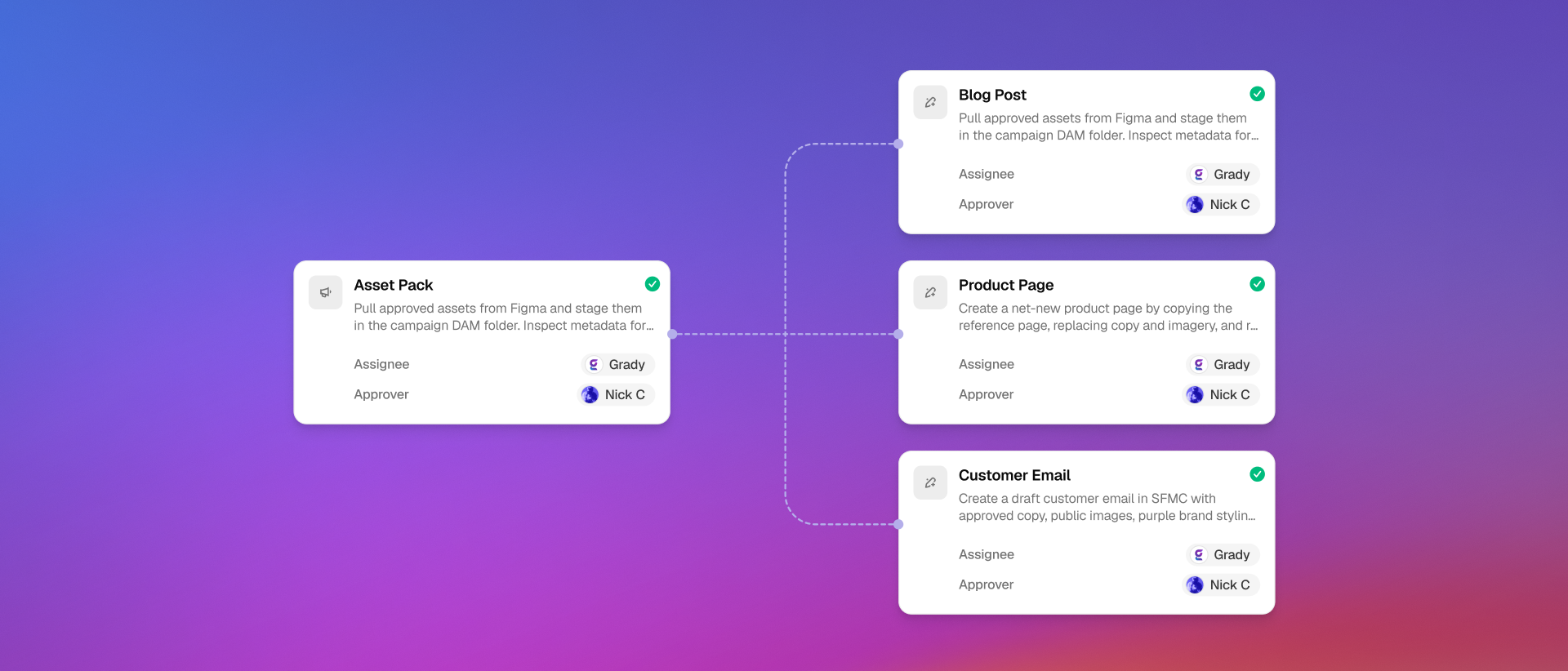
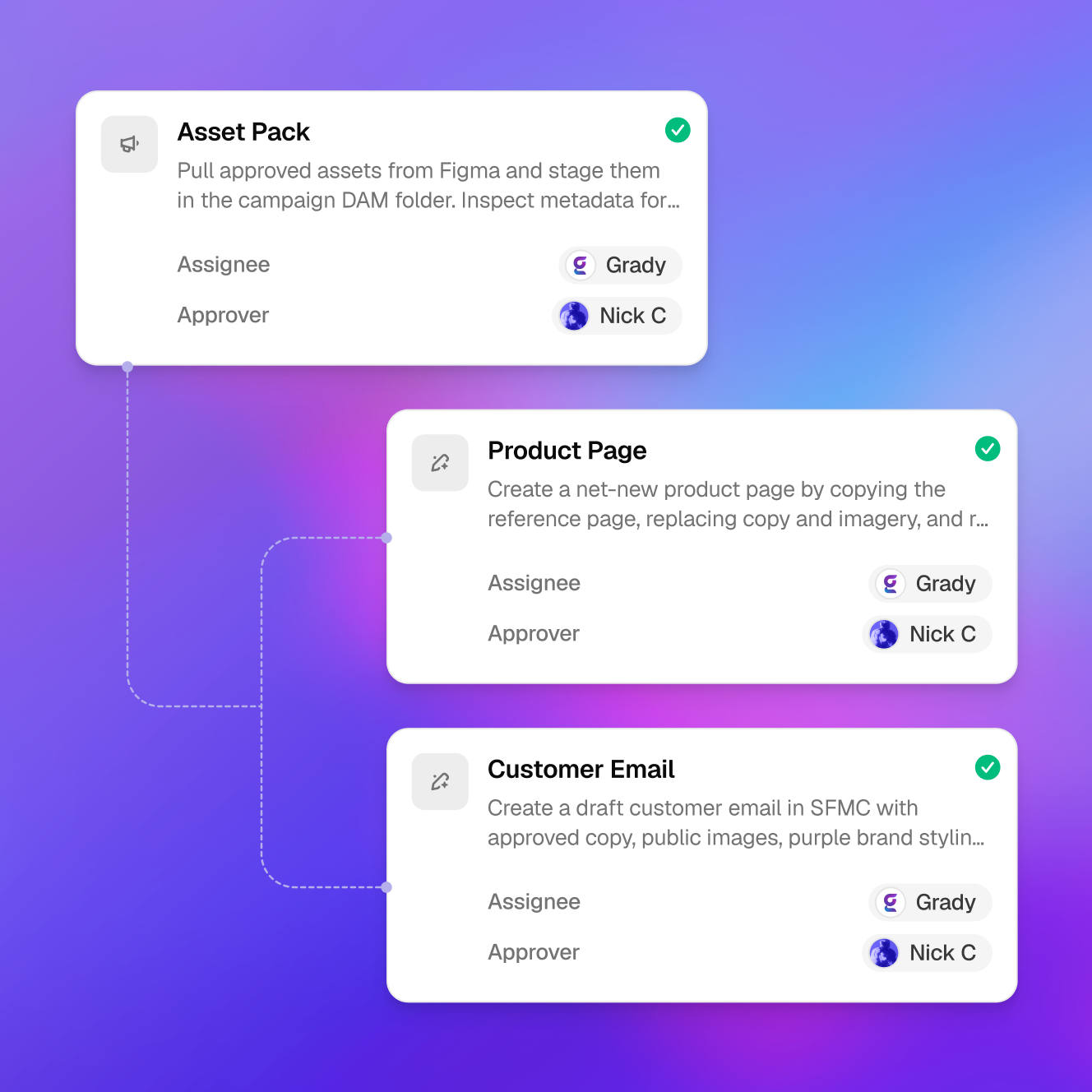
- Lineage-preserving execution: Gradial keeps source references and changed fields visible as work moves into destination systems.
- Delta-based review: Reviewers see what changed, why it changed, which source governed it, and which decisions remain.
- Update propagation: Workflows can identify dependent variants when an approved source changes.
Measure reuse without rewarding duplication
| Metric | Before | After |
|---|---|---|
| Approved modules reused | Baseline by content type | Target by workflow |
| Variants with valid source links | Baseline from audit | Target after lineage rules |
| Time spent recreating approved content | Baseline from sample | Target after retrieval |
| Stale variants after source change | Baseline by release | Target after propagation |
The goal is not the highest reuse rate. The goal is more appropriate reuse with lower drift and faster approval.
What governed reuse produces
- A registry of approved reusable units with owners, sources, status, and intended uses.
- Explicit variation rules for locked, bounded, contextual, local, and derived fields.
- Traceable variants with update and retirement paths.
- Connect reusable assets: Apply the same governance to media and renditions.
- Scale reuse across markets: Preserve lineage through locale adaptation.
- Map a reusable content workflow: Start with one high-volume content type.