
Content Intake and Orchestration: Turn Requests into Executable Work
Seven required fields separate an urgent request from executable content work: objective, audience, source, scope, destination, owner, and definition of done. Intake orchestration captures those fields, validates dependencies, classifies risk, and routes missing decisions before production time is committed.
This is the intake control layer of content supply chain automation. It focuses on how a request becomes governed work, not on the broader category or downstream CMS assembly.
Where intake breaks
- Channel-first asks: A request names the deliverable but not the audience outcome or source.
- Hidden dependencies: Product, legal, design, data, asset, or locale decisions appear after work begins.
- Owner gaps: The requester, producer, reviewer, and release owner are treated as one role.
- Priority by noise: Urgency is inferred from follow-up volume rather than business value, risk, and date.
- False completeness: A filled form advances even though approved inputs are missing.
The executable intake contract
| Field | Question | Validation |
|---|---|---|
| Objective | What audience or business result should change? | Named outcome and success signal |
| Audience | Who needs the content and in which context? | Segment, market, journey, or task |
| Source | Which facts, copy, designs, and assets are approved? | Current owner and version |
| Scope | What can change and what is protected? | Routes, systems, fields, channels, and exclusions |
| Destination | Where must the work exist? | System, environment, content type, and locale |
| Ownership | Who produces, reviews, decides, and releases? | Named roles with separate authority |
| Done | What evidence proves completion? | Stored result, rendered proof, checks, and measurement plan |
Routing logic that teams can trust
Routing should be explainable. Content type selects the workflow. Risk selects the control level. Destination selects the system skill. Locale selects market context. Deadline and business priority set queue order. Missing sources create a blocker rather than a production task.
- Low risk: Metadata, internal links, or standard updates can move to scoped draft execution.
- Medium risk: New customer-visible content, localization, and asset changes require preview and named review.
- High risk: Regulated claims, rights restrictions, redirects, bulk changes, and live release require explicit approval and recovery planning.
How Gradial orchestrates intake
- Source-aware classification: Gradial identifies content type, systems, risk, deadlines, and missing inputs from briefs, tickets, documents, and designs.
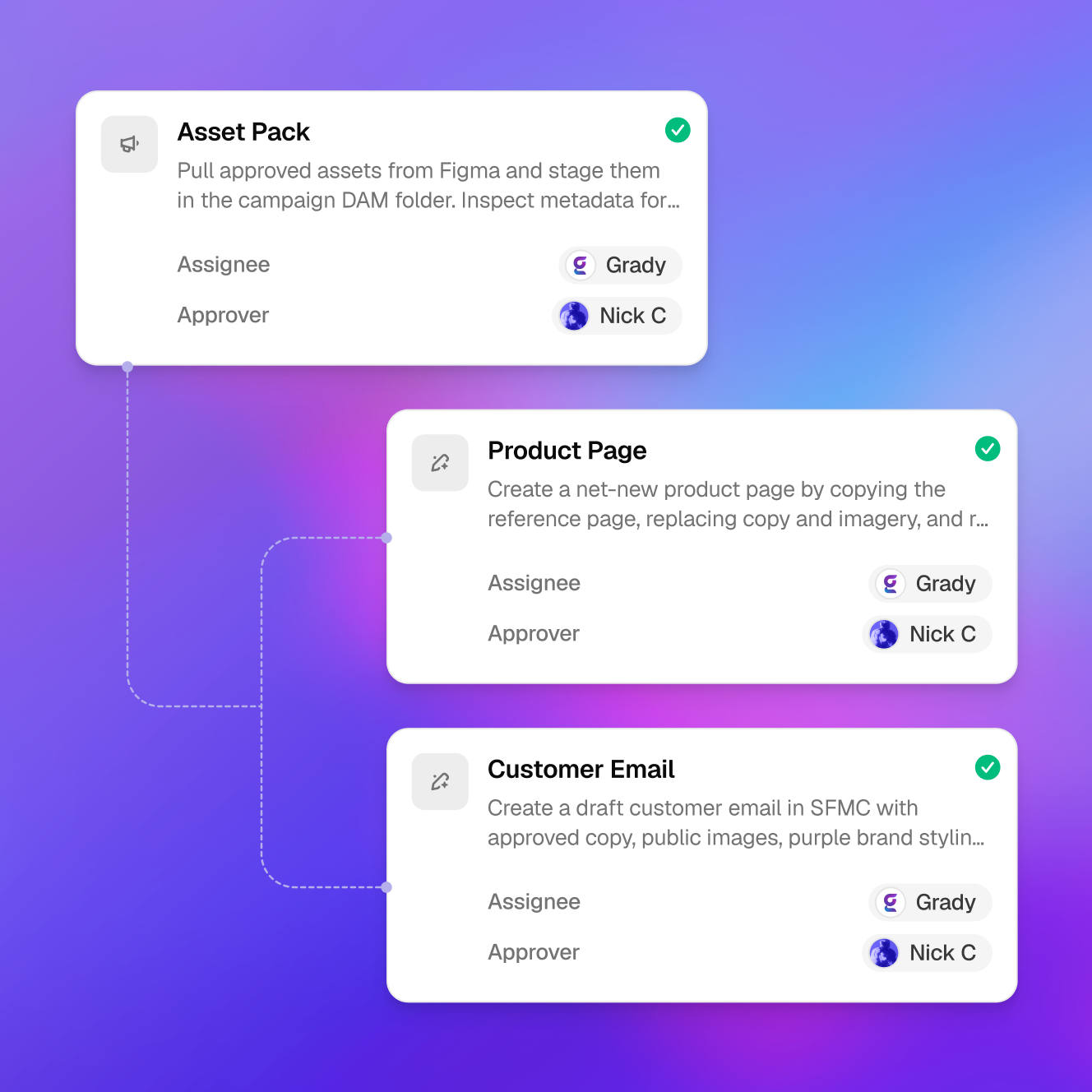
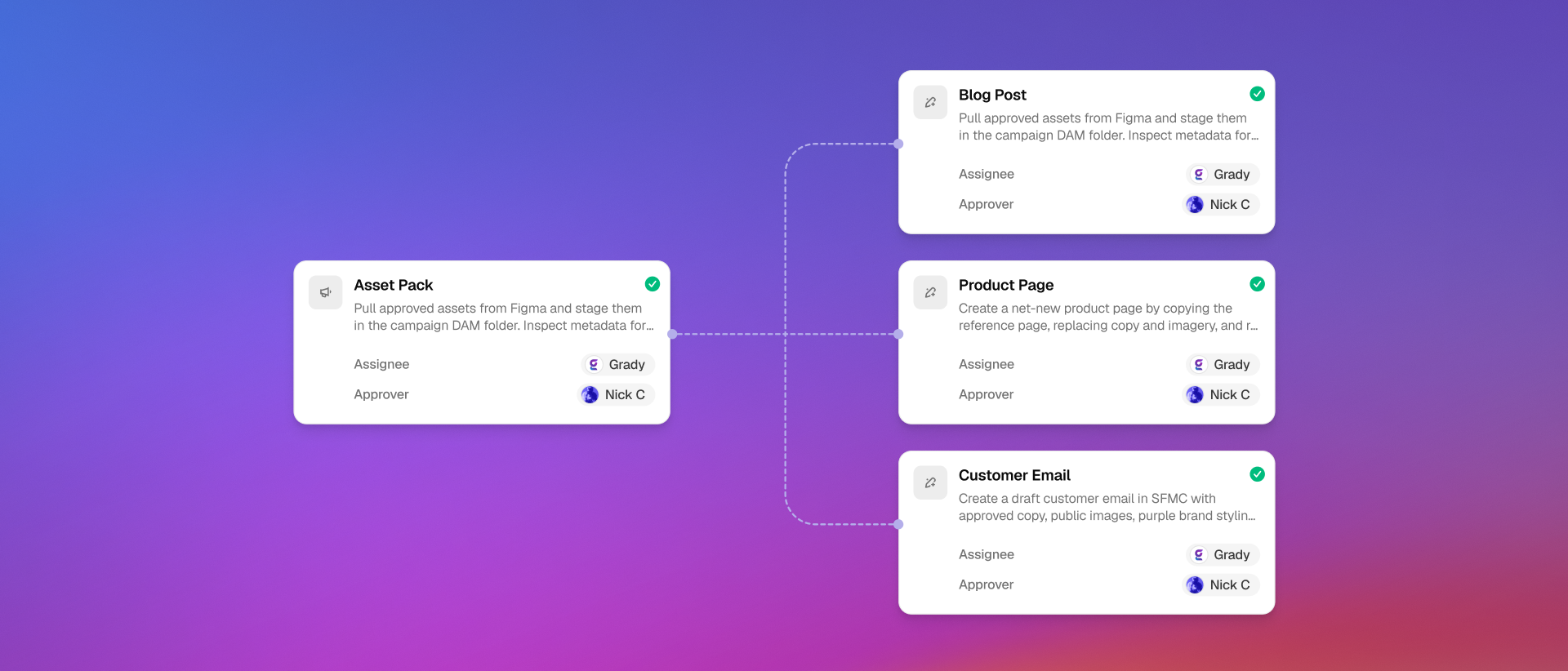
- Dependency mapping: Gradial separates independent work from decisions that must happen in sequence.
- Context-carrying handoffs: Each task receives the approved source, scope, owner, and acceptance criteria it needs.
- Blocker visibility: Missing authority or conflicting sources stop the affected step without discarding completed work.
- Evidence at exit: The workflow advances only when the required result and proof are present.
Measure intake quality before production speed
| Metric | Before | After |
|---|---|---|
| Requests complete at first review | Baseline from current queue | Target after required-field validation |
| Time waiting for sources | Baseline by content type | Target after source checks |
| Work restarted after scope change | Baseline by quarter | Target after protected-scope capture |
| Unowned approval decisions | Baseline from escalations | Target after role routing |
These signals show whether intake is reducing downstream rework. Set real baselines from one workflow before choosing targets.
What strong intake produces
- One validated request with objective, audience, sources, scope, destination, owners, and definition of done.
- One risk-based workflow path with visible dependencies and exceptions.
- One evidence package that travels into production and approval.
- Continue to governed reuse: Find approved modules before creating net-new work.
- Design approval evidence: Define what reviewers need before the work begins.
- Map your intake workflow: Turn one recurring request into executable work.