
Content Approval and Release Governance: Move Fast with Evidence
Five decisions separate a finished draft from a verified customer experience: content approval, experience approval, risk acceptance, release authorization, and post-release confirmation. Approval and release governance makes each decision explicit, evidence-based, and limited to the exact scope under review.
This guide covers the decision and release layer of content supply chain automation. It does not collapse drafting, approval, release, and publication into one action.
Why approval queues grow
- Full-document review: Reviewers cannot see the exact change or source.
- Wrong reviewer: Every stakeholder receives every item regardless of decision type.
- Late risk discovery: Claims, rights, accessibility, or market exceptions appear at the final gate.
- Unclear authority: Commenting, approving, releasing, and publishing are treated as equivalent.
- Weak evidence: A successful save or automated score replaces rendered proof.
- All-or-nothing release: Unrelated changes move together without a defined rollback unit.
The approval package
| Evidence | What it answers | Reviewer |
|---|---|---|
| Request and scope | What was authorized and protected? | Content owner |
| Sources and provenance | Which facts, claims, assets, and rules governed the work? | Subject owner |
| Change comparison | What changed and why? | Editor or producer |
| Checks and exceptions | What passed, what was repaired, and what remains? | Brand, legal, accessibility, or technical owner |
| Rendered proof | What will the customer actually experience? | Experience owner |
| Release plan | Which scope, environment, time, dependencies, and recovery path apply? | Release owner |
Route approval by risk and decision
Stable, low-risk checks can run automatically. Medium-risk changes can advance to a reviewable draft. High-risk actions require explicit human authority. The workflow should route by the decision needed, not by a fixed list of stakeholders.
- Content decision: Is the message accurate, useful, on brand, and supported?
- Experience decision: Does the complete rendered result work for the audience?
- Risk decision: Can the unresolved legal, rights, accessibility, privacy, or policy issue be accepted?
- Release decision: Can this exact set of changes advance now?
- Recovery decision: Should the release continue, pause, repair, or roll back?
The bounded release sequence
- Freeze reviewed scope: Identify the exact content, assets, variants, routes, and configuration under approval.
- Resolve dependencies: Confirm related assets, navigation, redirects, data, integrations, and market approvals.
- Stage: Build the release candidate from the approved source of truth.
- Inspect: Verify rendering, links, metadata, responsive behavior, and critical paths.
- Authorize: Record the named release decision for the selected scope.
- Activate: Move the approved candidate to the live channel.
- Verify: Confirm the live customer experience and telemetry.
- Recover: Repair or roll back the smallest failed unit without discarding valid work.
How Gradial orchestrates approval and release
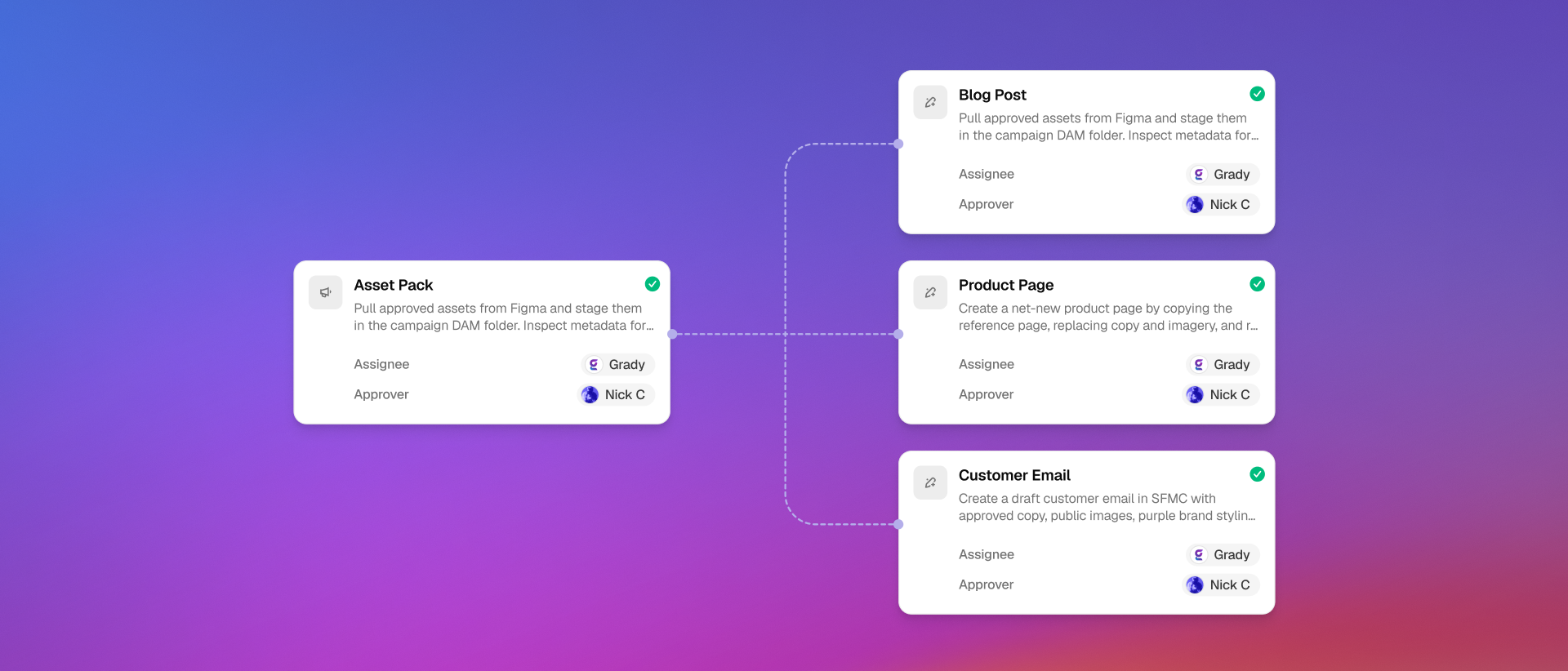
- Evidence-attached routing: Gradial sends the source, delta, checks, preview, exceptions, and requested decision to the accountable reviewer.
- Decision-specific ownership: Gradial separates content, risk, experience, release, and publication authority.
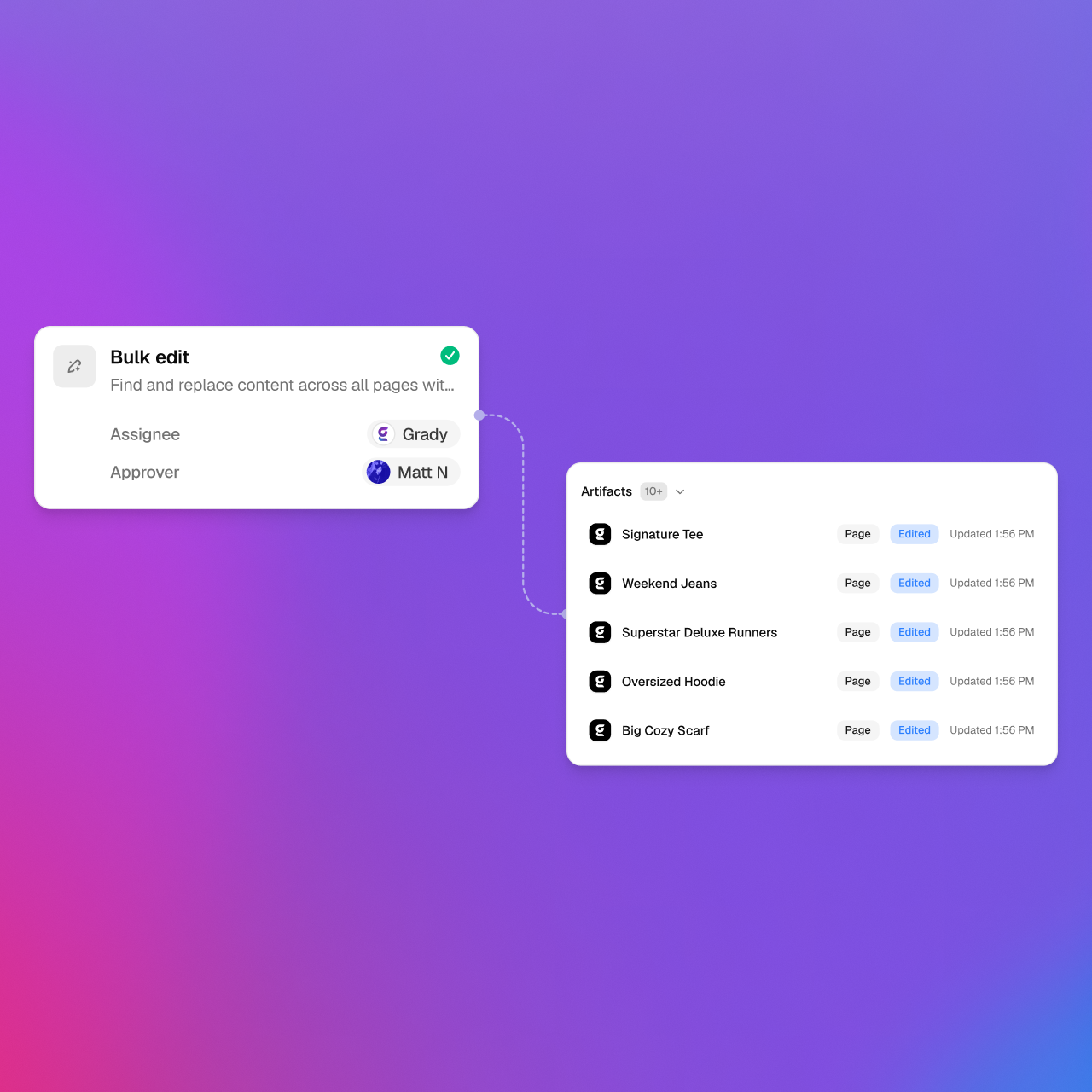
- Scope-preserving approval: Review applies to the exact content and assets presented, not an expanding bundle.
- Release-aware execution: Gradial can preserve environment boundaries and selected release scope in supported systems.
- Visible verification: Gradial checks the live or reviewable result before completion is recorded.
Measure review and release reliability
| Metric | Before | After |
|---|---|---|
| Review time by decision type | Baseline from workflow history | Target after evidence routing |
| Approval rounds per item | Baseline by content type | Target after delta review |
| Exceptions found at final gate | Baseline by release | Target after early controls |
| Release defects and recovery events | Baseline by quarter | Target after bounded release |
Faster review matters only when decision quality and release reliability hold or improve.
What strong approval and release governance produces
- Decision-specific review packages with complete evidence.
- Separate authority for content, risk, experience, release, and publication.
- Bounded releases with visible dependencies, verification, and recovery.
- Measure the operating result: Connect review and release signals to quality and outcome.
- Explore governance controls: See how access, actions, and context stay governed.
- Map an evidence-based approval flow: Start with one high-friction release.