
A look at how I moved from trend and search signals to branded-search cleanup, page briefs, live guides, and post-launch performance milestones.
Gradial's new /guides hub is live, three pages built around Agentic Marketing Operations, Enterprise AI Agents for Marketing Teams, and Campaign Workflow Orchestration. Getting there started with a problem: a Search Console review showed branded demand for "Gradial" splitting across nine different pages, with no single page clearly responsible for the traffic. Homepage variants, documentation, company pages, news content, and a handful of other URLs were all picking up some share of it, and none of it was by design.
I had six new topic pages ready to move into briefs, but none were ready to move forward until that branded-search picture was sorted out first. Pausing the new pages to clean up branded search became the first real decision of the workflow.
In this post, I share how I used Gradial to turn trend and search signals into a content workflow that carried evidence, page boundaries, human review, publishing, and measurement forward together.
The First Pass Gave the Series Its Shape
The first research pass looked at which topics were gaining attention in Gradial’s competitive space and returned the expected mix of rising terms around AI agents, marketing operations, campaign workflows, CMS automation, and search visibility. Several of them looked publishable on a keyword sheet, with the same themes appearing across media attention and search demand.
I put the topics beside the existing site before I let any one of them become a brief. For each topic, I checked whether the page would answer a buyer problem Gradial could credibly address, whether the demand looked durable enough for evergreen content, whether an existing page already owned the intent, and what neighboring searches the new page would have to leave alone.
By the time I finished the review, the topic list became a working plan. Agentic Marketing Operations would define the category and Enterprise AI Agents for Marketing Teams would focus on adoption, governance, use cases, and ROI. Campaign Workflow Orchestration would follow work from intake through approval and launch readiness. AI SEO Operations, CMS Authoring Automation, and Content Supply Chain Automation would stay in the plan as the next parts of the series.
The page roles mattered more than the count of opportunities. If those topics collapsed into the same claim about AI agents helping marketers move faster, the series would compete with itself and blur the category story. I wanted each page to do one editorial job, earn its own search intent, and strengthen the pages around it.
I Started by Creating Two Reusable Skills
Before drafting began, I created two reusable operating skills inside the workflow: one for trend-led content intelligence and one for SEO intent governance. Those instructions captured how I wanted the work evaluated each time a new opportunity appeared.
The trend-led skill required each recommendation to compare external attention with search demand, separate temporary spikes from durable category opportunities, and connect a topic to a specific operational marketing problem. The intent-governance skill required a current-site check, a primary intent assignment, explicit exclusions, overlap risks, and review gates before a page could move forward.
Once those rules existed, I could ask for research without restating the method from scratch. I could also improve the method (by using Gradial to update the skill) when the work exposed a gap. The skills became a place to store judgment: how I wanted evidence weighed, where the site needed protection and governance, and when the workflow had to stop for a decision instead of advancing in the workflow.
That operating context changed the quality of every later artifact. The research package, cleanup handoff, briefs, page drafts, and measurement prompts all carried the same assumptions about intent, risk, and approval.
Branded Search Had to Be Cleaned Up First
The branded-search fragmentation I mentioned above, with nine pages splitting "Gradial" demand with no clear owner, meant the queries were landing on homepage variants, documentation, company pages, news content, and other destinations that answered different user needs.
The way those searches were landing changed the order of work. Before I added new category pages, I needed to clarify where brand, product, documentation, company, location, careers, and news intent belonged.
The cleanup became a decision document and SEO handoff artifact. I confirmed the preferred homepage host and the canonical homepage direction. Engineering confirmed that the first pass should clarify the preferred homepage without changing page routing, and I updated the handoff before the new pages moved into drafting. I also confirmed where careers, company, and Seattle-related searches should resolve.
I then expanded the exclusion list for the new category pages. The new guides had to stay out of brand lookup, product navigation, technical setup, company profile, recruiting, funding news, broad AI education, agency services, pure reporting, and tool-comparison intent.
Once those guardrails were written down, the pillar and cluster pages could move into drafting with clearer ownership.
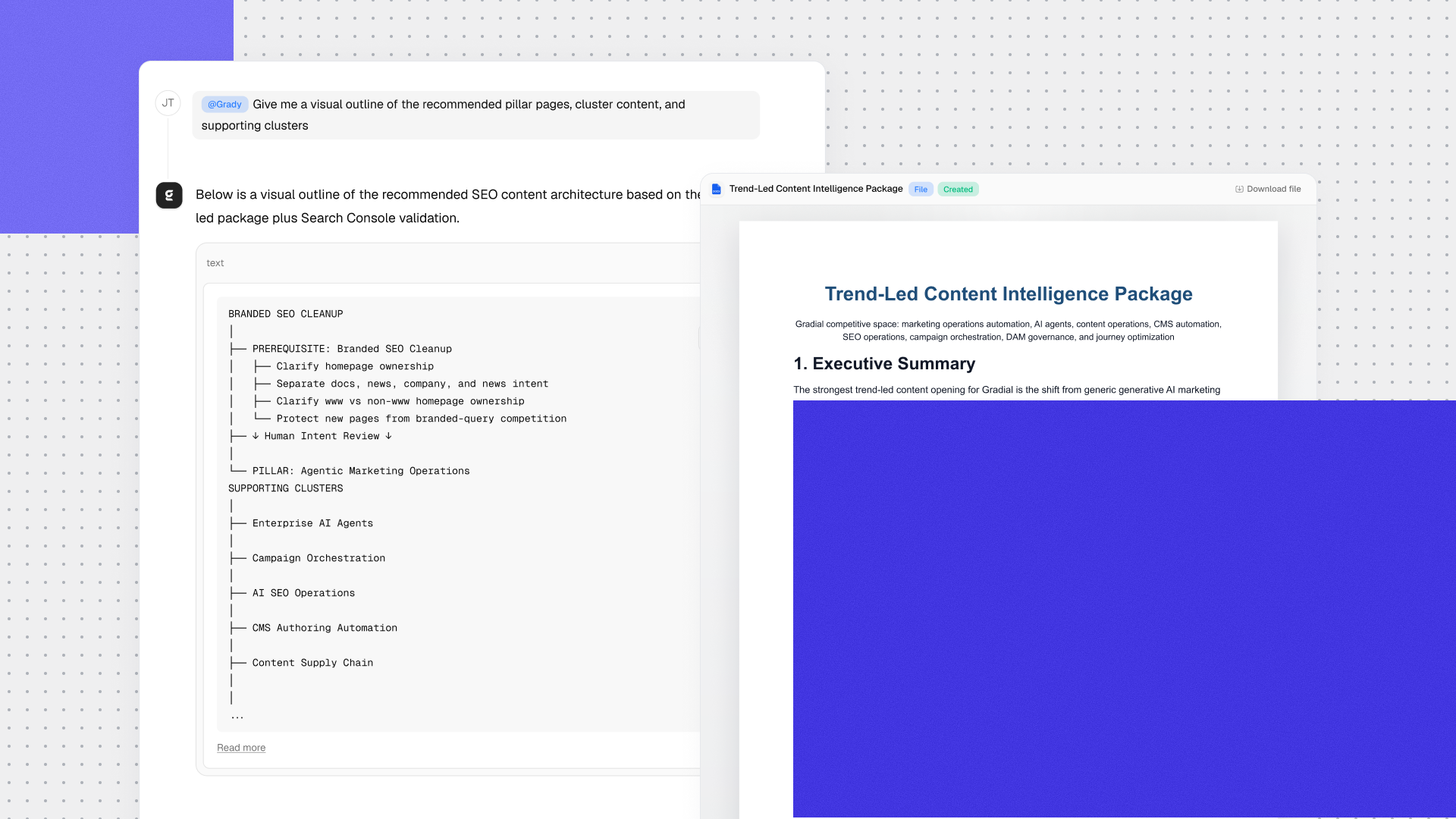
Gradial turned trend and search evidence into a governed content architecture. SEO cleanup became a prerequisite before drafting the pillar and cluster pages.
The Cleanup Handoff Kept the Drafting Work from Drifting
The branded SEO handoff gave the new pages boundaries before drafting began. A page about agentic marketing operations could define the operating model without becoming a product-navigation page. A campaign workflow orchestration guide could describe intake, approvals, production handoffs, and launch readiness without taking over documentation or support intent. A future AI SEO page could address search workflow and visibility without becoming a broad reporting article. That artifact gave me something specific to approve, which was a proposed routing system for real queries and real pages.
Because the cleanup stayed in a handoff instead of becoming an immediate live-site change, I could review which searches should lead to which pages before anything changed on Gradial.com. I approved the page roles and intent boundaries that set the pattern for the rest of the workflow. This allowed Gradial to move the work forward, but the choices that shaped the page, the site, or the user’s experience came back to me before they were actioned on or became final.
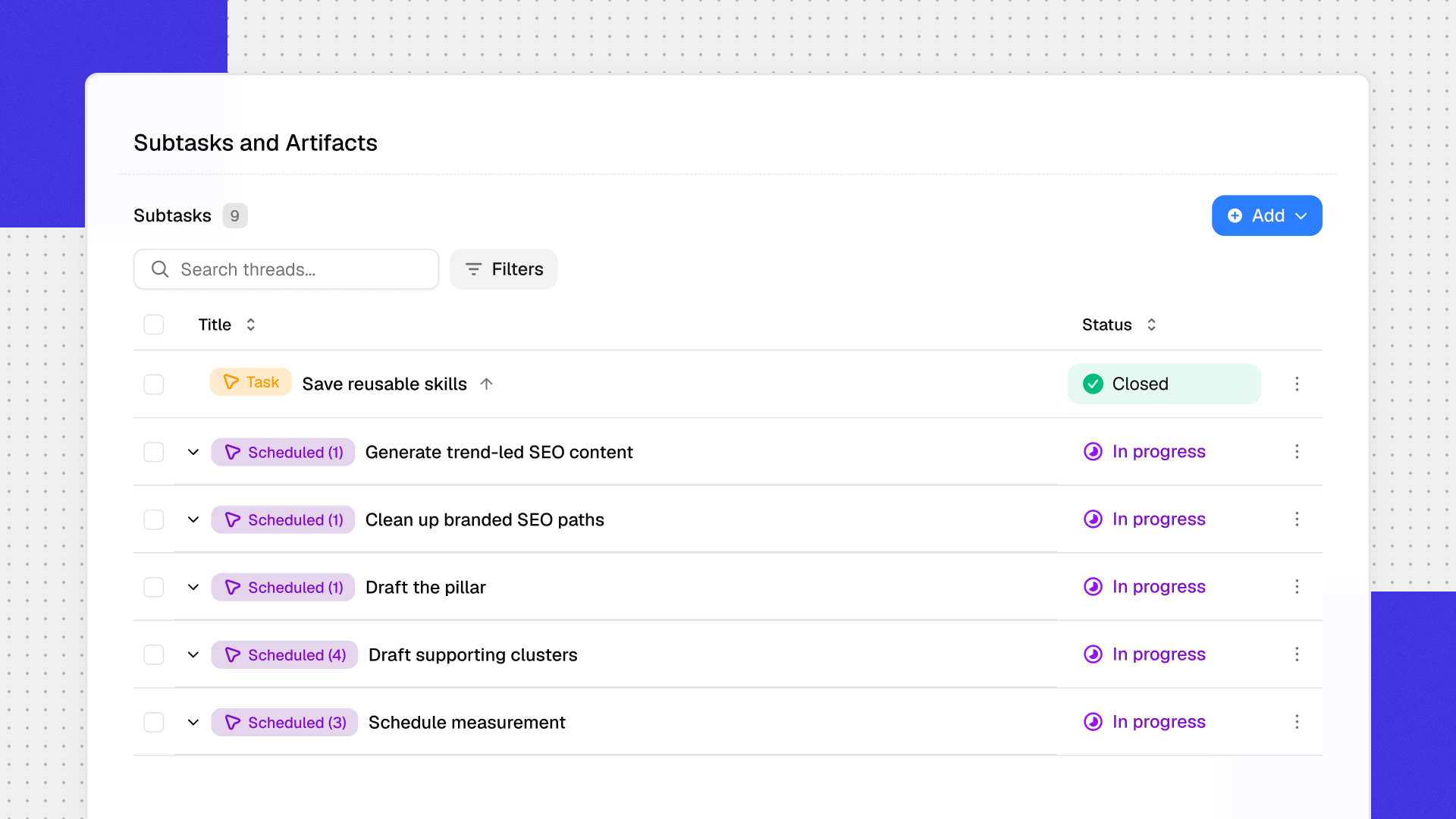
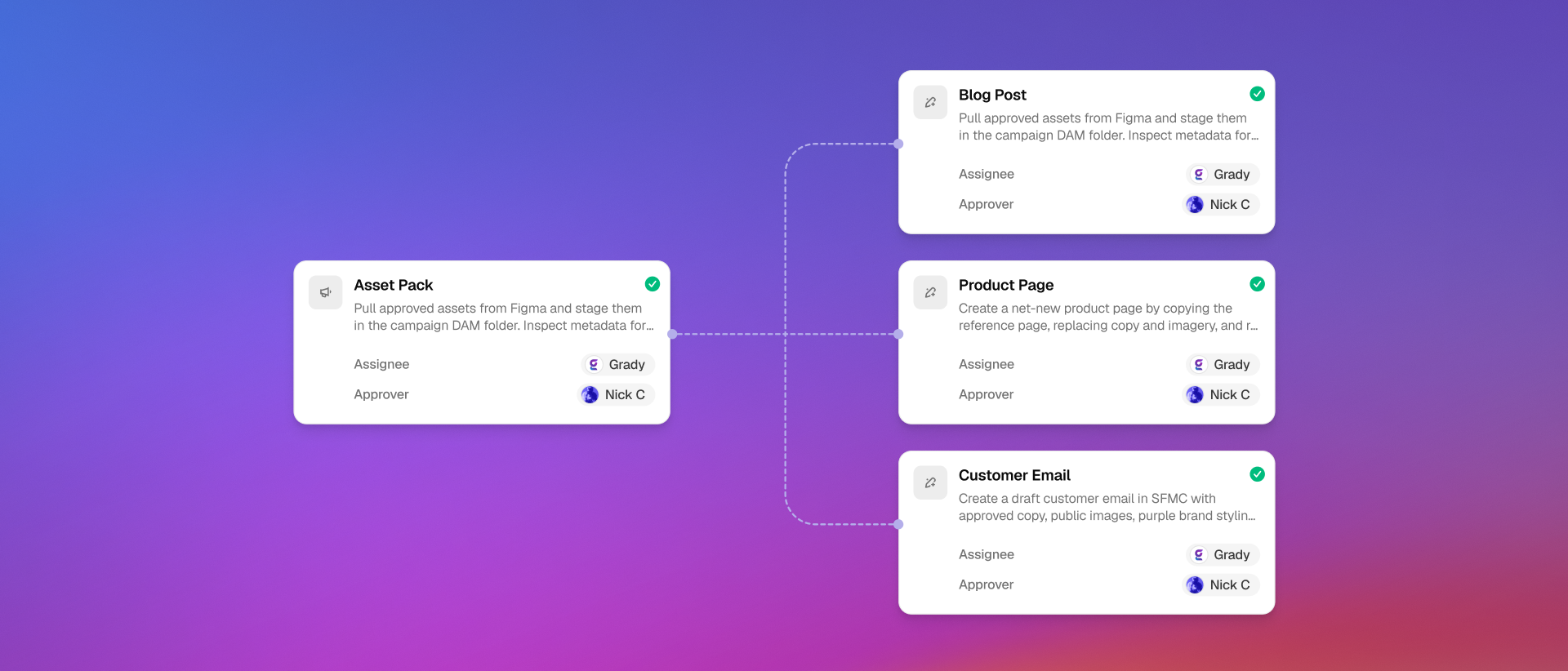
A research request became a managed content program with reusable context, related tasks, artifacts, and scheduled follow-up work.
From Page Boundaries to Human Judgment Through the Workflow
The briefs did not move straight from research into copy. Before a page advanced, I reviewed whether the topic deserved durable content, which search need it should answer, where it could avoid overlap with existing pages, and what the draft needed to carry forward.
That review changed the work before it became public. Some topics moved later in the sequence while page boundaries got sharper, drafts carried fewer assumptions, and the Guides hub had a clearer job.
Gradial helped prepare the evidence, organize the open questions, and keep approved context moving from one artifact to the next. I spent less time reconstructing why a recommendation existed and more time approving, rejecting, or sharpening the decision in front of me.
Publishing the Guides
Once the first pages were ready, I asked for a Guides destination inside the existing Resources experience so readers could find the related guides in one place without changing the top-level navigation. The hub needed to feature the pillar, make the supporting guides visible, and leave room for the AI SEO and CMS guides still to come.
That became the public Guides hub at https://gradial.com/guides, with three pages connected around it for Agentic Marketing Operations, Enterprise AI Agents for Marketing Teams, and Campaign Workflow Orchestration.
The hub made the internal structure visible to readers. Instead of treating the pages as isolated articles, it gave the category and supporting topics a shared home and showed how each one connected to the category as a whole.
Beyond Publishing
The workflow continued beyond publishing and moved swiftly into the next set of checks: reviewing launch health, early search and engagement signals, branded-search safety, and reviewing the next topic to move forward.
Before launch, I checked the URLs, CTA destinations, tracking, approvals, intent boundaries, crawl readiness, and accessibility were in place. After that, the review windows separated into different jobs.
At day 7, I needed to confirm launch health: the pages were live, accessible, functioning, and starting to show crawl or indexing signals. At day 30, I needed an early read on non-branded queries, impressions, clicks, engagement, CTA activity, and cannibalization risk. At day 90, I needed enough evidence to decide whether to strengthen internal links, expand the content, or build the next guide.
The follow-up prompts and scheduled tasks kept those checks from getting buried after launch. Each one brought the original page plan, success criteria, and intent boundaries back into view the moment the data could support a better decision.
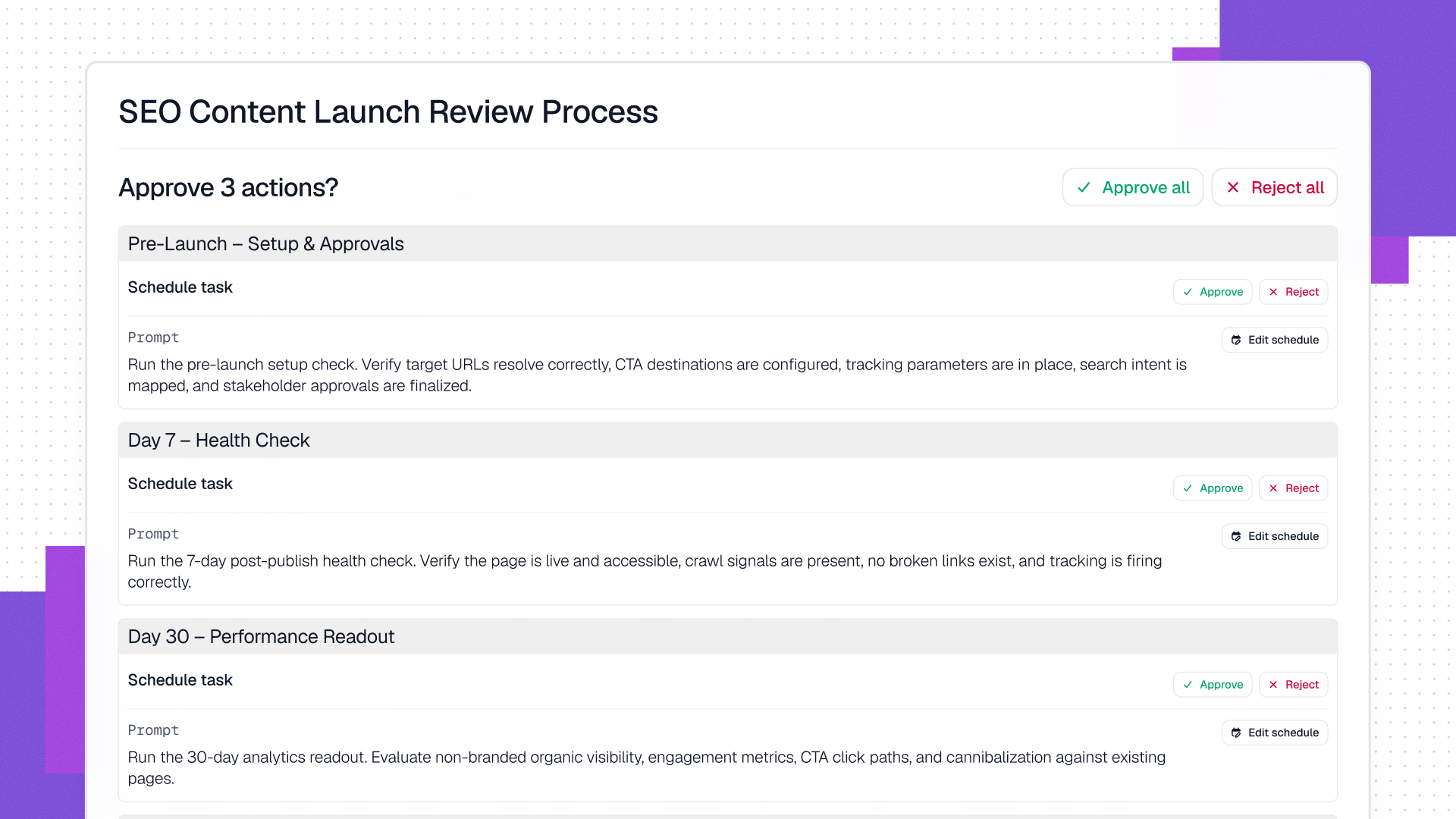
The workflow continued with pre-populated, scheduled check-ins to measure early performance.
A Few Things Needed a Second Look
The workflow exposed two places where I still needed to intervene. After I updated the branded SEO cleanup handoff, the downstream drafting work needed a deliberate pass so the new page boundaries could be carried forward. The handoff existed, but I still had to make sure the updated decisions reached the next artifact.
The measurement setup also needed review. I'd asked for checks at seven, thirty, and ninety days, but the schedule that got set up would have run every day instead, and nothing about the workflow caught that mismatch on its own so I had to manually interject.
Neither miss changed the direction of the work, but both showed where the workflow needed a clearer checkpoint. I corrected the downstream draft with the updated handoff, fixed the measurement schedule, and carried those checks forward for the next run. The artifacts made it possible for me to move quickly after that. The research package, cleanup handoff, copy drafts, page previews, and measurement prompts gave me tangible items to review. When something needed correction, I could point to the exact decision, setting, or artifact that needed attention.
What I’ll Reuse Next Time
By the end of the workflow, the decisions were no longer scattered across research notes, drafts, approvals, and memory. They lived in artifacts that carried the work forward:
- Trend-led content intelligence skill: Captured how I evaluate market attention, search demand, durability, buyer relevance, and content gaps.
- SEO intent governance skill: Captured how I check the current site, assign page intent, define exclusions, and flag overlap risks.
- Trend and search intelligence package: Turned rising topics into a page plan for the pillar, supporting guides, and future clusters.
- Branded SEO cleanup handoff: Clarified branded-query ownership, preferred homepage direction, canonical metadata, page territories, and measurement needs.
- Page briefs and draft copy: Carried the approved page roles, intent boundaries, CTAs, and review decisions into content development.
- Guides hub and live pages: Published the first public surface for the series: Guides, the pillar, and two supporting guides.
- Prescheduled performance tasks: Preserved the 7-day, 30-day, and 90-day checks so performance review would not disappear after launch.
In older workflows, I would have had to remember why each page was proposed, which evidence supported it, where it might overlap, what changed the plan, what needed to move downstream, and when to return to measure the result. Here, those decisions existed in objects I could review and reuse.
The four published pages are the visible output. The stronger outcome is the structure behind them: evidence, decisions, boundaries, approvals, and follow-up checks preserved in a workflow I can return to, reuse, and improve.
I didn't get everything right on the first pass and I'm happy to talk through what needed a second look. Send me a note at janet@gradial.com if you want to compare workflows, or if you've used AI in the marketing process that changed how the work moved forward and are willing to share. I'd genuinely like to hear about it.