
AI SEO Operations: The Enterprise Guide to Governed Search and GEO Execution
Eight control points determine whether AI SEO insights become visible, governed changes: demand sensing, intent ownership, prioritization, briefing, execution, quality assurance, approval, and measurement. Most enterprise teams already have more search data, content recommendations, and AI-generated drafts than they can operationalize. The constraint is the path from evidence to a verified change in the CMS, DAM, analytics stack, and approval workflow.
AI SEO operations is the discipline of coordinating people, agents, data, policies, and end systems to improve visibility in traditional search and AI-generated answers. It treats SEO and generative engine optimization (GEO) as an operating loop, not a collection of prompts. Agents can research, classify, prepare, update, check, route, and measure work, but they do so within shared context, permissions, budgets, and human review rules.
This guide explains how enterprise marketing teams can use AI agents for SEO without creating a new layer of disconnected tools, inconsistent pages, uncontrolled model spend, or content that no one can safely publish.
For the broader operating model, start with the Agentic Marketing Operations guide. For enterprise-wide agent architecture and governance, read AI Agents for Marketing.
What is AI SEO operations?
AI SEO operations is the governed system that turns search and answer-engine evidence into prioritized, reviewable, and measurable changes across a brand's digital estate. It combines classic SEO, content operations, technical SEO, GEO, workflow orchestration, and controlled agent execution.
The definition matters because an AI SEO tool and an AI SEO operating model are not the same thing. A tool may produce a keyword list, content score, or draft. An operating model decides which evidence is trusted, which page owns the intent, which system must change, which agent or person performs the work, which rules apply, who approves it, what the work costs, and how the result is verified.
| Capability | What it produces | What an operating model adds |
|---|---|---|
| Search analytics | Queries, pages, clicks, impressions, rankings, and crawl signals | Prioritization, ownership, and a route to action |
| GEO monitoring | Prompts, answers, citations, brand mentions, and competitive visibility | Evidence-linked page changes and repeatable measurement |
| Generative AI | Research summaries, briefs, drafts, and recommendations | Approved sources, brand context, evaluation, and review |
| AI agents | Planned actions across connected tools | Permissions, dependencies, budgets, stop conditions, and accountability |
| End-system execution | Saved changes in CMS, DAM, workflow, and analytics systems | Preview, QA, approval, release control, and visible verification |
SEO and GEO belong in one operating loop
Search behavior is fragmenting across classic results, AI Overviews, AI Mode, ChatGPT search, other answer engines, social platforms, marketplaces, and vertical discovery experiences. That does not mean enterprises need separate content factories for every surface.
Google's current guidance says that the same foundational SEO practices remain relevant for AI features. There are no special files or unique schema requirements for inclusion in AI Overviews or AI Mode. Pages still need to be crawlable, indexable, useful, internally linked, and available in textual form. OpenAI separately documents that OAI-SearchBot is used to surface sites in ChatGPT search, and that search crawling can be controlled independently from model-training crawling.
The operational conclusion is straightforward: SEO and GEO share a foundation, then diverge in measurement and optimization detail.
- Shared foundation: accurate facts, clear entities, useful answers, strong information architecture, crawlable text, internal links, fresh proof, and technically sound pages.
- SEO-specific signals: query demand, rankings, impressions, clicks, crawl and index status, rich results, and landing-page behavior.
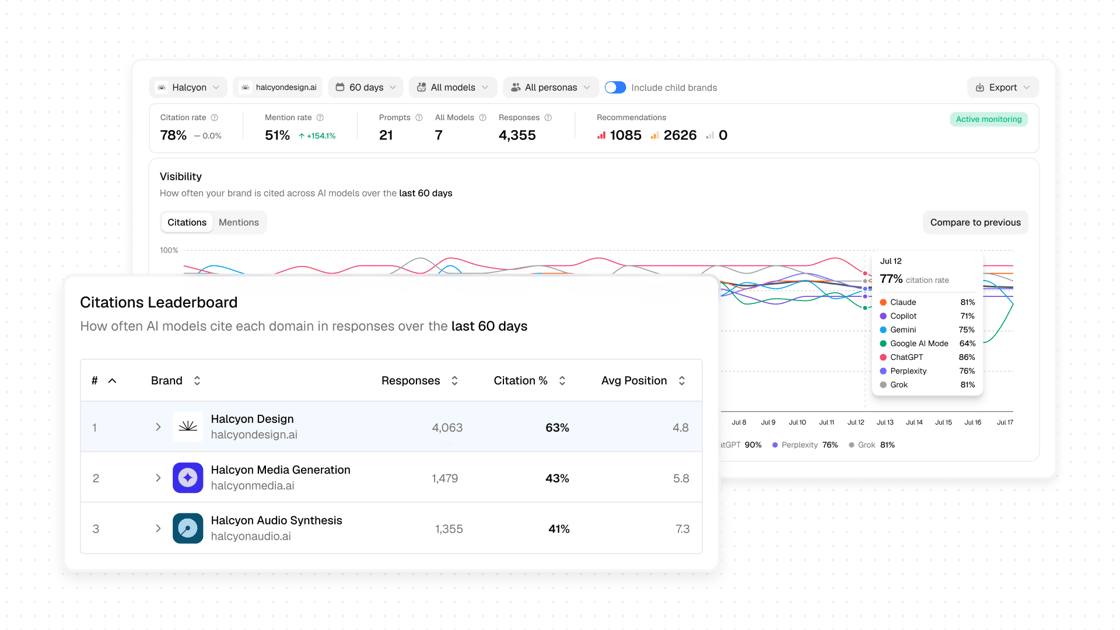
- GEO-specific signals: prompt coverage, share of answer, citation frequency, source accuracy, brand representation, and the pages or third-party sources models rely on.
- Shared execution: briefs, page updates, metadata, structured content, links, proof, technical fixes, QA, approvals, publishing, and measurement.
A unified loop prevents two teams from producing competing recommendations for the same page. It also makes every change easier to attribute because the search and answer-engine hypotheses travel with the work.
Why adding more SEO agents does not create scale
Agent count is not an operating metric. A team can add separate agents for keyword research, content briefs, technical audits, internal links, schema, AI-search monitoring, drafting, and CMS work, then discover that the total system has become harder to govern.
- Conflicting intent: Different agents target adjacent keyword variations and create pages that compete with each other.
- Fragmented context: One agent uses the current product language, another uses an old page, and a third invents a category definition from general web results.
- Recommendation backlog: Agents produce more audits and drafts than the team can review, implement, or measure.
- Manual end-system work: A person still copies recommendations into tickets, rewrites the draft, enters the CMS, finds assets, checks links, and rebuilds the evidence package.
- Unbounded spend: Long context windows, repeated crawls, retries, multi-agent loops, and premium-model routing increase cost without proving a better outcome.
- Compounding errors: An unsupported fact, wrong canonical, or mistaken intent assignment moves quickly from research into multiple pages.
- Missing accountability: Activity looks high, but no owner can answer whether the intended page was changed correctly and whether visibility improved.
The alternative is not one giant SEO agent. It is a governed system of work that gives specialized agents one plan, shared context, clear permissions, defined budgets, review gates, and responsibility for a verified result. Anthropic's published guidance on effective agents reaches a similar architectural conclusion: start with simple, composable workflows, add autonomy only when it improves outcomes, and account for the latency, cost, and error tradeoffs of more complex systems.
The eight control points of enterprise AI SEO operations
A scalable program makes the operating loop explicit. Each control point has an input, an accountable owner, a governed action, evidence for review, and a condition that allows the work to advance.
| Control point | Question it answers | Required output |
|---|---|---|
| 1. Demand sensing | What are customers searching, asking, and comparing? | Evidence set with source, date, scope, and confidence |
| 2. Intent ownership | Which existing or proposed page should answer the need? | Primary owner, exclusions, overlap check, and internal-link role |
| 3. Prioritization | Which opportunity deserves execution now? | Scored backlog with business value, effort, risk, and freshness |
| 4. Briefing | What must change, why, and under which constraints? | Source-grounded brief with acceptance criteria |
| 5. Execution | Which systems and fields need to change? | Draft changes in the CMS, DAM, workflow system, or supporting artifact |
| 6. Quality assurance | Does the change satisfy search, brand, technical, and accessibility requirements? | Passed checks, repaired issues, and unresolved exceptions |
| 7. Approval and release | Who can authorize the customer-visible outcome? | Review package, decision record, and controlled release path |
| 8. Measurement | Did the verified change improve the intended outcome? | Baseline, observation window, result, and next action |
These control points can support one page or thousands of pages. The scale comes from preserving the same decision logic while agents handle repeatable work and people keep authority over strategy, risk, and release.
1. Demand sensing: collect evidence without creating noise
Demand sensing brings together signals that describe what audiences need and how discovery systems represent the topic. Useful inputs include Google Search Console, web analytics, site search, sales and support questions, competitive page coverage, search results, AI-answer prompts, citations, community language, product launches, and content freshness events.
The agent's job is not to summarize everything. It is to normalize the evidence and preserve provenance.
- Record the source: Keep the property, report, prompt set, page, document, or conversation that produced the signal.
- Record the window: Separate durable demand from a short-lived spike or launch event.
- Separate observation from inference: “This query gained impressions” is evidence. “We need a new page” is a decision that requires an overlap check.
- Group related needs: Cluster questions by searcher job and entity relationship, not only by lexical similarity.
- Expose missing data: If conversion, citation, or index evidence is unavailable, mark the gap rather than allowing the agent to invent certainty.
At Gradial, first-party search data showed that current organic visibility was still dominated by branded demand. That kind of signal does not prove demand for a specific non-branded page, but it does clarify the opportunity: new guides need distinct non-branded jobs and careful boundaries so they do not further confuse branded intent.
2. Intent ownership: decide which page deserves to rank
Intent ownership is the strongest defense against AI-generated content sprawl. Before an agent proposes a new page or expands an existing one, it should compare the opportunity with the site's current architecture.
A complete ownership decision names:
- Primary intent: The single job the page should satisfy.
- Excluded intent: Adjacent jobs that belong to the homepage, product pages, documentation, news, customer stories, or another guide.
- Page type: Guide, solution page, product page, blog post, documentation, glossary, or campaign destination.
- Canonical owner: The URL that should receive the strongest internal links and the clearest metadata for the topic.
- Cluster role: Whether the page defines a category, supports a pillar, or converts a solution-aware reader.
- Consolidation rule: When an existing page should be expanded instead of creating another URL.
This guide owns the operating model for AI SEO operations. It does not replace the broader enterprise AI agents guide, the product-focused GEO solution page, technical product documentation, or timely research posts. That boundary makes the page more useful to readers and clearer to search systems.
3. Prioritization: turn opportunity into a governed backlog
SEO teams often prioritize by search volume and ranking position because those fields are easy to compare. Enterprise operations need a wider model. The best opportunity is the one the organization can credibly satisfy, safely execute, and measure.
| Factor | What to evaluate | Why it matters |
|---|---|---|
| Audience value | Relevance to a priority audience, journey, product, or customer need | Prevents traffic without business value |
| Evidence strength | First-party demand, prompt observations, sales questions, and source quality | Prevents strategy based on one noisy signal |
| Intent gap | Whether the site already satisfies the need | Prevents duplication and cannibalization |
| Execution readiness | Approved facts, subject-matter input, template, owner, and destination system | Prevents briefs that cannot move |
| Risk | Regulated claims, customer data, sensitive topics, and brand exposure | Determines approval depth and agent authority |
| Freshness cost | How often facts, products, sources, or search behavior change | Ensures the organization can maintain the page |
| Measurement clarity | Whether the team can define a baseline and observation window | Creates a learning loop instead of a publishing queue |
Agents can score and explain the backlog, but the scoring model belongs to the organization. A command center should show who changed the priority, which evidence supported it, and which work was deferred.
4. Briefing: make the page decision executable
A strong AI SEO brief is not a keyword list. It is the contract between evidence, strategy, production, governance, and measurement.
Each brief should include the page purpose, audience, journey stage, primary and excluded intent, target topic set, route, title tag, meta description, H1, content structure, source requirements, internal links, canonical expectation, indexability requirements, schema opportunity, CTA path, review owners, risk level, and definition of done.
Agents can prepare the brief by gathering evidence and comparing existing pages. They should also return conflicts instead of resolving strategic ambiguity silently. If two pages appear to own the same intent, the workflow should stop for a consolidation or differentiation decision. If a claim requires product, legal, or customer-proof validation, the brief should route that question to the accountable owner before drafting.
This turns the brief into a control object. The same approved requirements can guide writing, CMS assembly, QA, approval, and measurement without asking each downstream person or agent to interpret the strategy again.
5. Execution: make the change where search systems can see it
Recommendation-only AI does not remove the operational bottleneck. The work creates value when an authorized change is prepared in the system where the customer experience lives.
Depending on the opportunity, execution may include:
- CMS: Create or update the page, headings, body content, metadata, links, components, canonicals, and redirects.
- DAM: Find the approved asset, apply metadata and alt text, confirm rights and dimensions, and connect it to the page.
- Workflow system: Create owner-specific tasks, attach evidence, manage dependencies, and preserve decisions.
- Analytics: Confirm measurement requirements, events, reporting dimensions, and baseline windows.
- Search platforms: Inspect crawl and index status, submit or validate sitemap changes, and monitor the resulting page.
- Knowledge and proof sources: Update approved product facts, customer evidence, or structured records that multiple pages depend on.
Enterprise execution requires environment awareness. Agents can prepare draft changes, but live actions should follow the organization's release policy. A successful save is not the outcome. The workflow must inspect the stored state and, when a rendered experience exists, verify what a reviewer or customer can actually see.
6. Quality assurance: evaluate the whole page, not only the prose
AI can increase production volume faster than review capacity. The answer is not to remove review. It is to move deterministic checks earlier and package the remaining judgment clearly.
A review-ready AI SEO change should cover:
- Intent: The page answers its assigned searcher job and stays out of excluded territory.
- Factual grounding: Product facts, customer evidence, statistics, dates, and claims trace to approved sources.
- Search foundations: Title, description, H1, headings, canonicals, indexability, internal links, sitemap expectations, and structured data are aligned.
- GEO readiness: Definitions, entities, relationships, evidence, answer blocks, and sources are clear enough to extract and cite.
- Brand: Voice, terminology, typography, and visual patterns follow current guidance.
- Accessibility and usability: Links, alt text, heading order, readable tables, and critical text work for people as well as crawlers.
- Technical integrity: Links resolve, critical content renders, media is efficient, and the page works on mobile.
- Portfolio safety: The change does not introduce duplicate routes, competing metadata, unsupported redirects, or new cannibalization risk.
Some findings can be repaired automatically in draft. Others require a person to decide. The workflow should distinguish the two, record every repair, and prevent unresolved blockers from disappearing inside a generic quality score.
7. Approval and release: keep authority proportional to risk
Not every SEO change needs the same approval path. A title refinement on a low-risk resource page is different from a new regulated claim, a production redirect, or a change to a high-traffic template.
| Risk level | Examples | Control pattern |
|---|---|---|
| Low | Internal-link suggestion, issue list, metadata draft, content brief | Source visibility, named owner, no direct live action |
| Medium | CMS draft, alt text, page refresh, structured content update | Scoped access, preview, change log, required reviewer |
| High | Regulated claim, canonical change, redirect, mass page edit, final publication | Mandatory human approval, source validation, rollback plan, audit trail |
The review package should show the hypothesis, source evidence, before-and-after change, checks completed, unresolved exceptions, expected impact, systems touched, and total agent cost. Review becomes faster when the accountable person can make a decision without reconstructing the workflow.
8. Measurement: optimize for verified outcomes
AI SEO operations should be measured as a system. Rankings and citations matter, but they do not explain whether the organization is learning faster, shipping higher-quality work, or controlling cost.
| Measurement layer | Signals | Decision it supports |
|---|---|---|
| Discovery | Impressions, ranking distribution, click-through rate, AI-answer presence, citations, source accuracy | Did visibility or representation change? |
| Experience | Engaged sessions, task completion, conversions, assisted journeys, return visits | Did the page help the intended audience? |
| Content quality | Freshness, first-pass approval, defect escape, factual corrections, broken links | Did execution preserve quality and trust? |
| Operations | Cycle time, backlog age, manual handoffs, review time, throughput, rework | Did the operating model remove friction? |
| Economics | Token, model, tool, infrastructure, and human-review cost per approved outcome | Did the workflow create efficient capacity? |
Set the baseline before execution and define observation windows that fit the change. Technical launch health may be visible quickly. Search demand, citations, and conversion impact usually require longer windows. The workflow should preserve the original hypothesis so later measurement can decide whether to keep, refine, consolidate, or reverse the change.
Govern brand, access, and agent spend from one command center
Governance cannot live only in a policy document when agents can take actions across live marketing systems. Enterprise teams need an operating view that turns policy into limits and shows the state of every consequential workflow.
Shared context and brand governance
Agents need versioned access to approved brand guidance, product facts, customer proof, content models, taxonomy, workflow rules, regional constraints, and feedback. The command center should show which context governed a run and prevent an agent from silently substituting an unapproved source.
Identity, permissions, and environments
Each agent needs a scoped identity and the minimum access required for its job. Reading Search Console, drafting a CMS page, changing a canonical, updating DAM metadata, and publishing live content should not share one permission boundary. Environment separation, approval gates, and action logs reduce the impact of an error.
Token, model, and tool spend controls
Cost control starts before the first call. Set budgets by organization, workspace, workflow, campaign, or agent. Route simple classification and extraction to efficient models. Reserve more capable models for ambiguous research, synthesis, or high-stakes evaluation. Limit context size, tool calls, retries, recursion depth, and total steps. Define what happens when a threshold is reached: stop, route to a lower-cost path, or request approval.
Measure cost per approved page, resolved issue, or verified update, not only cost per token. The cheapest model call can be expensive if it creates rework. The most expensive model call can be justified if it replaces a costly exception loop. The command center should make both unit cost and outcome cost visible.
Evidence, observability, and recovery
Record the plan, sources, model and tool usage, system changes, checks, reviews, cost, latency, errors, retries, and final state. Define stopping conditions and rollback paths before increasing autonomy. NIST's Generative AI Profile reinforces the need to incorporate trustworthiness considerations across the design, development, use, and evaluation lifecycle. For SEO operations, that principle becomes concrete through source provenance, permission boundaries, human accountability, evaluation, and recoverable execution.
A reference architecture for AI SEO agents
A scalable architecture separates responsibilities so teams can change models, agents, or tools without losing the operating logic.
- Signal layer: Search Console, analytics, crawl and index data, keyword and SERP research, AI-answer monitoring, customer questions, and content inventory.
- Context layer: Brand, product facts, customer proof, site architecture, intent ownership, taxonomy, content models, policies, historical decisions, and feedback.
- Planning and orchestration layer: Opportunity scoring, task decomposition, dependencies, routing, parallel work, human assignments, budgets, and stop conditions.
- Specialist agents: Research, intent analysis, technical SEO, content strategy, drafting, internal linking, schema, QA, GEO analysis, and measurement.
- Execution layer: CMS, DAM, workflow, analytics, search platforms, collaboration tools, and other end systems.
- Governance layer: Identity, permissions, approved models and tools, data boundaries, brand rules, cost controls, approvals, and audit records.
- Evaluation layer: Task quality, workflow quality, rendered verification, search and AI visibility, business impact, operational efficiency, and cost per outcome.
The architecture should remain open. Enterprises need to use the right model, agent, data source, and system for each job without forcing every workflow into one closed suite. What stays consistent is the shared context, governance, evidence, and accountability surrounding the work.
How Gradial orchestrates AI SEO operations
Gradial is the marketing operations system of work for enterprises. Its role in SEO is not to produce another report that marketing operators have to translate into tickets and system changes. Gradial connects evidence to governed execution across the existing stack.
- Evidence-triggered workflows: Search, GEO, content, or customer signals can become scoped work with owners, dependencies, sources, and acceptance criteria attached.
- Intent-aware planning: Gradial can compare opportunities with the current site, assign page roles, identify overlap, and preserve exclusions before drafting begins.
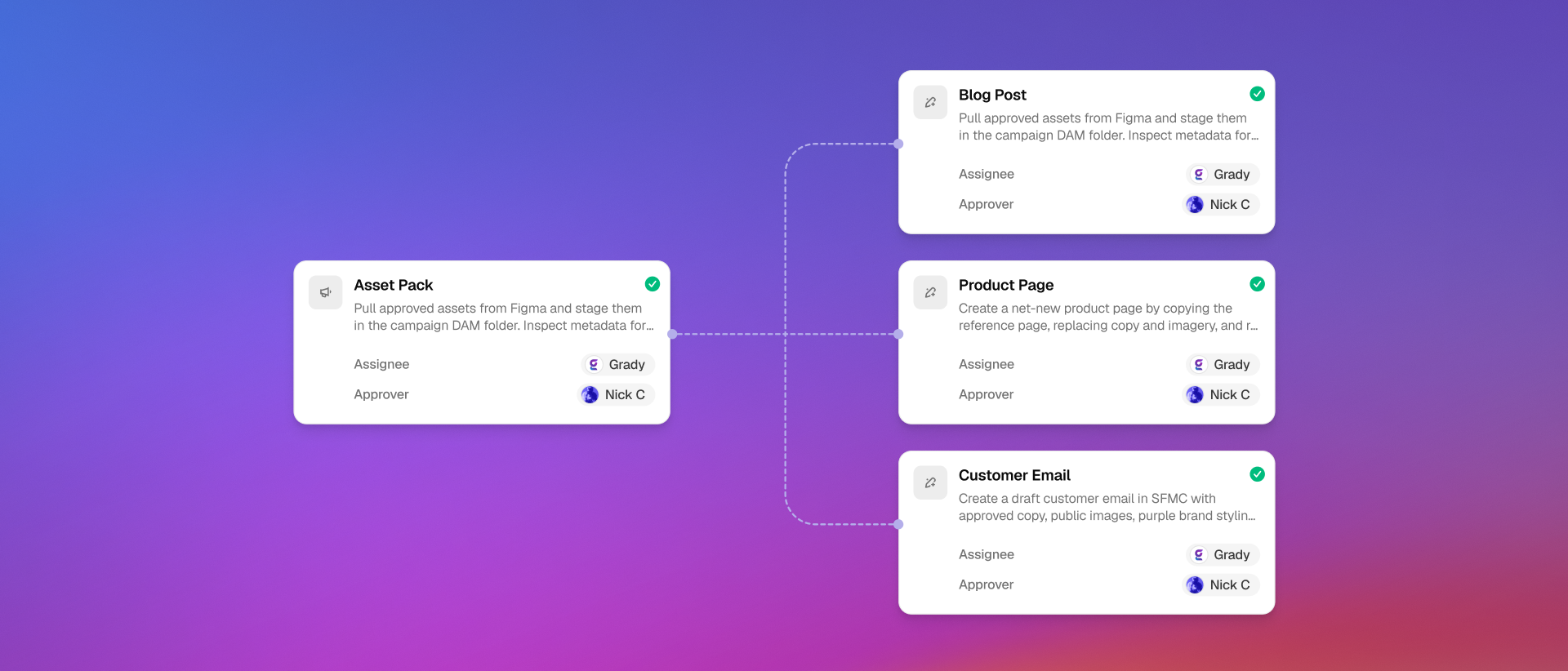
- Execution in end systems: Gradial agents can prepare and apply authorized changes in connected CMS, DAM, workflow, copy, analytics, and collaboration systems instead of stopping at a recommendation.
- Open agentic ecosystem: Specialized agents, models, tools, data sources, and enterprise systems can work through one governed operating layer.
- Agentic content infrastructure: Brand, content, workflow, governance, and business context stays reusable across research, briefing, execution, QA, and review.
- Governed brand and spend: Permissions, approval points, model and tool policy, token limits, workflow budgets, and exceptions can be controlled and observed from a command-center view.
- Verified outcomes: Gradial checks the saved and rendered result, preserves the evidence, and keeps measurement connected to the original decision.
This is the difference between using agents to create more SEO activity and using agents to build dependable search execution capacity.
A phased roadmap for enterprise adoption
Phase 1: Observe and prioritize
Connect a limited set of trusted signals. Let agents normalize evidence, identify opportunities, compare existing pages, and prepare a prioritized backlog. Keep all changes advisory. Measure whether the recommendations are accurate, differentiated, and useful enough to reduce investigation time.
Phase 2: Brief and prepare
Let agents create source-grounded briefs, internal-link plans, metadata drafts, and review-ready content changes. Require human approval before any system mutation. Measure first-pass approval, correction patterns, briefing time, and cost per approved brief.
Phase 3: Execute in draft
Grant scoped access to prepare CMS drafts, update approved metadata, connect assets, run checks, and generate previews. Preserve environment separation and require review for release. Measure cycle time, handoffs, defect escape, and review time.
Phase 4: Orchestrate the loop
Connect demand sensing, prioritization, end-system execution, QA, approval, and measurement. Allow low-risk work to advance automatically within policy. Keep high-risk and customer-visible decisions with accountable people. Measure throughput, freshness, search and AI visibility, business impact, and total cost per verified outcome.
Expand autonomy only when the previous phase produces reliable evidence. The maturity model is not “more agents.” It is more work completed safely with less manual coordination and clearer economics.
How to evaluate an AI SEO agent platform
Evaluate the complete workflow, not the quality of one generated answer. Ask vendors and internal teams to demonstrate:
- First-party evidence: Can the system use search, analytics, site, customer, and AI-answer data without losing provenance?
- Intent governance: Can it compare the current site, assign ownership, prevent cannibalization, and recommend consolidation?
- End-system action: Which CMS, DAM, analytics, workflow, and collaboration systems can it read and change directly?
- Open integrations: Can it use the models, agents, tools, and systems that fit each job?
- Reusable context: How are brand rules, product facts, proof, page models, taxonomy, and feedback maintained?
- Orchestration: Can it manage dependencies, parallel work, blockers, retries, and human assignments?
- Governance: Can administrators control identity, permissions, environments, models, tools, token budgets, approvals, and exceptions?
- Evidence: Can reviewers see sources, changes, checks, spend, failures, and unresolved issues?
- Verification: Does it inspect the final saved and rendered experience?
- Measurement: Can it connect the shipped change to search, AI visibility, operational, and cost outcomes?
Use a real page as the test. Provide approved sources, a destination system, intent boundaries, governance requirements, a review gate, and a measurable definition of done. Then evaluate the result, not the demo narrative.
Frequently asked questions about AI agents for SEO
What is an AI SEO agent?
An AI SEO agent is a goal-directed system that can use approved search data, site context, tools, and policies to complete a bounded part of SEO work. It may research demand, classify intent, prepare a brief, update a CMS draft, run checks, route approval, or measure results. Enterprise agents operate within defined permissions, budgets, sources, and human review rules.
How is an AI SEO agent different from SEO automation?
Traditional automation follows predefined rules. An agent can interpret a goal, choose among approved actions, use tools, and adapt within a bounded workflow. The strongest operating models use both: deterministic automation for stable checks and routing, and agents for research, synthesis, planning, and exception handling.
What is the difference between SEO and GEO?
SEO improves discoverability and performance in search engines. GEO improves how a brand, entity, or topic appears in AI-generated answers, including whether owned content is cited and represented accurately. They share foundations such as crawlable content, clear entities, evidence, internal links, and technical quality, but they use different measurement signals.
Does AI search require special markup?
Google says there are no additional technical requirements, special AI files, or special schema needed for AI Overviews or AI Mode. Standard SEO fundamentals still apply. Structured data should match visible page content. Other answer engines have their own crawler controls, so enterprises should manage access deliberately and keep policies current.
How can a site appear in ChatGPT search?
OpenAI documents OAI-SearchBot as the crawler used to surface websites in ChatGPT search. A site that opts out will not appear as a cited search result, although navigational links may still appear. OpenAI manages search crawling and model-training crawling through separate controls, which lets site owners make distinct choices.
Should AI agents publish SEO content autonomously?
Only within an explicit risk and approval policy. Most enterprises should keep human approval for new public pages, regulated claims, high-traffic templates, redirects, canonical changes, major content edits, and exceptions. Lower-risk draft preparation and deterministic repairs can gain more autonomy after quality and recovery behavior are proven.
How should enterprises control SEO-agent token spend?
Set budgets by workflow, workspace, campaign, or agent. Route simple tasks to efficient models. Limit context size, steps, tool calls, retries, and recursion. Require approval above cost thresholds. Track total model, tool, infrastructure, and review cost per approved and verified outcome.
How do you prevent AI-generated content from causing keyword cannibalization?
Assign intent ownership before drafting. Compare every proposal with existing pages, define excluded intent, choose a canonical owner, and consolidate overlapping opportunities. Agents should not create a new route until the operating model can explain why that page deserves to exist separately.
What should SEO teams measure beyond rankings?
Measure search and AI visibility, citation accuracy, engagement, conversion, content freshness, cycle time, handoffs, review time, rework, defects, throughput, and agent cost per verified outcome. Use a baseline for the same unit of work.
Will AI SEO agents guarantee top rankings or AI citations?
No. Search engines and answer engines decide what to crawl, index, rank, cite, and display. A governed operating model improves relevance, quality, execution speed, measurement, and discoverability, but it cannot guarantee placement.
Sources and scope
This guide synthesizes current public guidance and durable operating principles. Key sources include:
- Google Search Central, “AI features and your website”, updated December 10, 2025. Google states that standard SEO best practices remain relevant for AI Overviews and AI Mode, with no special AI markup required.
- OpenAI crawler documentation, accessed August 5, 2026. OpenAI documents separate controls for OAI-SearchBot, GPTBot, and user-initiated ChatGPT access.
- Anthropic, “Building effective agents”, published December 19, 2024. The article recommends simple, composable patterns, explicit evaluation, and careful tradeoffs among autonomy, latency, cost, and error.
- NIST AI 600-1, Generative AI Profile, published July 26, 2024 and updated April 8, 2026. The profile supports lifecycle-based management of trustworthiness and generative AI risk.
- Current Gradial platform, workflow, security, GEO, customer, and guide pages for product facts, operating patterns, and approved positioning.
Search and AI systems change frequently. The durable principles in this guide are clearer intent, useful content, crawlable and indexable foundations, approved evidence, end-system execution, governed autonomy, cost visibility, human accountability, and measurement of verified outcomes.
What a first governed AI SEO workflow should produce
- One clearly owned opportunity with primary intent, excluded intent, evidence, and a named accountable owner.
- One source-grounded brief that can move directly into controlled execution.
- One review-ready change in the destination system with search, GEO, brand, technical, and accessibility checks attached.
- One approval record that shows sources, changes, exceptions, agent activity, and total cost.
- One verified rendered outcome with a baseline, measurement window, and decision about the next iteration.
- See governed workflows: Explore how Gradial coordinates people, agents, systems, dependencies, and approvals.
- Explore GEO execution: See how Gradial connects AI-search visibility to prioritized content changes and measurement.
- Assess your SEO operating loop: Map one workflow from search evidence to a verified change in your stack.