
CMS Authoring for Enterprise Marketing: The Guide to Governed AI Agent Execution
AWS reduced page creation from roughly 10 hours per page to about 30 minutes with Gradial, a 20x improvement in a real enterprise content operation. The result matters because CMS authoring is one of the largest gaps between approved marketing direction and a live digital experience. Generative AI can produce copy quickly. Enterprise teams still have to map that copy to content models, assemble components, find approved assets, set metadata, validate the page, route review, manage environments, and confirm what actually rendered.
CMS authoring for marketing is the governed work of creating, updating, assembling, validating, and releasing digital experiences inside a content management system. AI agents can take on much of that operational work, but only when they share approved context, act through scoped permissions, follow the content model, respect human approval, operate within cost limits, and verify the result in the end system.
This guide explains how enterprise marketing teams can design AI-assisted CMS authoring that scales across brands, regions, languages, templates, and platforms without creating a new layer of agent sprawl, unreviewed content, or uncontrolled model spend.
For the broader operating model, start with the Agentic Marketing Operations guide. For enterprise-wide agent architecture, read AI Agents for Marketing.
What is CMS authoring for marketing?
CMS authoring for marketing is the complete process of turning approved content and design direction into a structured, reviewable, and publish-ready experience in a content management system. It includes more than writing. It covers page creation, component selection, field mapping, asset placement, metadata, taxonomy, links, localization, quality checks, approval, release controls, and visible verification.
For enterprise teams, the unit of work is rarely a single text field. It may be a product launch across hundreds of pages, a regulated content update across regions, a design-system migration, a new campaign experience, or a recurring backlog of small changes that cross CMS, DAM, ticketing, analytics, and approval systems.
| Layer | Typical work | Definition of done |
|---|---|---|
| Content | Copy, facts, offers, legal text, localization, and source attribution | Approved content is mapped to the right fields |
| Structure | Templates, components, content models, references, and page hierarchy | The experience follows the supported design and data model |
| Assets | Search, rights, rendition, crop, metadata, alt text, and placement | Approved media is usable, accessible, and correctly linked |
| Quality | Brand, accessibility, links, SEO, GEO, compliance, and rendering | Required checks pass and exceptions are visible |
| Operations | Ownership, environments, approvals, release, audit history, and measurement | The intended result is verified and traceable |
Content generation is not CMS authoring
A generated draft is an input. A CMS-authored experience is a controlled system change. Treating the two as equivalent pushes all of the difficult work back onto marketers and web teams.
- Generation creates text: Authoring maps approved text to fields, modules, variants, references, and layouts.
- Generation creates an asset idea: Authoring finds or prepares the approved asset, verifies rights and dimensions, adds metadata and alt text, and places the correct rendition.
- Generation suggests a page: Authoring chooses the supported template, creates the route, sets metadata, links the page, and preserves the information architecture.
- Generation proposes a change: Authoring saves the change in the destination system, creates a preview, runs checks, routes approval, and confirms the rendered outcome.
- Generation optimizes one output: Enterprise authoring coordinates related pages, locales, brands, environments, dependencies, and release policies.
The strategic distinction is execution. An AI assistant can help a person compose. An agentic system of work can carry approved direction through the operational path to a verified CMS result.
The CMS market is moving from AI features to agentic operations
CMS and digital experience vendors increasingly describe AI across the full content lifecycle. Current vendor positioning emphasizes brand-aware generation, translation, bulk updates, workflow automation, approvals, permissions, audit trails, model choice, and connections to external assistants or agents. The direction is important: the market is moving beyond a text-generation button toward systems that can reason over content and take action.
That shift also exposes a new constraint. Every CMS, DAM, analytics platform, workflow system, and AI provider can add an agent. If each agent owns only its local task, the enterprise inherits another coordination problem.
- Local optimization: A CMS agent may improve one entry without understanding the campaign, product source, DAM rights, measurement plan, or related pages.
- Context duplication: Brand rules, product facts, legal guidance, and feedback are copied into separate tools and drift over time.
- Permission sprawl: Multiple agents receive overlapping access without one view of who can change which system or environment.
- Unclear economics: Tokens, models, tool calls, retries, and human review costs accumulate across vendors and workflows.
- Broken accountability: Each tool reports activity, but no operating layer owns the final customer-visible result.
The next enterprise advantage is not the largest collection of agents. It is a governed, open operating layer that coordinates the right agents and systems around one outcome.
Why adding more CMS agents does not create scale
Agent count is not a measure of capacity. Capacity is the amount of useful, approved, and verified work the organization can complete within its quality, risk, and cost limits.
- Conflicting actions: One agent changes copy while another rewrites metadata or structure against a different brief.
- Lost provenance: An unsupported claim moves from a generated draft into multiple pages without a traceable source.
- Review saturation: Agents create more drafts and recommendations than the organization can evaluate.
- End-system gaps: People still copy output into the CMS, rebuild component structure, attach assets, and update tickets.
- Recursive cost: Long context, repeated retrieval, retries, and multi-agent loops consume budget without proving a better page.
- Environment risk: Draft, staging, approval, and live actions are treated as one permission boundary.
- False completion: A successful tool action is reported as done even though the page is broken, hidden, or visibly wrong.
Anthropic's guidance on effective agents recommends starting with simple, composable workflows and adding autonomy only when it improves results. The enterprise CMS version of that principle is practical: use deterministic rules where the work is stable, use agents where judgment or adaptation is needed, and put both inside one governed workflow with explicit stop conditions.
The 10 control points of enterprise CMS authoring
A scalable authoring workflow makes ten control points explicit. Each point has an input, an accountable owner, a bounded action, evidence for review, and a condition that allows the work to advance.
| Control point | Question | Required output |
|---|---|---|
| 1. Intake | What must change, for whom, and why? | Scoped request, source materials, owner, risk, and definition of done |
| 2. Source grounding | Which facts, copy, assets, and rules are approved? | Versioned evidence with provenance and freshness |
| 3. Content modeling | How does the request map to the CMS? | Template, components, fields, references, and taxonomy plan |
| 4. Experience assembly | What should be created or changed? | Structured draft in the correct CMS and environment |
| 5. Asset operations | Which approved media belongs in each container? | Valid references, renditions, metadata, rights, and alt text |
| 6. Portfolio safety | How does the change affect routes, links, search intent, and related content? | Canonical, redirect, internal-link, navigation, and overlap decisions |
| 7. Quality assurance | Does the complete experience meet requirements? | Checks, safe repairs, visible exceptions, and rendered proof |
| 8. Approval | Who can authorize the customer-visible outcome? | Review package and recorded decision |
| 9. Release | How does the approved change reach production safely? | Selected release scope, environment record, and recovery path |
| 10. Measurement | Did the change improve the intended outcome? | Baseline, observation window, result, cost, and next action |
1 and 2. Intake and source grounding: start with an executable contract
CMS work often begins in an email, ticket, brief, design file, spreadsheet, or conversation. The first agent task is not to write. It is to turn that input into a bounded contract.
The contract should name the business objective, audience, pages or content types in scope, approved source copy, product facts, legal language, design source, asset source, locales, destination environment, owner, approver, risk level, due date, and visible definition of done. It should also identify what the agent must not change.
Grounding means every consequential input has provenance. A product description should point to the current approved source. A customer metric should point to a public or authorized proof source. A design decision should point to the approved component or design system. A brand rule should carry its scope and current version. If sources conflict, the workflow stops for a decision instead of allowing the agent to choose silently.
3. Content modeling: translate marketing intent into CMS structure
Content models are where many AI authoring attempts fail. Human-readable copy does not automatically reveal which entry type, component, field, reference, validation rule, taxonomy term, locale, or inheritance pattern the CMS expects.
- Resolve the page family: Decide whether the work is a guide, solution page, product page, article, landing page, fragment, or structured record.
- Map fields deliberately: Match headings, body copy, CTAs, proof, metadata, and assets to the supported schema instead of flattening everything into rich text.
- Reuse approved patterns: Select existing templates, components, content blocks, and layout rules before proposing a new structure.
- Preserve identifiers: Keep stable IDs and references for existing content unless the change requires a new object.
- Plan variants: Define language, region, audience, brand, and channel variation without duplicating the base content unnecessarily.
- Return model conflicts: If the requested experience cannot be represented safely, escalate a design or engineering decision rather than inventing a field or component.
4 and 5. Experience assembly and asset operations: execute inside the end systems
The authoring agent should create the structured draft in the destination CMS, not merely describe the changes in a document. It should use the correct environment, supported content model, approved components, stable references, and current version of the page.
Asset work belongs in the same execution path. The agent may need to search the DAM, select the approved asset, check dimensions and rights, choose or create the correct rendition, write useful alt text, update metadata, and link the asset to the CMS entry. These actions require different permissions from page editing and should remain separately traceable.
| CMS pattern | Authoring consideration | Control to preserve |
|---|---|---|
| Component-based enterprise CMS | Template, component policy, inheritance, references, workflows, and environments | Use approved components and keep release authority separate from draft authoring |
| Headless CMS | Content types, fields, validations, references, locales, and API-delivered experiences | Validate schema and downstream rendering, not only the entry |
| Composable DXP | Content, personalization, experimentation, search, analytics, and connected services | Preserve cross-system dependencies and evidence |
| Traditional page CMS | Page hierarchy, modules, plugins, theme constraints, and editorial roles | Avoid unsupported structure and verify front-end behavior |
| Multi-CMS estate | Different models, workflows, teams, and release policies by brand or region | Use one operating contract with system-specific execution skills |
Gradial connects to enterprise systems including AEM Sites and Assets, Contentful, Drupal, Sitecore, DAM platforms, design tools, ticketing systems, and other agents or model-context connections. The operating layer stays consistent while execution adapts to the destination system.
6. Portfolio safety: protect information architecture, SEO, and GEO
A page can be technically valid and still damage the site. Enterprise authoring must evaluate the change as part of a portfolio.
- Routes and redirects: Use stable, descriptive URLs and preserve equity when a route changes.
- Canonical ownership: Decide which page owns the topic and prevent duplicate or competing destinations.
- Internal links: Add durable discovery paths from hubs, navigation, related content, and contextual references.
- Search intent: Confirm that the page answers one clear job and does not cannibalize another guide, product page, or article.
- AI-answer readability: Use direct definitions, clear entities, descriptive headings, factual tables, source attribution, and complete answers that can be understood out of context.
- Crawl and index readiness: Preserve indexability, canonical signals, sitemap expectations, textual access, and supported structured data.
GEO-friendly authoring is not a separate publishing trick. It is clear, useful, well-sourced content built on sound search foundations and maintained through a repeatable operating loop.
7. Quality assurance: verify the complete rendered experience
AI can increase production volume faster than human review capacity. The solution is to run stable checks inside the workflow, repair safe issues early, and reserve judgment for the people accountable for brand, customer experience, compliance, and release.
- Factual grounding: Claims, dates, product facts, customer proof, and sources are current and traceable.
- Brand and design: Voice, terminology, components, spacing, imagery, and approved patterns are consistent.
- Accessibility: Headings, links, labels, alt text, tables, contrast, focus, and critical content support real users.
- Technical integrity: References resolve, links work, critical text renders, media is efficient, and the experience works across screen sizes.
- Search readiness: Title, description, H1, headings, canonical, internal links, indexability, and structured content align with the page role.
- Governance: Permissions, required reviews, policy checks, and exceptions match the risk level.
- Visible verification: The reviewer sees the rendered draft. A successful save or valid field value is not treated as proof of the customer experience.
Checks should produce evidence, not only a score. Reviewers need to know what passed, what was repaired, what remains unresolved, and which source or rule supports each consequential finding.
8 and 9. Approval and release: separate authoring authority from publication authority
Enterprise autonomy should increase by risk level, not by enthusiasm for the technology. Draft preparation, evidence gathering, field mapping, and deterministic checks can often run with broad autonomy. New public pages, regulated claims, high-traffic templates, redirects, canonical changes, bulk edits, and final publication usually require accountable human approval.
| Risk | Examples | Control pattern |
|---|---|---|
| Low | Issue list, content brief, internal-link suggestion, metadata draft | Named owner, source visibility, no direct live action |
| Medium | CMS draft, asset metadata, localized variant, standard page update | Scoped access, preview, automated checks, required reviewer |
| High | Regulated claim, redirect, canonical change, mass update, live publication | Mandatory approval, evidence package, release scope, rollback path, audit trail |
The review package should show the request, approved sources, pages and systems touched, before-and-after changes, rendered preview, checks, exceptions, total agent cost, and recovery plan. Publication remains a distinct action. Approval of a draft does not silently grant authority to release it.
10. Measurement: optimize for cost per verified outcome
Throughput alone can reward low-quality output. Enterprise teams need to measure customer impact, content quality, operational performance, and economics together.
| Measurement layer | Signals | Decision |
|---|---|---|
| Experience | Engagement, task completion, conversion, errors, customer feedback | Did the page help the intended audience? |
| Discovery | Index status, impressions, rankings, clicks, AI-answer presence, citations | Did discoverability or representation improve? |
| Quality | First-pass approval, corrections, accessibility defects, broken links, policy exceptions | Did the workflow preserve trust? |
| Operations | Cycle time, backlog age, handoffs, review time, rework, throughput, release frequency | Did authoring become easier to operate? |
| Economics | Model, token, tool, infrastructure, and human-review cost per approved page or update | Did the workflow create efficient capacity? |
Set the baseline before execution. Define the observation window and the unit of work. A workflow that uses more tokens but eliminates hours of rework may be economical. A cheap generation step that creates review debt may not be.
Govern brand, access, and agent spend from one command center
Governance has to operate at the same speed as the agents. A static policy document cannot control a workflow that can read business context, call models, change a CMS, update a DAM, create tickets, and prepare a release.
Brand and business context
Agents need versioned access to brand standards, product facts, approved proof, audience guidance, design systems, content models, taxonomy, accessibility requirements, legal rules, regional constraints, and feedback. The command center should show which context governed each run and prevent unapproved sources from entering the workflow unnoticed.
Identity, permissions, and environments
Give every agent the minimum access required for its job. Reading a page, creating a draft, updating an asset, approving a change, and publishing live content should not share one permission boundary. Controls should apply by organization, workspace, workflow, system, content area, action, and environment.
Token, model, and tool spend controls
Set budgets by organization, workspace, campaign, workflow, agent, or outcome. Route deterministic and low-complexity tasks to efficient models or rules. Reserve more capable models for ambiguity, synthesis, or high-stakes evaluation. Limit context size, tool calls, retries, recursion depth, parallel branches, and total steps. When a threshold is reached, stop, choose an approved lower-cost path, or request human approval.
Track spend in the unit the business can evaluate: cost per approved page, localized variant, resolved defect, or verified update. Token cost remains useful for diagnosis, but it is not the operating outcome.
Observability and recovery
Record sources, plans, models, tools, actions, changes, checks, approvals, cost, latency, failures, retries, and final state. Define stop conditions and recovery before granting more autonomy. NIST's Generative AI Profile supports lifecycle-based management of trustworthiness and risk. In CMS authoring, that principle becomes concrete through provenance, scoped access, evaluation, human accountability, and recoverable execution.
A reference architecture for AI agents in CMS authoring
A scalable architecture separates responsibilities so the enterprise can change a CMS, model, agent, or tool without rebuilding the operating logic.
- Intake layer: Briefs, tickets, plans, designs, spreadsheets, conversations, and recurring events that initiate work.
- Context layer: Brand, product, customer proof, design systems, content models, taxonomy, policies, locales, history, and feedback.
- Planning and orchestration layer: Scope, decomposition, dependencies, routing, owners, approvals, budgets, stop conditions, and evidence.
- Specialist agents: Research, content strategy, copy, content modeling, asset operations, localization, SEO, GEO, accessibility, QA, and measurement.
- Execution layer: CMS, DAM, design, workflow, ticketing, analytics, collaboration, and search systems.
- Governance layer: Identity, permissions, environments, approved models and tools, data boundaries, brand rules, spend controls, and audit history.
- Evaluation layer: Source accuracy, task quality, workflow quality, rendered verification, business impact, operational efficiency, and cost per outcome.
The architecture should remain open and additive. Enterprises need to use the right model, agent, and system for each job while preserving one shared layer for context, governance, evidence, and accountability.
How Gradial orchestrates CMS authoring
Gradial is the marketing operations system of work for enterprises. It does not stop at generating content or recommending CMS changes. Gradial agents execute the operational work across the systems where marketing already happens.
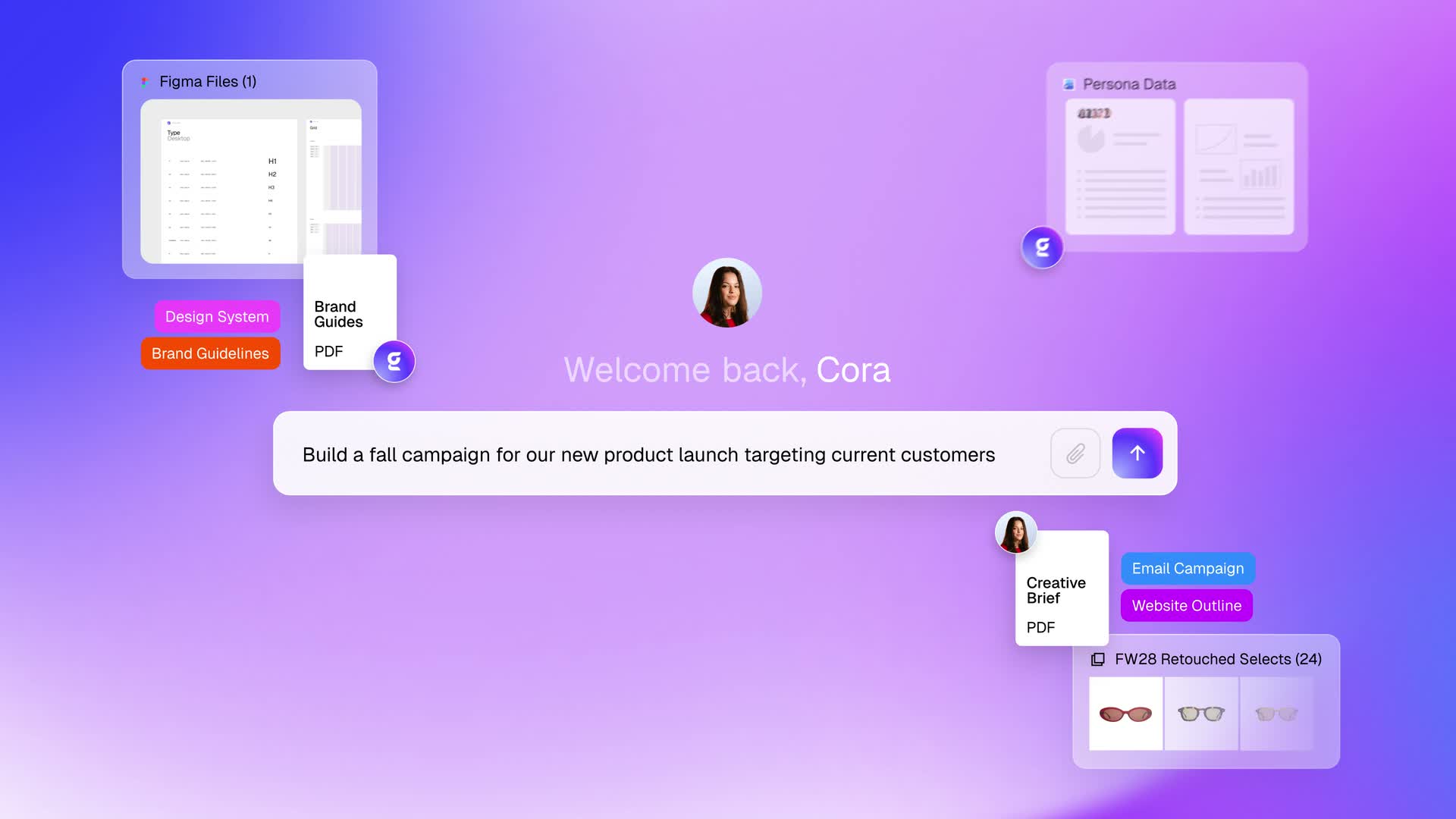
- Executable intake: Gradial can turn briefs, copy documents, design files, tickets, and launch plans into scoped work with owners, dependencies, evidence, and acceptance criteria.
- Reusable enterprise context: Gradial Skills encode content models, brand standards, workflow rules, review logic, and learned practices so each task does not start from a blank prompt.
- Native end-system execution: Gradial can prepare and apply authorized work in connected CMS, DAM, design, ticketing, analytics, collaboration, and campaign systems.
- Open agentic ecosystem: Enterprise teams can coordinate specialized agents, models, tools, and model-context connections through one operating layer instead of locking every job into one suite.
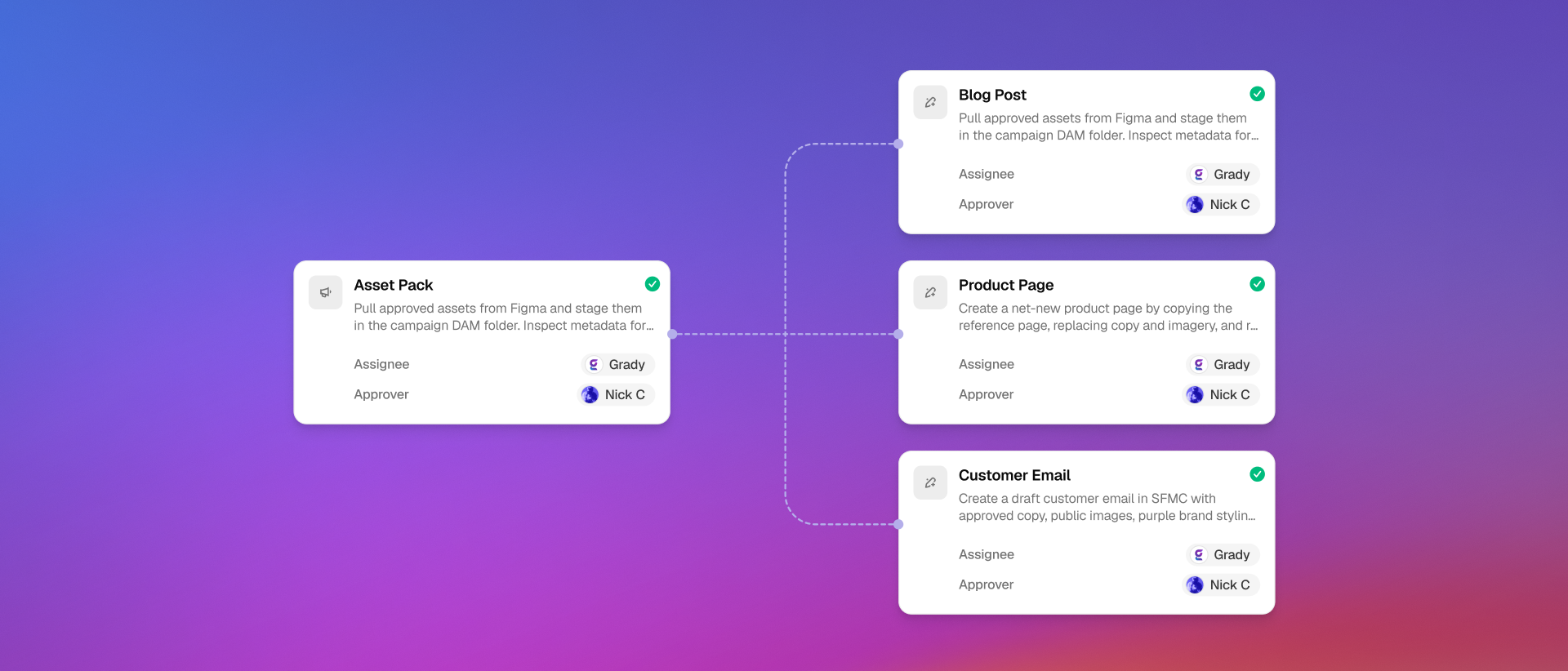
- Governed workflows: Gradial Workflows connect tasks, dependencies, parallel work, people, agents, systems, and approval gates.
- Brand, access, and spend control: Governance stays attached to execution through rules, scoped permissions, approval points, model and tool policy, budgets, observability, and audit history.
- Visible verification: Gradial checks stored changes and the rendered experience before treating the work as complete.
This is how enterprise teams move from isolated AI features to repeatable authoring capacity across AEM, Contentful, Drupal, Sitecore, and other systems in the stack.
High-value enterprise CMS authoring use cases
- Net-new page assembly: Map approved copy and design to supported components, author the page, connect assets, set metadata, and prepare a preview.
- Campaign launches: Coordinate landing pages, offers, emails, assets, tracking, reviews, and launch dependencies across systems.
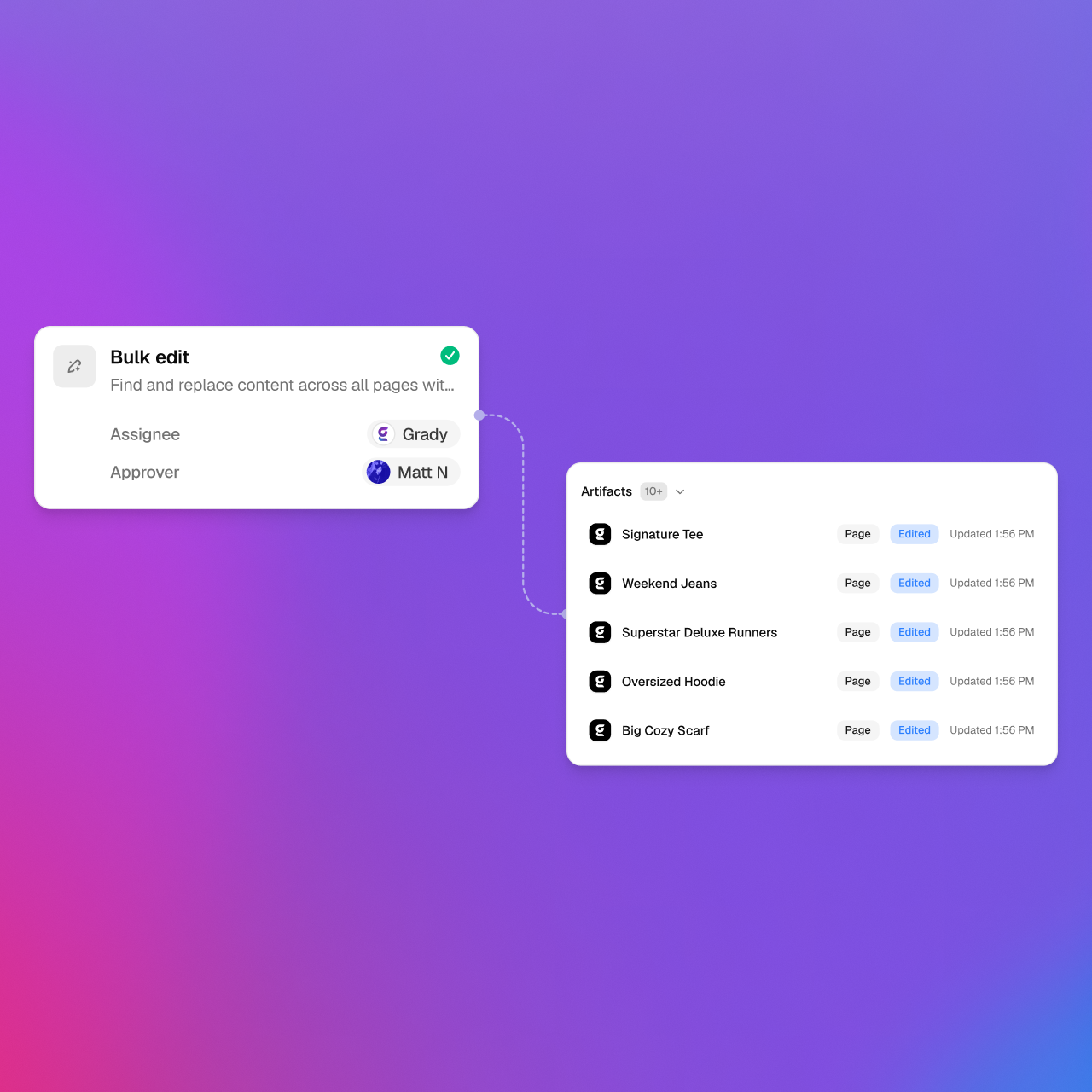
- Bulk content updates: Apply product, legal, naming, pricing, or policy changes across a controlled set of pages with preview, evidence, and rollback.
- Localization: Create regional and language variants from an approved source while preserving brand, legal, accessibility, and local review.
- Content migration: Inventory source pages, map content to the destination model, move assets, preserve routes and metadata, and validate the rendered result.
- Design-system adoption: Rebuild off-pattern pages with approved components while preserving content, SEO signals, and experience requirements.
- Accessibility and quality remediation: Find repeated issues, repair safe cases, route exceptions, and preserve validation evidence.
- SEO and GEO refreshes: Turn search and answer-engine evidence into governed page updates, internal links, proof improvements, and measurement.
- Backlog elimination: Execute high-volume small and medium updates directly in the CMS without turning every change into a multi-team project.
A phased roadmap for enterprise adoption
Phase 1: Observe and map
Choose one repeatable authoring workflow and document its inputs, systems, content model, handoffs, controls, exception paths, time, and cost. Let agents classify requests, gather sources, and prepare plans without changing the CMS.
Phase 2: Prepare structured drafts
Grant scoped access to create CMS drafts, map fields, connect approved assets, and run stable checks. Require human approval for every mutation and release. Measure first-pass approval, corrections, cycle time, and cost per accepted draft.
Phase 3: Orchestrate related systems
Connect the CMS workflow to DAM, design, ticketing, collaboration, analytics, and search systems. Carry sources, decisions, dependencies, and validation evidence across the workflow instead of recreating them at each handoff.
Phase 4: Expand bounded autonomy
Allow low-risk work to advance automatically within policy. Keep high-risk claims, structural changes, redirects, bulk edits, and publication behind explicit approval. Add budgets, stop conditions, recovery, and exception routing.
Phase 5: Operate the portfolio
Coordinate authoring across brands, regions, languages, platforms, and recurring programs. Optimize for verified outcomes, content health, backlog reduction, and cost per completed unit of work. Expand autonomy only when evidence from the previous phase supports it.
How to evaluate an AI CMS authoring platform
Evaluate the complete workflow against a real page, not the quality of one generated answer. Ask vendors and internal teams to demonstrate:
- Content-model fidelity: Can the system map work to the correct templates, components, fields, references, locales, and validations?
- Source provenance: Can reviewers trace product facts, copy, designs, assets, and rules to approved sources?
- End-system execution: Which CMS, DAM, design, ticketing, analytics, and collaboration systems can it read and change directly?
- Open integrations: Can the enterprise use the models, agents, tools, and systems that fit each job?
- Reusable context: How are brand rules, content models, product facts, proof, taxonomy, and feedback maintained?
- Orchestration: Can it manage dependencies, parallel work, blockers, retries, human assignments, and cross-system state?
- Governance: Can administrators control identity, action, content scope, environment, model, tool, data, budget, approval, and exception?
- Spend controls: Can teams set limits on tokens, models, tools, retries, steps, recursion, and total workflow cost?
- Evidence: Can reviewers see sources, changes, checks, approvals, failures, retries, spend, and unresolved issues?
- Verification: Does the system inspect the stored and rendered result in the destination environment?
- Recovery: Can it stop safely, preserve partial work, explain failure, and support rollback or targeted repair?
- Measurement: Can it connect the verified change to customer, discovery, quality, operational, and economic outcomes?
Provide an approved source, a design or content model, a destination CMS, a related asset, governance requirements, a review gate, a budget, and a visible definition of done. Score the completed result and evidence package, not the demo narrative.
Frequently asked questions about AI agents for CMS authoring
What is AI CMS authoring?
AI CMS authoring uses agents, models, rules, approved context, and connected tools to create or update structured content inside a content management system. Enterprise AI authoring includes content modeling, component assembly, asset operations, metadata, validation, approval, release controls, and rendered verification.
How is CMS authoring different from content generation?
Content generation produces copy or media. CMS authoring turns approved inputs into a structured experience in the destination system. It maps content to fields and components, connects assets, applies metadata, runs checks, routes approval, and verifies the visible result.
Can AI agents author in AEM, Contentful, Sitecore, Drupal, and headless CMS platforms?
Yes, when the agent has an approved integration, understands the system's content model, operates with scoped permissions, and follows the organization's environment and release policy. The operating logic can stay consistent while system-specific execution adapts to each CMS.
Should AI agents publish CMS content autonomously?
Only within an explicit risk policy. Most enterprises should keep human approval for new public pages, regulated claims, high-traffic templates, redirects, canonical changes, bulk edits, and final publication. Lower-risk draft preparation and deterministic repairs can gain more autonomy after quality and recovery are proven.
How do enterprises keep AI-authored CMS content on brand?
Use versioned brand standards, approved terminology, design-system rules, source content, reusable workflow instructions, automated checks, and accountable review. Apply that context during planning and execution, not only in a final prompt or late-stage review.
How should enterprises control token spend for CMS agents?
Set budgets by workflow, workspace, campaign, agent, or outcome. Route simple tasks to efficient models or deterministic rules. Limit context, calls, retries, recursion, branches, and steps. Require approval above thresholds and track total model, tool, infrastructure, and human-review cost per approved and verified result.
Do more CMS agents create more scale?
Not by themselves. More agents can increase coordination cost, context drift, permission sprawl, spend, review debt, and error propagation. Scale comes from shared context, clear roles, orchestration, bounded permissions, budgets, review gates, evidence, and responsibility for a verified outcome.
What is an open agentic ecosystem for marketing?
An open agentic ecosystem lets an enterprise use the models, agents, tools, data sources, and marketing systems that fit each job while preserving shared context, governance, orchestration, and accountability. It adds to the existing stack instead of requiring every workflow to move into one closed suite.
How should teams measure AI-assisted CMS authoring?
Measure cycle time, backlog age, handoffs, first-pass approval, rework, defects, throughput, release frequency, customer impact, search and AI visibility, and total cost per verified outcome. Compare the same unit of work before and after the workflow change.
Will AI-authored pages rank first in Google or ChatGPT?
No platform can guarantee rankings or citations. Search engines and answer engines decide what to crawl, index, rank, cite, and display. Governed authoring can improve usefulness, clarity, evidence, discoverability, execution quality, and measurement, but it cannot guarantee placement.
Sources and scope
This guide synthesizes current public market direction and durable operating principles. Key sources include:
- Contentful, AI for every step of the content journey, accessed August 5, 2026. The page describes grounded AI, model choice, visible changes, permissions, approvals, audit trails, workflows, and connections to external assistants.
- Sitecore, artificial intelligence for marketing and digital experiences, accessed August 5, 2026. The page describes brand-aware agents, intelligent workflows, content operations, orchestration, permissions, data protection, and enterprise governance.
- Anthropic, “Building effective agents”, published December 19, 2024. The article recommends simple, composable patterns, evaluation, and explicit tradeoffs among autonomy, latency, cost, and error.
- NIST AI 600-1, Generative AI Profile, published July 26, 2024 and updated April 8, 2026. The profile supports lifecycle-based management of generative AI trustworthiness and risk.
- Gradial and AWS customer story, published March 29, 2026. AWS reduced page creation from roughly 10 hours to about 30 minutes per page with Gradial.
- Current Gradial platform, workflow, Skills, security, enterprise, content execution, customer, and guide pages for product facts and approved positioning.
CMS platforms, models, agents, and crawler behavior change frequently. The durable principles are structured authoring, approved context, end-system execution, scoped access, human accountability, cost controls, visible verification, and measurement of verified outcomes.
What a first governed CMS authoring workflow should produce
- One scoped request with approved sources, destination system, content model, owner, risk level, budget, and visible definition of done.
- One structured CMS draft built with supported components, fields, references, metadata, and approved assets.
- One evidence package containing sources, changes, checks, repairs, exceptions, agent activity, and total cost.
- One accountable review decision with release authority kept separate from draft authoring.
- One verified rendered outcome with a baseline, measurement window, and next action.
- See CMS execution in practice: Explore how Gradial authors pages, updates content, connects assets, and prepares governed experiences inside enterprise systems.
- Explore enterprise governance: See how Gradial governs access, actions, business context, and audit history.
- Map your first CMS workflow: Choose one high-friction authoring process and see how it can move from approved direction to a verified result.