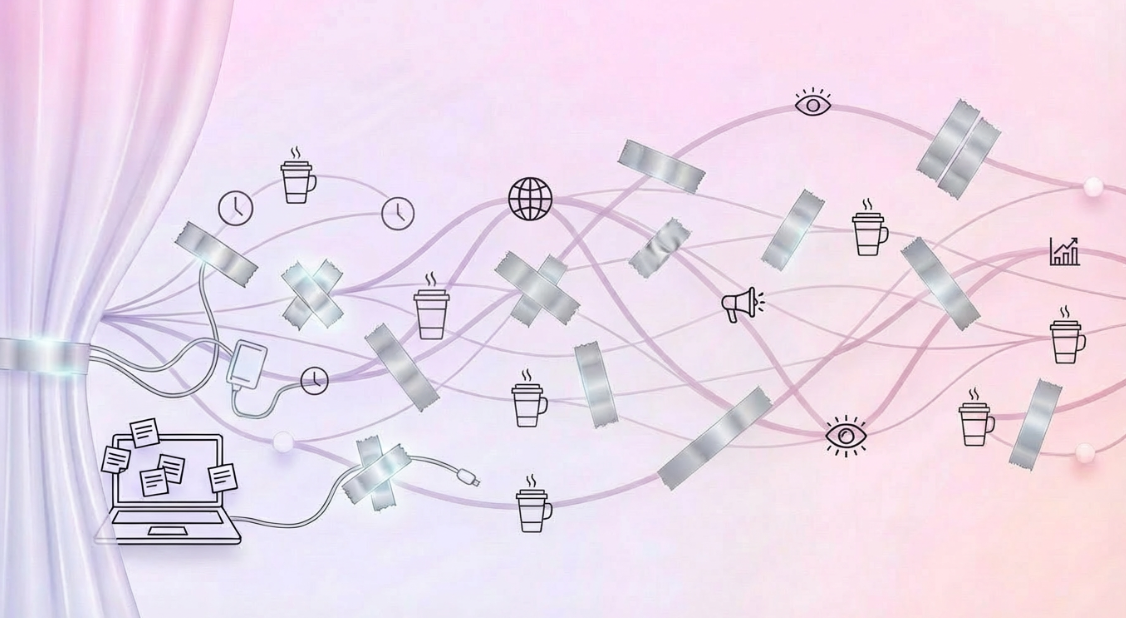



What it really feels like behind the curtain of enterprise marketing—and how I finally found a better way.
Hi, I’m Janine.
After more than two decades in enterprise marketing operations—leading large-scale teams, navigating complex tech stacks, and helping creative work see the light of day—I’ve seen the good, the bad, and the burnout.
Now that I’m at Gradial, I finally have language—and leverage—for things that always felt broken but impossible to fix.
This is a look back at a very typical day from before. The problems are still familiar—but now I see them with fresh eyes.
Fire drill before coffee
7:45 AM – “Did that new hero image go live yet?”
That early-morning ping from a senior leader. You know the one.
Yes, we updated the hero asset. It was approved. Routed. Updated in most places...
But then someone found the old version still live on a tucked-away subpage. And another one on mobile.
“Didn’t we already decide to change that 55+ couple weeks ago?”
We did. Just not everywhere.
What I really needed wasn’t a better process doc—it was an automated QA loop. Something to catch this before it became a Slack fire drill. But we didn’t have that.
So I did what a lot of ops leaders do: I put out the fire, logged the issue, and moved on.
Ticket overload and timeline chaos
9:30 AM – Campaign Check-In
Three launches. A dozen stakeholders. Competing priorities.
The creative team was crushing it.
Channel leads were pushing for faster timelines.
And then there was the website.
Not slow people—just a slow process.
Manual CMS updates. Rigid workflows. A backlog of 72 tickets.
Most of them small, but time-consuming:
- Alt text tweaks
- Broken links
- Component swaps
- Language edits
Not strategic, not scalable, and it was holding us back.
Ambition vs. Approval
11:00 AM – Marketing Transformation Working Session
We gathered the usual suspects: VPs, directors, team leads.
“Let’s go agile.”
“Let’s modernize.”
“What about AI?”
All great ideas… until they hit the wall of:
- Approvals
- Budget
- Buy-in
- Fear
Teams hearing “automation” weren’t thinking scale. They were quietly bracing for what it might mean for their roles.
We weren’t trying to cut people—we needed to upskill them. But without clarity or proof, it was hard to bring everyone along.
Everyone’s burned out
2:00 PM – Creative Integration Sync
By mid-afternoon, you could feel it. Brand. Content. UX. Web. Everyone was tired.
The web team especially. They were keeping dozens of plates spinning inside a fragile authoring environment. One person was out. Another stuck waiting on approvals.
And yet... the asks kept coming.
“We’re not against new tools—we’re just trying to keep the lights on.”
If we’d had Gradial then, we wouldn’t have needed a full reset. We just needed breathing room.
We could’ve automated the repetitive stuff:
- QA
- Copy updates
- Accessibility checks
That would’ve freed up capacity for the work that actually fuels growth—and joy.
What I Know Now
I caught up with a former teammate recently. We swapped stories—pages that got stuck, tickets that vanished into the abyss, campaigns that launched too late.
And I found myself saying:
“We could’ve done it differently.”
Not with more people. Not with heroic effort. But with the right kind of support—the kind that removes the drag, not the people.
What we needed back then is exactly what Gradial offers now:
AI agents that take on the tedious work your team doesn’t want to do—so they can focus on the high-impact, creative work that actually brings them joy.
It starts with a quick win and scales into a smarter way to meet today’s growing demand for content, personalization, and speed.
Because the future of marketing ops isn’t more hustle—it’s more intelligent support. Gradial helps teams shift from overload to orchestration, giving them the clarity, capacity, and creative headroom they’ve always needed—but rarely had.