
What DMWF North America 2026 Put on the Agenda for Marketing Teams
DMWF North America 2026 put a wide range of marketing questions on the agenda: AI and agentic innovation, automation, content and storytelling, CRM, search, customer experience, and the systems required to connect it all.
Rather than trying to reconstruct unverified takeaways from every session, this recap focuses on what is documented: the themes named in the public DMWF program, the two sessions Gradial brought to the event, and the execution model we are building for enterprise marketing teams.
The connecting question is simple: once a team knows what it wants to do, how does the work actually get done across the stack?
From AI experiments to operating models
The DMWF agenda included sessions such as Marketing at Machine Speed: AI, Automation & Competitive Advantage and Human-AI Collaboration: Powering the Next Generation of CRM.
Those titles reflect a useful shift in the market conversation. The question is no longer limited to whether AI can generate an asset. Enterprise teams also have to decide how AI participates in real workflows, how people retain control, and how output moves through the systems where marketing already operates.
That is an operating-model question. It requires context, connected systems, governance, and clear human approval points, not just a better prompt.
Content and storytelling still carry the customer experience
The public program also featured The Next Chapter of AI, Content Creation & Storytelling: Driving Growth and Relevance, alongside the Social Media, Storytelling & Content Marketing panel joined by Gradial Product Lead Nick Hessler.
AI changes how content is produced and distributed, but it does not remove the need for audience judgment, brand clarity, or a coherent story. It increases the amount of context teams must carry from strategy into execution.
The operational implication is significant. More channels, variants, and customer moments create more work to assemble, review, govern, update, and measure. The content idea matters, but so does the system that gets it live.
Search and discovery are being rewritten
The DMWF program described AI overviews, zero-click results, and conversational search in its Future of Search and Discovery for Brands fireside chat.
That shift changes the work for marketing teams. Brands need to understand where they appear in AI-generated answers, which sources shape those answers, and what content needs to be created or improved.
Insight is only the first step. The harder operational work is turning a visibility gap into an approved page update, structured content, metadata, supporting assets, QA evidence, and a live experience while the answer landscape continues to move.
What Gradial brought to DMWF
Gradial participated in two sessions on September 9. Nick Hessler joined the Social Media, Storytelling & Content Marketing panel, then presented From 10 Hours to 30 Minutes: Closing the Execution Gap.
The second session focused on the constraint between an approved marketing direction and a finished customer experience. That path can include intake, tickets, page assembly, email production, asset work, metadata, accessibility, brand review, approvals, and publishing across systems that were not designed to move together.
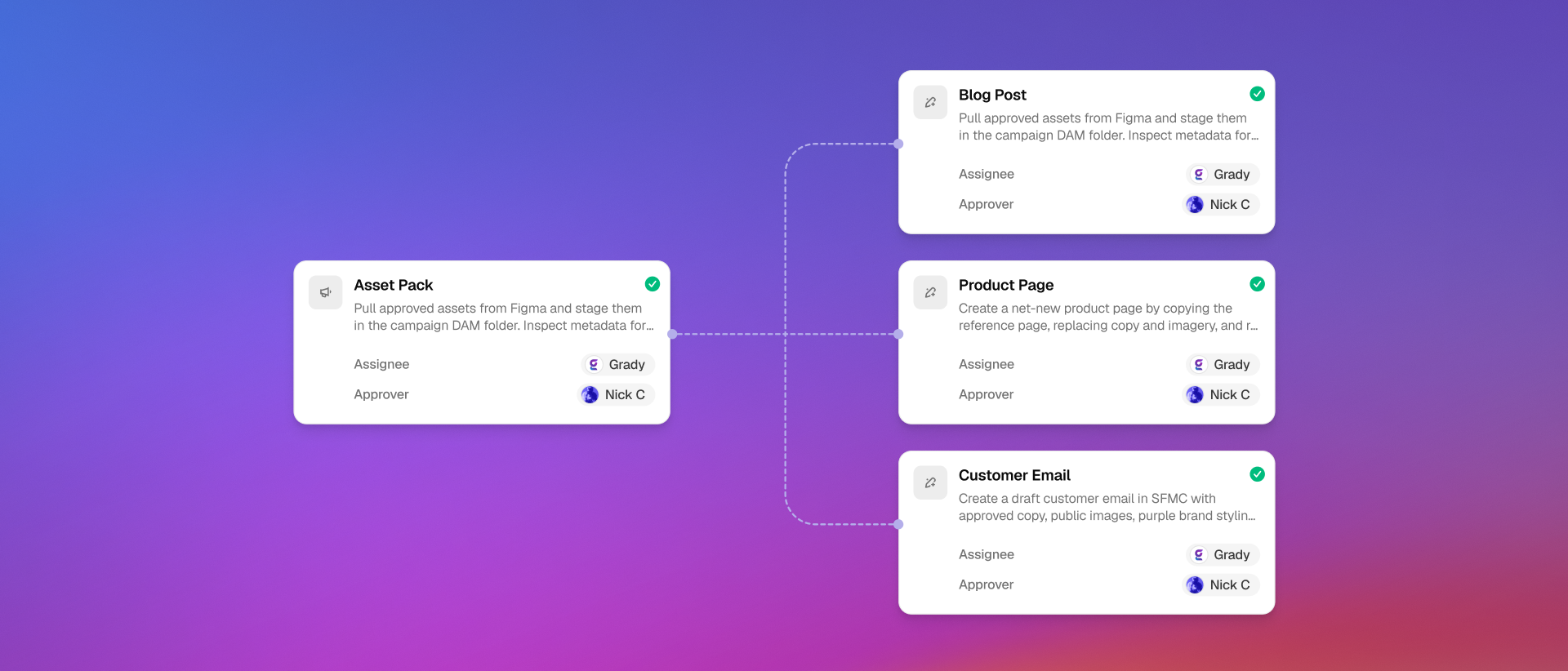
Gradial addresses that execution layer. Agents work across the marketing stack while business context, governance, QA evidence, and human approval stay attached to the workflow.
The execution gap is measurable
The AWS customer story provides a concrete example. Gradial helped reduce complex page creation from roughly ten hours per page to about thirty minutes.
The value is not only speed. Compressing repetitive production work reduces handoffs and gives marketers more time for strategic customer experience work.
The full result is available in How AWS accelerates content operations with Gradial.
The stack has to work as one
Enterprise marketing does not happen in one platform. A request may begin in Jira, require content work in AEM or Contentful, use customer context from Salesforce, pull assets from a DAM, and stop for brand, accessibility, legal, or compliance review.
Gradial is designed to be open and additive across that environment. The goal is not to replace the systems teams already own. It is to let agents execute the operational work between them with the organization's rules and context built in.
That is what turns a collection of capable tools into a system of work.
See the operating model live on September 30
Gradial Live will show this model in a real production environment on Wednesday, September 30, 2026 at 8:30 a.m. PT / 11:30 a.m. ET.
The live virtual demo and Q&A will show a Jira request and campaign brief becoming ready-to-review work in connected systems such as Jira, AEM, Salesforce, and a DAM. Brand, accessibility, metadata, quality, and governance rules will be applied during execution, with QA evidence and human approval before anything goes live.