















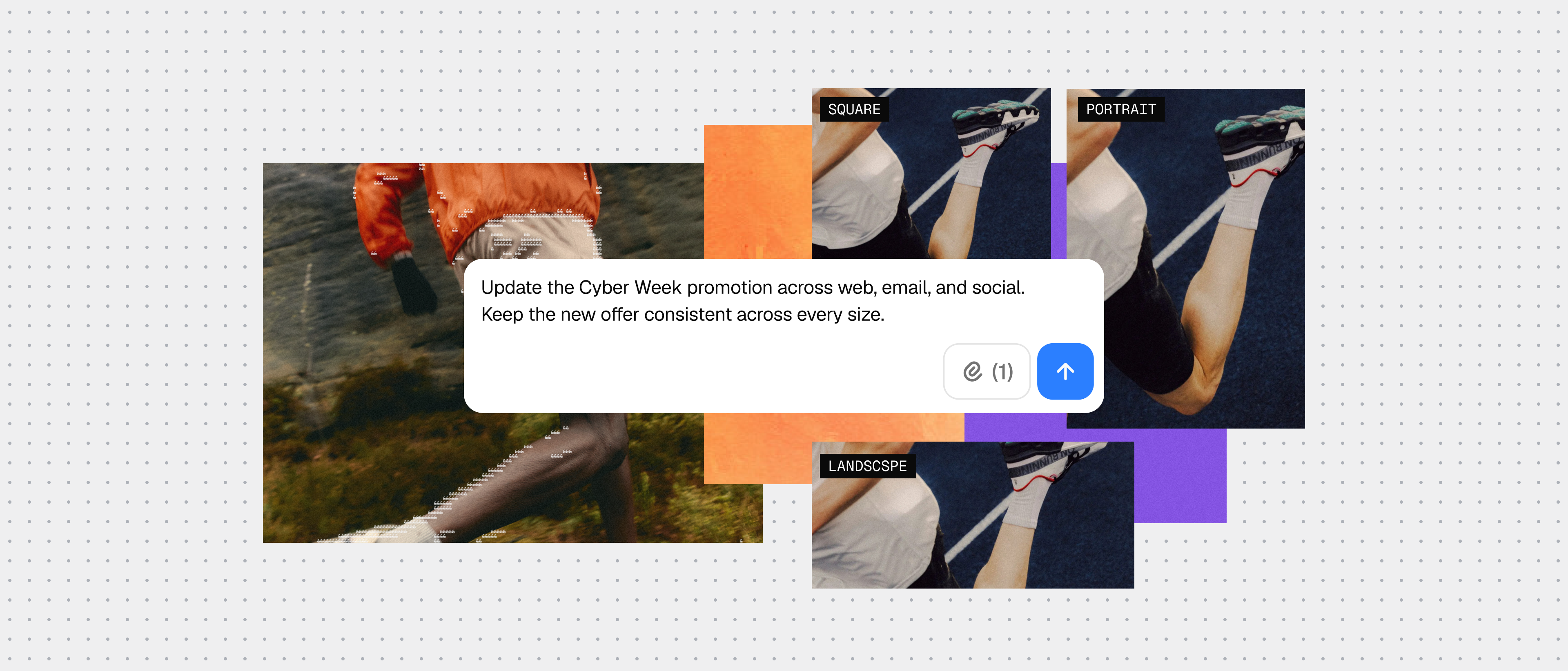

It's the second week of November. The Christmas aisles went up before the Halloween candy was gone, promotions are changing every few days, and someone on your team is cropping the same hero image for the tenth time. Cyber Week hasn't even started.
In my recent conversations with retail marketing leaders, the same pressure comes up every year: a hard deadline, enormous pressure to perform, and not enough hands to move at the speed the calendar demands. That's true whether the sale happens online, in-store, or, increasingly, across both.
So here's what most holiday-readiness posts won't tell you. If you're stretched thin right now, it isn't because you didn't plan hard enough. The real problem is that last year’s content production model can't keep pace with the relentless demands of this year’s holiday season.
Your creative isn't the bottleneck. Everything after it is.
The window is short, and the stakes are high. Adobe projects $47.5 billion in US online sales during Cyber Week, up 7.4%, with Cyber Monday on track to become the first $15 billion online shopping day. Bain expects Black Friday through Cyber Monday retail sales to grow 8.75%, nearly double the 4.5% it projects for the full season. More revenue is landing in fewer days.
Meanwhile, the offers keep moving. Discounts are forecast to reach up to 14% in early November, up to 21% just before Thanksgiving, up to 30% during Cyber Week, and then 10-15% through December. Every day is a new offer, a new badge, a new banner, a new email, a new product page treatment and, for omnichannel retailers, a new sign in the store. And with mobile expected to drive a record 63% of online spend on Thanksgiving and 57.4% across the season, each of those has to work well on a small screen too.
A large retailer I spoke with recently is treating Cyber Week as their must-win; but their biggest bottleneck isn’t strategy or even media budget. It’s the time and process of cropping and versioning: the repetitive, deadline-driven work of getting every asset into every size and every promotion state. With too little bandwidth in-house and a steady bill for the offshore teams and agencies who handle it today, when a promotion changes at 9 a.m., can you ship the updated creative by 11? This is the question that decides who wins Cyber Week.
This is not the problem of just one large retailer. In a May 2026 survey of more than 400 marketers, asset versioning was the number one bottleneck for brand marketers, and 70% said they’re producing more creative with the same or fewer resources.
The agency model wasn't built for a 2-hour pivot
This isn't an indictment of agencies. The great ones are brilliant at concepts, brand, and big ideas. But the traditional model—a brief, a retainer, a review cycle, and a handoff across time zones—adds latency to work that has none to spare. When the job is high-volume, repeatable, time-critical variation, you're paying a premium for speed you aren't getting.
So here's a question worth asking in your post-mortem: did your agency actually get you ready this year? Look at where the hours went. If most of them went to resizing, cropping, and swapping promotions rather than strategy, that's a signal about how the work is organized, not about anyone's talent.
The industry is already moving. A NewtonX and ADWEEK survey found 32% of brands expect to handle nearly all creative in-house within a year, and another 23% plan to bring at least half in-house. Medialink reports that advertisers and agencies that have adopted AI have cut creative production spending by an average of 27%.
Take your agency back
This isn’t about firing your agency. It’s about taking back control. Three shifts can make the difference:
Split the work by type. Keep agency partners on concepts, brand, and strategy. Bring repeatable production, such as cropping, versioning, promotion swaps, and localization, in-house, where AI can handle the volume, and your team keeps control of taste and judgment.
Rethink what your team looks like with more capacity. If production stops eating your hours, those people can move to merchandising, testing, insight, and optimization. Do the same audit on your tools. Many of your platforms now ship AI features, and it's fair to ask whether each one is worth the squeeze.
Make the screen and the shelf tell one story. Your product pages and your in-store displays should reflect the same merchandising logic. A shopper who sees one offer online and another at the shelf doesn't see two channels, just a retailer that can't keep its story straight.
Plot twist: Your shopper has an AI agent, too.
Here's what makes optimizing your content production model urgent beyond the next three weeks. Forecasts expect AI-referred traffic to US retail sites to rise 130% year over year this holiday season. More and more shoppers will first meet your products through an assistant that reads your catalog and summarizes it for them.
Those systems read what you publish: titles, attributes, descriptions, images. If that content is thin, stale, or inconsistent from one channel to the next, you have more than a conversion problem. You have a visibility problem.
The same content engine that gets you through Cyber Week versioning is also the one that keeps your product information accurate and consistent for machines and people alike. It’s also what helps your products get discovered through AI answers and organic search long after Cyber Monday.
What to do before Cyber Monday
You can't rebuild your operating model in three weeks. You can make the next three weeks less painful, and start the shift.
Be ready to adjust promotions in real time. Your campaigns may already be built, but how quickly can you respond when conditions change? If a competitor drops their prices or an offer needs to change, your team should be able to update promotional content and pricing across channels without another round of production bottlenecks. Start identifying where AI agents can take on repetitive creative production and versioning so a promotion change is a swap, not a new project.
Protect your top assets first. Get product pages and creative optimized for the SKUs that drive most of your revenue, then work down the list.
Track where the hours go. Log how much time goes to production versus thinking. That number is the business case for next year.
Schedule the post-mortem now. On December 1, ask where you waited, who you waited on, and what you'd never do by hand again.
The holiday rush will come and go, but the opportunity to change how the work gets done is here to stay. Take what this season teaches you and use it to build a smarter, faster way of working. Because next year, when the Christmas aisles go up before the Halloween candy is gone, your team should be ready for what's coming—not bracing for it.