


Why usage-based AI pricing puts growth and cost control at odds
Your CFO sees agentic AI as an unbounded cost line. Your CMO sees it as the only practical way to deliver personalization at revenue-moving scale. Both are reading the situation correctly. The pricing model is what put them on opposite sides of the table.
Personalization has always been constrained by production capacity. Teams built six personas because they could afford six versions, then called the segments strategy. The research mattered, but the number of experiences was still set by the budget and the production calendar.
Agentic execution changes that equation. Producing a version for a smaller audience, across more markets and channels, is no longer the hard part. The hard part is giving the business enough cost certainty to use that capacity.
Put a meter on every action and the old constraint returns in a new form.
Two executives, one quarter, opposite conclusions
In marketing, personalization has moved well beyond a brand exercise. It is tied directly to revenue mix, loyalty, direct demand, and repeat purchase.
Delta reported premium revenue of $6.92 billion in Q2 2026, ahead of main cabin revenue of $6.85 billion for the first time in company history. McDonald’s said trailing-twelve-month systemwide sales to loyalty members passed $40 billion, up more than 20%, while 90-day active loyalty users rose 13% to nearly 220 million across 70 markets. Chipotle reported digital sales at 38.3% of food and beverage revenue, up from 35.5% a year earlier.
Those are not engagement metrics. They show up in the P&L. The CMO is not asking for a novelty.
Finance sees the same technology through a different instrument. Seventy-two percent of enterprises report at least one unexpected AI cost spike in the past year. Organizations estimate that 26% of AI spend is wasted. More than half say there is no clear cost owner, and 56% say anticipating AI spend still feels like guesswork. Uber reportedly exhausted its 2026 AI budget by April.
Gartner has pointed to limited transparency in how token consumption is calculated and billed, which makes enterprise forecasting and control difficult. Deloitte found that 46% of CFOs at billion-dollar companies named cost uncertainty as their biggest internal concern about AI.
The CFO is not being an alarmist. Both leaders are reading the same instrument correctly. They are simply reading opposite ends of it.
The argument is settled before the evidence arrives
The deeper problem is timing. AI cost and personalization value are measured on different clocks.
The invoice arrives every month. It is precise, immediate, and hard to dispute. The payoff from personalization appears as a cohort curve: attachment rate, direct share, repeat frequency, lifetime value. It can take four to six quarters before that value is defensible in a boardroom.
That leaves finance with evidence and marketing with a thesis. Every cycle starts with the same asymmetry, which helps explain why programs that everyone wanted to work still get cut in month seven.
Delta’s quarter shows how quickly the pressure appears. Revenue per available seat mile rose 17%, while cost per available seat mile rose 21%. When costs are growing faster than revenue, the line item nobody can forecast will not win an argument on potential alone.
Agentic work makes forecasting harder
Agentic systems do not behave like a fixed number of simple prompts. Stanford’s Digital Economy Lab reported that agentic tasks can consume roughly 1,000 times more tokens than chat. Input drives much of the cost because the agent rereads accumulated context before each action. In the same research, an identical agent completing an identical task varied in cost by as much as 30 times.
Gartner describes the enterprise version as the Inference Paradox: unit economics improve while total AI cost rises, without a clear path to equally predictable value. It estimates that an agentic reasoning task costs at least five times more than a basic interaction and expects inference cost per agentic workflow to rise more than fivefold through 2028.
Unit prices fall. Total bills rise. Forecasting remains difficult.
The CFO’s concern is a rational response to a cost structure that behaves unpredictably. The CMO’s frustration is equally rational. The business has a revenue engine that cannot run at the volume the strategy requires.
What the meter changes for customers
McKinsey surveyed 1,719 organizations across 97 countries and found that one in five was limiting AI use because of operating cost.
Inside a marketing organization, that looks less like a technology decision and more like a series of quiet compromises. A regional manager sees a shrinking credit balance and delays a property refresh for 340 hotels in nine languages. A field marketer launches local creative in 30 DMAs instead of 212. A brand team produces one global film and leaves the dealer tier to improvise.
Those are customer experience decisions. They become revenue decisions the moment a customer sees a stale rate, a generic offer, an untranslated page, or a dealer message that no longer matches the brand.
A meter does not reduce output evenly. It cuts the long tail first.
The eleventh market. The 300th property. The second language. The small DMA. The low-volume dealer. These audiences may be low volume, but they are not low value. High intent in a smaller market is often where relevance matters most, precisely because competitors are less likely to invest there.
Usage pricing optimizes against the wrong variable. Finance believes it is trimming waste. In practice, the company may be trimming margin without a clean way to see it.
The same facts, read from two chairs
Across experience-driven industries, the pattern repeats. Marketing sees a growth mechanism. Finance sees a variable cost. The business reality sits between them.
| Category | What the CMO sees | What the CFO sees | What is actually true |
|---|---|---|---|
| Airlines | Premium revenue has moved ahead of main cabin revenue. Service posture now shapes the revenue mix. | Fuel represents more than 31% of operating expense. Every non-fuel line is under review. | A premium promise has to be honored across every touchpoint, not only in the cabin. That is a content volume problem. |
| Hotels | Direct share is the fight, and recognition is the product. | OTA commission is a distribution cost. | Hotel sites appear in only about 6% of AI hotel recommendations, while 82% of cited sources are OTAs, metasearch sites, and editorial publishers. A visibility problem becomes a distribution cost problem. |
| QSR | Loyalty sales protect margin and strengthen first-party demand. | Advertising funds use franchisee money, often 2% to 7% of gross sales. | Eighty-five percent of QSR loyalty members say saving money is the most important benefit. The category scaled currency because recognition was harder to produce. |
| Automotive | The brand promise passes through national, regional, and dealer localization before it reaches the buyer. | Incentive spend is $3,384 per vehicle, up 5.9%, and equal to 6.6% of MSRP. | Incentive is the cash discount paid when the relationship does not hold price. Failed personalization already has a budget line. |
| Cruise and gaming | Anticipation is part of the product across an eleven-month purchase window. | Customer deposits above $8 billion create valuable float. | Anticipation has to be maintained with relevant content. That content helps protect the float. |
The automotive example belongs in front of a CFO. A $3,384 incentive is not an abstract marketing measure. It is cash the company gives up to close the sale. The tooling that could help build a stronger relationship sits in the same business case, but almost nobody models the connection that way.
The data is not the missing piece. A WIRED reporter requested his McDonald’s loyalty file and received 515 pages, including a forecast of 2.16 visits over six weeks, a $13.49 average order, and a churn score of zero. The brand knew him with precision. It still could not consistently produce an experience that felt like recognition.
That gap between what a company knows and what it can make is the real constraint. It is a production problem that has spent years being described as an insight problem.
Capacity certainty resolves the conflict
Forrester’s 2027 planning guidance says 91% of marketers expect larger budgets, then recommends cutting AI initiatives that lack governance, clear ownership, success criteria, or a defined path to scale. Gartner reports that CMOs are putting 15.3% of budget into AI, while only 30% say they are ready to scale it and 56% say they lack the budget to deliver the strategy already promised.
Read together, those findings point to a forecasting problem more than a demand problem.
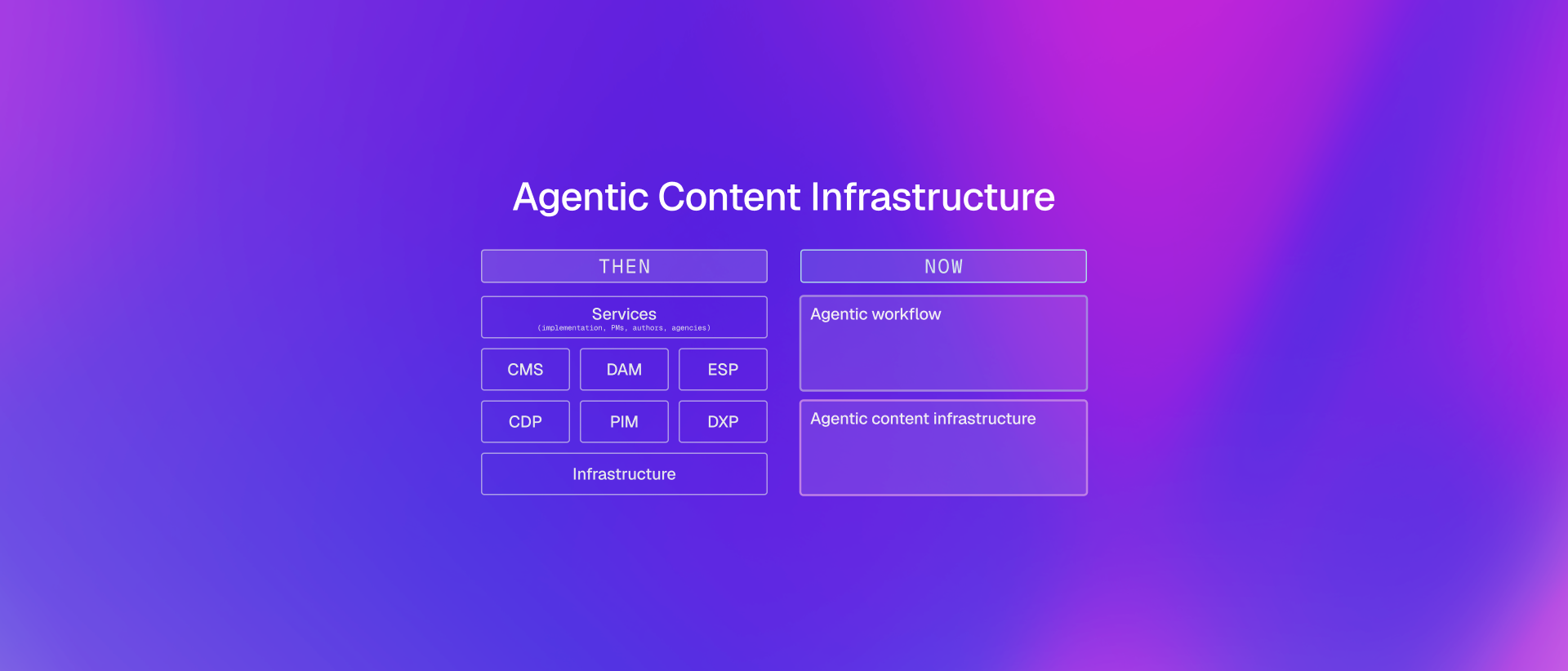
That is why Gradial should be evaluated as capacity certainty, not consumption. The model has to make both executive narratives true at the same time.
Finance gets a number that does not move. A flat annual fee covers the platform and a defined catalog of standard work. Bespoke rebuilds and one-off transformations sit outside that catalog and are priced deliberately, not discovered on an invoice. Clear fair-use terms make annual cost comparable with annual value.
Marketing gets a system that keeps working. There is no depleting credit balance and no approval gate between a marketer and the eleventh market. The team sees a queue of work, not a countdown.
Both teams get an audit trail. Governance runs inside execution. Fare disclosures, rate and cancellation terms, allergen and price accuracy, dealer pricing claims, brand checks, accessibility checks, and legal review stay attached to the work. People still approve decisions that affect revenue, price, or brand.
The meter still runs on Gradial’s side. Every action is logged and costed because capacity cannot be governed without measurement. The difference is that action-level consumption does not become the customer’s operating model.
Replace the shrinking balance with an ascending one: markets launched, properties refreshed, backlog cleared, cycle time reduced, and revenue signals connected to the work. That gives finance evidence sooner and gives marketing room to execute before the quarter is over.
Take the meter off the marketer’s desk
Seats are seats. Beds are beds. A crossover is a crossover. A burrito is a burrito. Experience-driven brands win on how it feels to be their customer.
That feeling now has to be produced across more audiences, markets, channels, and moments than a traditional team can handle manually. The CMO and CFO both want the company to grow without losing control. A consumption meter forces them to defend those goals from opposite chairs.
Take the meter off your team’s desk. Keep it on ours.