

Marketing has never mattered more.
At its core, marketing is the most human-centric work in the enterprise — the discipline that takes a company's beliefs, products, and promises and translates them into something a customer actually feels. It is craft, judgment, taste, and trust. It is what brands are made of.
It is also, today, what gets buried under the stack.
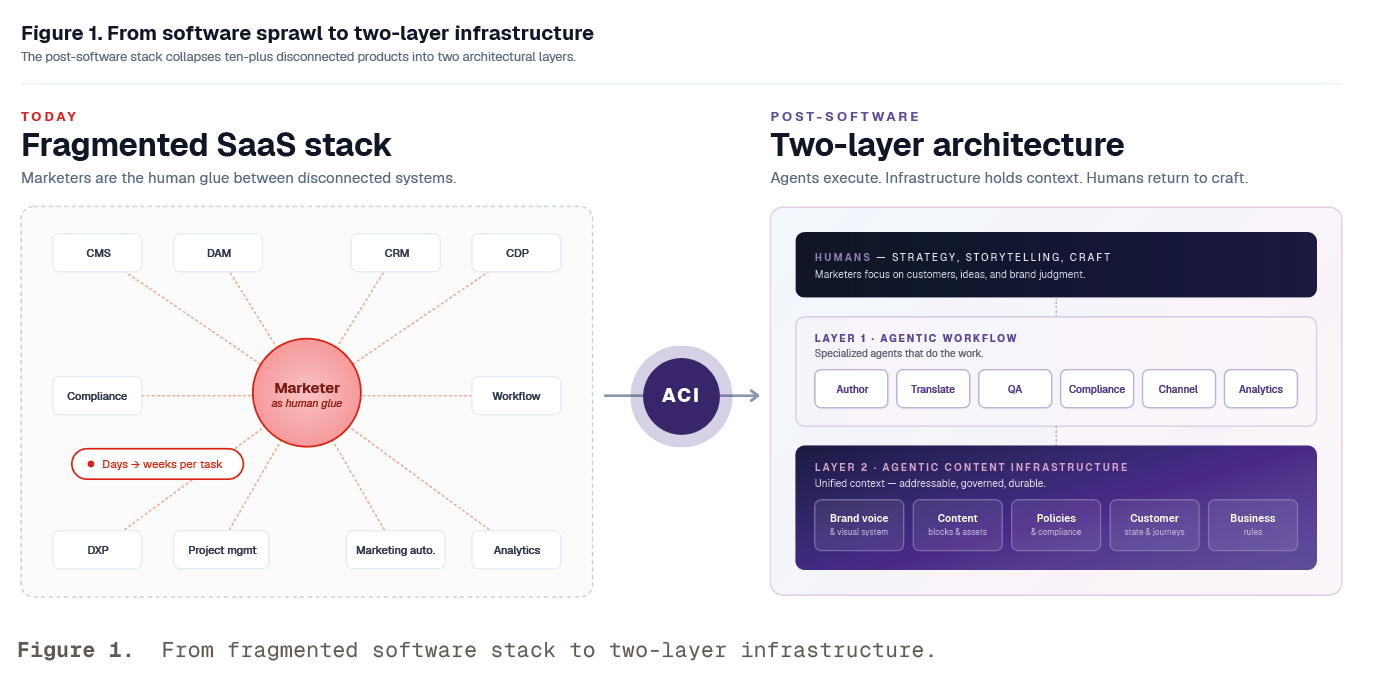
Enterprise marketing teams spend their best hours stitching together CMS, DAM, CDP, DXP, CRM, project management, legal review, analytics, and a growing layer of AI bolted onto each of them. The work marketers were hired to do — understand customers, make sharp choices, protect the brand, create experiences people remember — keeps getting displaced by the work the software requires.
That is the fight we are swapping out. The fight to integrate ten systems is ending. The fight to make AI execution trustworthy at scale — and to give marketers their craft back — is just beginning.
The architecture that wins it is not another SaaS tool. It is Agentic Content Infrastructure, or ACI: the runtime where the brand, the rules, and the memory of the work all live in one place, and where every agent — ours, yours, or one that has not been built yet — earns the right to act on the enterprise's behalf.
This is fundamentally an execution and infrastructure problem. It is not a content problem.
Read the agentic marketing operations guide | Download our white paper
The SaaS stack was built for operators, not agents
For the last decade, the enterprise martech playbook was simple. Identify a capability gap. Buy a specialized SaaS tool. Integrate it. Assign a human to operate it. Repeat that pattern long enough and every meaningful workflow crosses four or five systems, each with its own data model, permissions, approvals, and version of truth.
Launching a localized landing page is the canonical example. The brief sits in one system. Copy lives in a doc. Design is in Figma. Assets are in a DAM. The page is assembled in a CMS. Personalization rules live somewhere else. Compliance review happens in email. Analytics close the loop after the fact, if they close it at all. None of those systems know what the others know. The marketer becomes the integration layer.
Adding AI on top does not collapse that complexity. It often deepens it. A task-specific agent inside one tool can generate an asset, rewrite copy, or summarize performance. But production marketing depends on governed, cross-system execution. Without shared context, every new agent becomes another local optimization inside a global bottleneck.
The agents are not the problem. The infrastructure beneath them is.
The agent-native stack has two layers
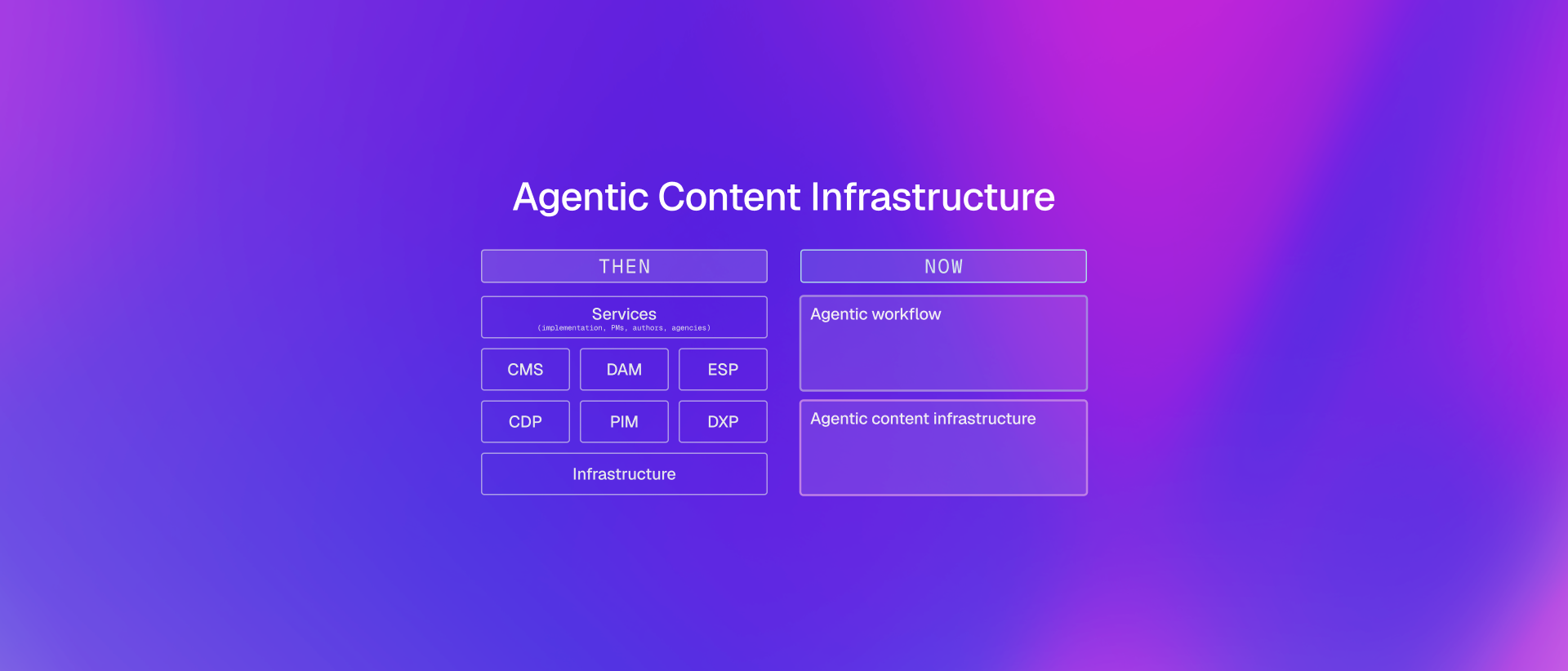
ACI reframes the stack around two layers instead of ten.
The workflow layer is where the work happens. Specialized agents author pages, localize campaigns, validate accessibility, generate variants, deploy to channels, run compliance checks, and measure outcomes. Workflow agents are the system of work.
The infrastructure layer is where the work is governed, remembered, and trusted. ACI is the agent-readable runtime that holds brand voice, design tokens, approved assets, content blocks, policies, business rules, customer state, and the running history of what has been done and why. Context lives here. Trust gets earned here.
Models and agents are becoming easier to swap. Context, governance, and execution memory are not. The enterprise that makes its brand and its rules addressable as infrastructure will get compounding value from every model and every agent it adopts. The enterprise that does not will keep paying integration tax forever.
This isn't another martech wave
Agentic marketing isn't a stack upgrade. It is a redefinition of how work gets done.
Search, the internet, cloud, mobile — each of those shifts reshaped how enterprises operate. AI is doing all of them at once and reaching further: it is changing not just how work happens, but who does it. Software is no longer something humans operate. It is something that operates with us.
Marketing is where this hits hardest. It is the most human-centric work in the enterprise — and the work most exposed to AI. The stack marketers have been running on was built for humans operating software. The stack they need now is built for humans and agents working together, in a runtime where the brand, the rules, and the memory of the work are all in one place.
ACI is what that runtime looks like.
Context and trust
Every existing martech tool — CMS, DAM, CDP, CRM — was built to be a system of record for some slice of the enterprise. ACI is not another system of record. It is something different: a runtime where context lives and trust gets earned.
Context is the agent-readable model of the brand: voice, visual system, tokens, content blocks, policies, rules, customer state, execution history. All of it addressable. All of it governed. All of it kept current as the brand evolves.
Trust is what becomes possible when context is real. Every agent action and every published artifact can be answered for: was this approved, against which rule, with what authority, on whose behalf, and how do we know? Trust is not a banner on a product page. It is an architectural property. You either have it or you have meetings about it.
ACI gives you context and trust as a runtime. Workflow agents run on top. Without it, every agent is an unsupervised intern with publish access.
The agent-native loop spins faster
Enterprise marketing teams do not want audits. They want outcomes. The work has to detect what is wrong, fix it, deploy the fix, and learn from the result. Detect, fix, deploy, measure, repeat.
That loop is a context problem at every step. Detection needs a current map of the brand. The fix needs the rule, the asset, and the approval chain. Deployment needs to land in the CMS, DAM, or channel that actually serves the customer. Measurement needs to flow back into the same runtime that produced the work.
Detach any step and the loop breaks. Most AI marketing tools sit at a single step and call it a product. ACI is the layer that lets the loop run continuously — and every loop spins faster than the last because the context is sharper, the rules are clearer, and the memory of what worked is already in the runtime.
That is what agent-native means. The infrastructure learns. The agents accelerate. The work compounds.
What ACI looks like in practice
A practical ACI architecture has four parts.
- A single source of truth, encoded as data. Brand voice, visual rules, content blocks, policies, and approved assets live in one versioned, addressable layer.
- Governance as a build constraint. Agents cannot pick colors outside the token system or publish layouts outside the approved block vocabulary because validation is part of the runtime, not a downstream check.
- Composition over component sprawl. A small set of primitives lets agents assemble new pages and campaigns safely without waiting for a new template every time the market changes.
- Workflow agents that read and write through the runtime. Authoring, translation, QA, accessibility, compliance, deployment, and measurement agents all use the same context. No agent owns the brand. The infrastructure does.
This is where flexibility and governance stop being opposites. The composition layer gives agents room to execute. The infrastructure prevents drift. The two need each other.
Any agent. Same infrastructure.
If ACI is real, it cannot be locked to one vendor's agents. The point of infrastructure is that the enterprise owns the context layer: the brand, assets, policies, approvals, customer knowledge, and execution memory that agents need to do useful work.
A customer's internal agent, a partner's specialized workflow, a bought agent, a built agent, or a model that does not exist yet should all be able to read from the same governed source of truth and write back with accountability.
That is the advantage. Enterprises already have more context than any outside system can recreate. Unified and made agent-readable, that context makes every AI investment more effective. Left fragmented across SaaS tools and disconnected interfaces, it becomes friction: slower workflows, weaker trust, higher costs, and agents that cannot reliably execute.
What this unlocks
Once context, governance, and execution memory are unified, the benefits become practical quickly.
- A trust layer that makes agent actions reviewable, governed, and accountable.
- Faster feedback loops because detection, fixes, deployment, and measurement all connect back to the same runtime.
- Better workflow execution because agents can operate against the real brand system instead of stitching together stale context from disconnected tools.
- More effective agents whether teams build them, buy them, or combine both approaches.
- Cheaper, faster, and more reliable execution because less work is trapped behind manual handoffs and UI-driven integration tax.
- More enterprise control because the durable asset is the context layer the business owns, not a single model or workflow.
That is where Gradial's agentic workflow fits naturally: not by turning ACI into another silo, but by helping marketing teams use this architecture to execute real work — authoring, localization, QA, compliance, deployment, and measurement — against governed enterprise context.
Why this is the only viable architecture
The status quo is not stable. Enterprise AI adoption is high. Governed, end-to-end agentic marketing workflows are still rare. The gap is not enthusiasm or model quality. It is architectural debt.
At the simplest level, ACI says that enterprise context is too valuable to remain trapped behind fragmented application layers. Brand systems, assets, claims, performance data, approvals, and customer knowledge should be addressable as infrastructure, not scattered across interfaces agents have to navigate indirectly.
Every alternative collapses under the same three forces. Stacks that bolt AI onto fragmented systems collapse under integration debt. Stacks that route agents through human-operated SaaS consoles collapse under operational debt. Stacks that promise agents without governance collapse under brand and compliance debt. The only path that does not collapse is the one where the infrastructure carries the context, the governance, and the memory, and the agents do the work on top.
Marketing leaders should ask a different set of questions. Where does our brand actually live? Which systems hold canonical state, and which only hold stale copies? Which contracts execute work, and which only store context? What is the smallest end-to-end loop we could move onto a unified runtime this quarter?
Marketing has never mattered more
Agents will keep getting cheaper. Models will keep getting better. Neither of those facts protects an enterprise that cannot make its brand, its rules, and its execution memory addressable to the systems doing the work.
What ACI protects is rarer than either. It protects the work itself — the human craft at the heart of marketing — by giving marketers an infrastructure that finally serves them instead of consuming them.
Agents execute. The infrastructure holds the brand. That is what makes the work trustworthy. The marketers get to do what they were hired to do.
We are still incredibly early. The enterprises that move first will spend the next decade compounding while everyone else integrates.
ACI is not optional. It is the next default.