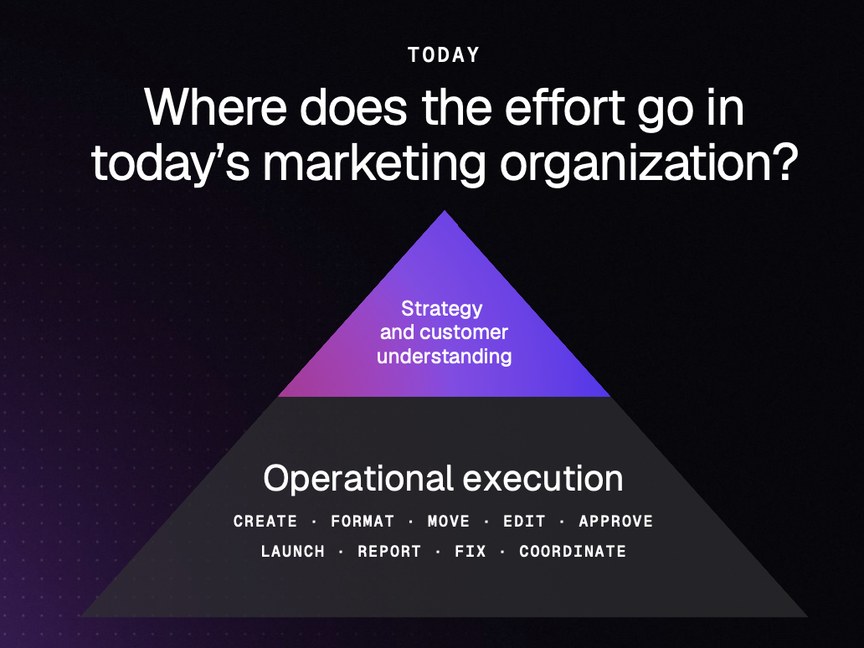
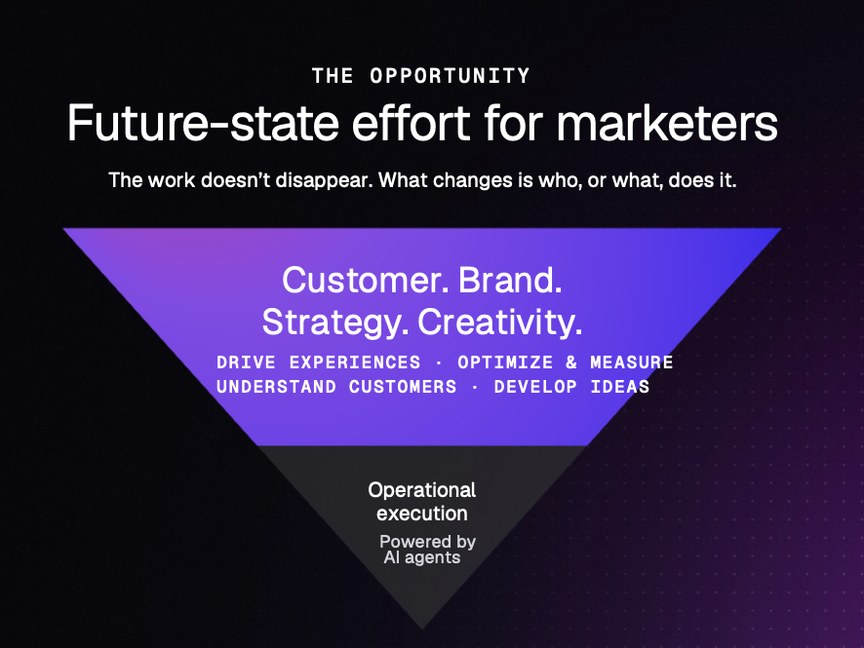
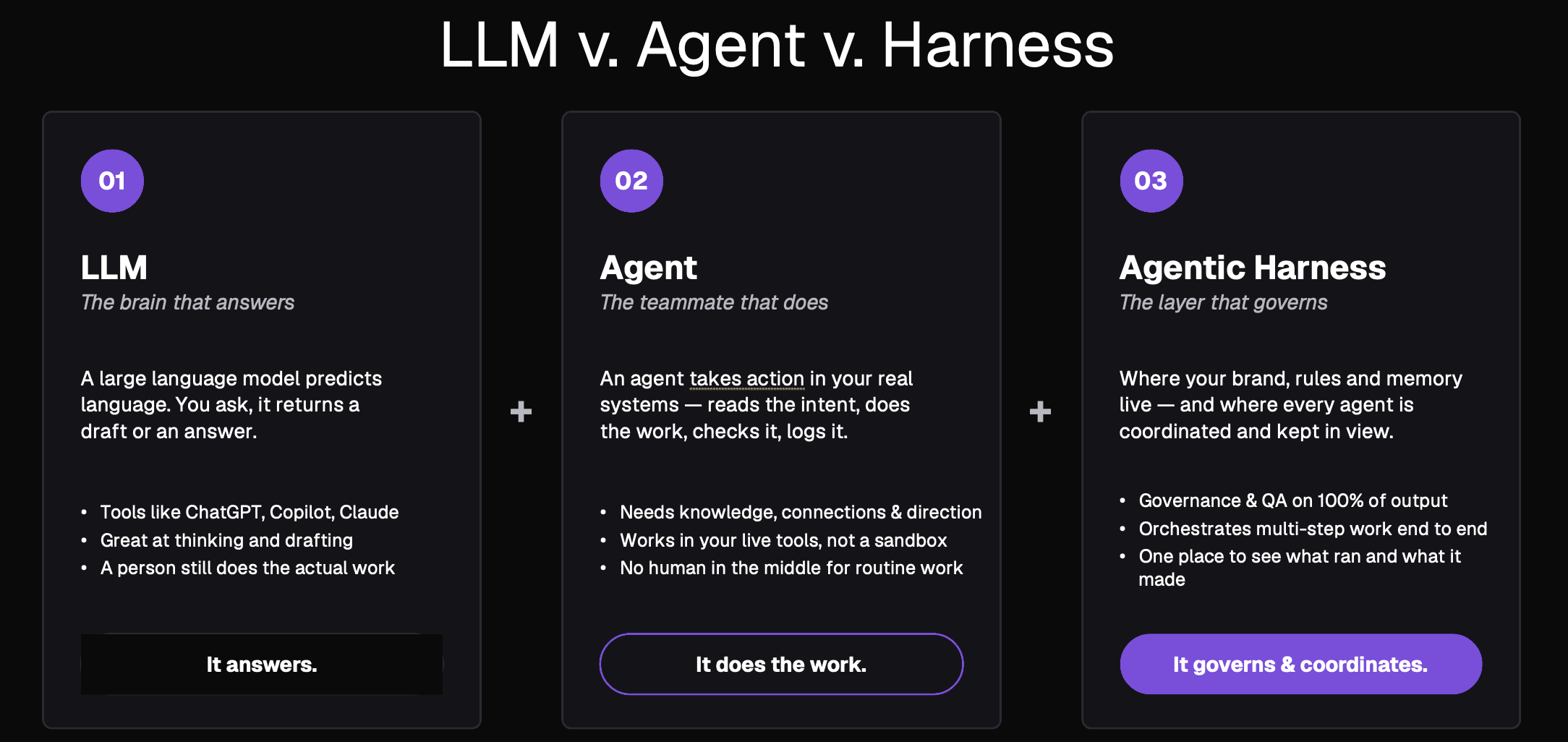
That’s the shift Gradial is building toward: not just making individual marketers more productive, but enabling the entire marketing operation to work differently. And importantly, you don’t have to rip out your existing technology to get started. You can begin unlocking workflows in the systems you already have while building toward an infrastructure designed for agents.
And here’s the problem: as agents dramatically increase production capacity, they also create more work for the systems and processes downstream. Your agents can move at AI speed. Your legacy SaaS platforms can’t. Which brings us to the next phase.
Phase 2: Unlock the systems
You don’t get a self-driving car by adding one more feature to the dashboard. You have to rethink how the vehicle operates. The same is true for marketing. Our legacy SaaS systems were designed for people to operate them manually. They weren’t built for the speed, scale, or coordination required by thousands of agents. So why are we trying to force an entirely new way of working into systems designed decades ago?
In marketing, it means we have to look under the hood and rebuild the foundation. Why do we want to rebuild the foundation? Because we can do more. I recognize this feels daunting, and none of us wants to do a system migration. And let’s be honest—just thinking of a system migration is giving me PTSD. The number of website and CRM migrations that I’ve done over my career is time that I’ll never get back. And the sadder thing is the millions of dollars and months of work with zero value added for the business while it was happening.
This is why getting your marketing agents and AI harness in place first is critical. Once the agents are running the workflow across systems, the system just becomes a database. This makes the move to a native agentic system much faster and less costly.
The opportunity is enormous: unlock millions in legacy systems cost savings while avoiding the massive, time-consuming migration projects that have historically slowed marketing down. With agents and orchestration in place, you can modernize your infrastructure faster and move at the speed your business demands.
Phase 3: Unlock the potential
With your agents orchestrated and running on AI-native systems, you’re no longer constrained by the limitations of legacy technology. Now you can unlock what’s truly possible.
Now, imagine the car isn’t a car anymore. It’s a hovercraft. You’re no longer constrained by the roads someone built decades ago. You can get from point A to point B in ways that weren’t possible before.
That’s the opportunity ahead for an AI-native marketing organization. Instead of manually defining and coordinating every campaign step, imagine setting business objectives and allowing an intelligent marketing engine to determine, execute, and continuously improve the next best action based on customer signals and outcomes. An operation that learns and adapts. One that creates personalized experiences at a scale we couldn’t previously achieve.
We’re not there yet. But the decisions we make about our work and systems today will determine how ready we are when that future arrives.
Let’s be clear: marketers still set the destination. We decide which customers matter, what our brands stand for, what outcomes we’re pursuing, and where the guardrails belong. The goal isn’t to remove human judgment from marketing. It’s to remove the operational constraints that keep us from putting that judgment to better use.
You don’t have to wait for the hovercraft
We don’t have to be the Jetsons just yet. And the even better news is that you can unlock a lot of value in the first phase. Marketing transformation doesn’t require us to replace everything overnight. It starts with identifying where work gets stuck today and finding a better way to move it through the organization.
Two examples illustrate what’s already possible.
T-Mobile wanted to move faster and scale content production without sacrificing accuracy. Rather than simply adding more AI tools, they worked with Gradial to orchestrate execution across their existing systems.
The team reported 99% accuracy and an 80–90% improvement in time to market, without requiring a platform migration.
That’s an impressive operational result. But what interests me most is what happens when you give that capacity back to the people doing the work.
Amazon Music offers another perspective.
Its design organization produces more than a thousand assets each week. That’s an enormous volume of work, much of it repetitive and templatized.
When talented designers spend their days versioning assets and managing production, how much time is left to stretch their creative abilities?
By reducing repetitive work, the team has an opportunity to develop new skills, take on more complex creative challenges, and spend more energy on the craft they were hired to do.
“With just the little bit of automation…they’ve been able to learn new design tasks. They came in as static designers. They’re now learning motion design because that’s the way the business is going,” said Kelli Johnston, Sr. Design Ops Manager at Amazon Music.
That’s the human opportunity behind AI transformation.
Not simply getting more work out of the same people, but changing the work they’re able to do.
Time saved isn’t the win. What you do with it is.
Let’s say we successfully give our teams back a significant amount of capacity. What happens next? If we immediately fill that time with another pile of uncoordinated requests, we’ve made everyone busier without necessarily making marketing better.
But if we reinvest that capacity in the work that matters, the opportunity becomes much more interesting. We can get to market faster, tackling high-value initiatives that have been sitting in the backlog. We can do better work, giving teams room to test new ideas, improve customer experiences, and focus on the details that make a brand stand out. And we can develop new skills, helping talented people grow into the more strategic and creative work that AI makes possible.
For CMOs, this is where the business case becomes real. Saving time doesn’t automatically mean saving money. The value comes from what we do with that time.
Did we get a campaign to market faster? Improve an experience? Unlock an experiment we couldn’t previously support? Give our people room to take on higher-impact work? Those are outcomes we can measure and take back to the CFO. And they make a far more compelling case than simply reporting how many AI tools we’ve deployed.
Stop adding agents. Start redesigning the work.
Here’s what I’d encourage every marketing leader to consider.
Before you buy another AI tool or build another agent, ask yourself: What work is keeping my team from doing something more important?
Find a workflow that’s painful enough to matter and repeatable enough to improve. Understand where the handoffs break down, who owns the outcome, and what success should look like.
Then start there.
Prove the value. Learn from what changes. Use that experience to connect the next workflow and build toward a more orchestrated marketing operation.
Because the goal isn’t to prove that AI works. We already know it can.
The goal is to prove that marketing can work differently.
And build an organization where our best people spend less time operating the machinery and more time creating the ideas, experiences, and growth that move the business forward.
Download the event slides
Curious to see what AI orchestration could look like for your marketing organization? See Gradial in action.