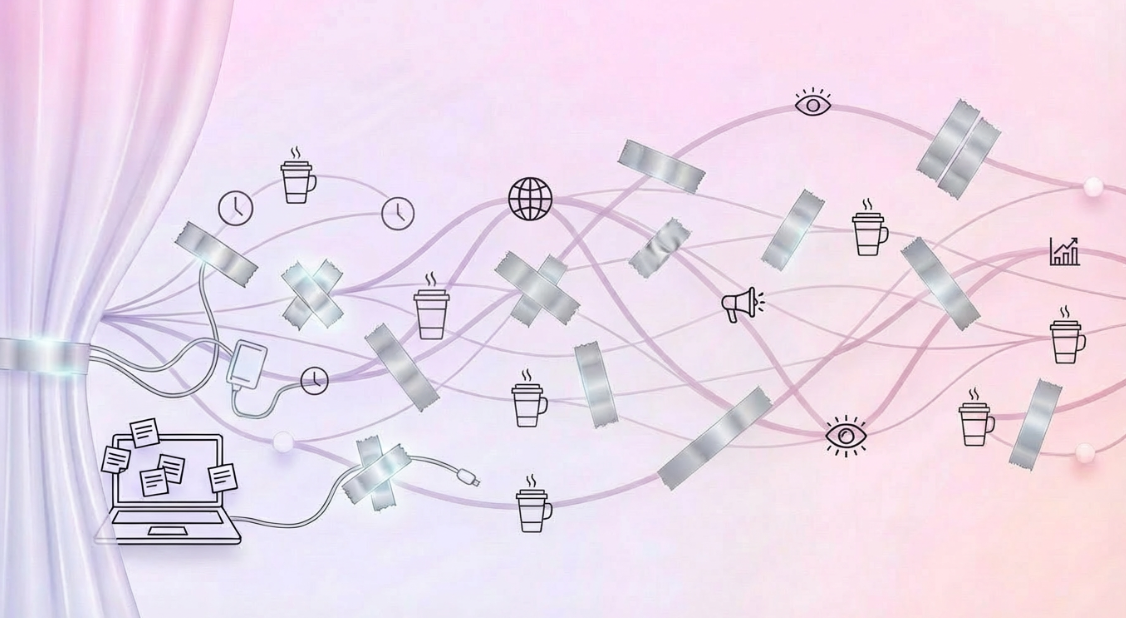

In marketing operations today, speed isn't a luxury—it's a mandate. And yet, despite massive investments in technology, most enterprise content teams still feel stuck in place. There’s a disconnect.
AI Summary
- Generative AI is everywhere, but execution remains manual and slow.
- Most teams still rely on handoffs, tickets, and approvals to publish.
- The real bottleneck is orchestration—not creation.
- This post introduces a 6-level model for evolving to agentic operations.
- At the highest levels, AI doesn't just generate—it executes, adapts, and delivers.
Digital Marketing in the Age of AI
Over 85% of marketers say they’re under pressure to produce content faster (Adobe, 2024). And nearly 60% of enterprise organizations are already piloting or deploying generative AI (Capgemini). So why do campaign timelines still drag? Why are updates still routed through six approvals? Why do launches still take weeks?
Because while content generation has seen explosive adoption, execution and orchestration haven’t kept up.
According to Gartner’s 2025 Hype Cycle for Digital Marketing, AI-generated content is nearing the “Plateau of Productivity.” But AI for content execution is still in early adoption, with fewer than 10% of enterprise teams using autonomous agents to automate publishing, QA, or content migration at scale.
This gap between creation and execution is the next frontier—and it's where the real opportunity lies.

The Problem: Velocity Without Infrastructure
Despite all the investment in AI and automation, execution is still where most marketing ops teams get stuck. Content generation has accelerated—but the rest of the process hasn’t. Without an agentic layer to carry work across systems, teams are left with disjointed, labor-bound workflows:
- A designer exports from Figma, but production reassembles everything manually.
- A strategist delivers the copy and visuals, but a content author still needs to assemble everything—pixel by pixel—in the CMS.
- A migration project starts, but quickly balloons as every page requires human QA.
Even when content is AI-generated, the supply chain to deliver it remains fragmented. And that’s the bottleneck. The real gap isn’t creative horsepower—it’s infrastructure.
A Better Model: Evolving Through Levels
At Gradial, we think of this transformation the way autonomous vehicle companies think of driving. There are stages—clear, measurable stages—that marketing ops teams move through on their path to autonomy:
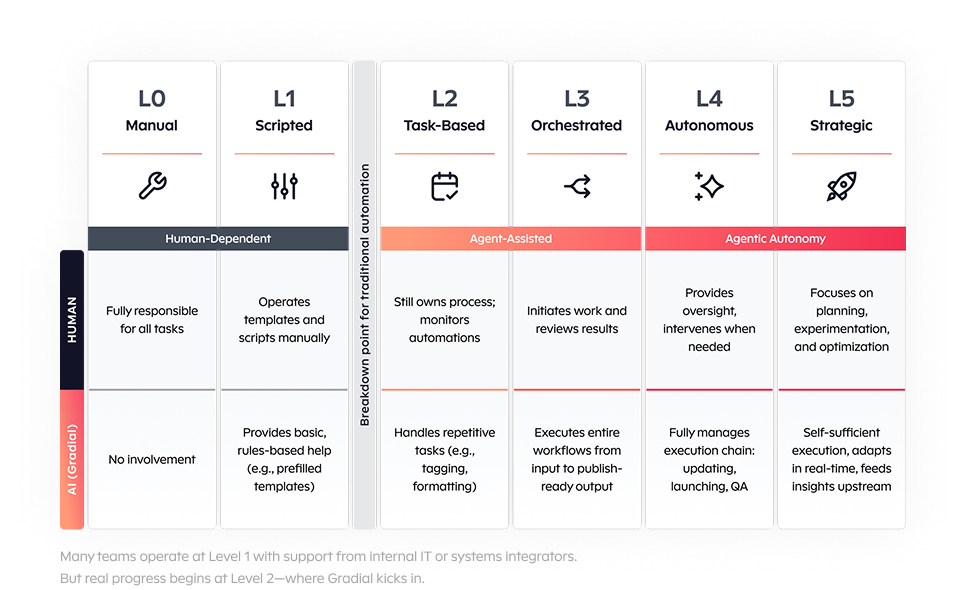
This is not theoretical. This is what we’re seeing in the field—with some of the largest enterprises in the world.
Here’s a closer look at what each level means in practice.
Level 0: Manual
Every task is handled by humans, routed through tickets, handoffs, and approvals. Most of the team’s energy goes into managing process—not producing outcomes.
Level 1: Scripted
Basic tools like templates or macros help reduce effort, but only in isolated spots. Execution still relies heavily on people to connect the dots.
Level 2: Task-Based Automation
Repetitive tasks like tagging or QA are automated after setup. Teams gain some efficiency, but human coordination is still required throughout.
Level 3: Orchestrated Execution
AI agents begin handling full workflows, turning briefs into publish-ready content. Execution accelerates—from intent to output in minutes.
Level 4: Autonomous Ops
Agents own the full delivery chain across tools and channels. Teams set direction and provide oversight, but no longer touch every step.
Level 5: Strategic Autonomy
With execution covered, teams shift focus to strategy, testing, and growth. AI becomes a force multiplier for insight, speed, and scale.
What Makes It Possible: Gradial’s Agentic Stack
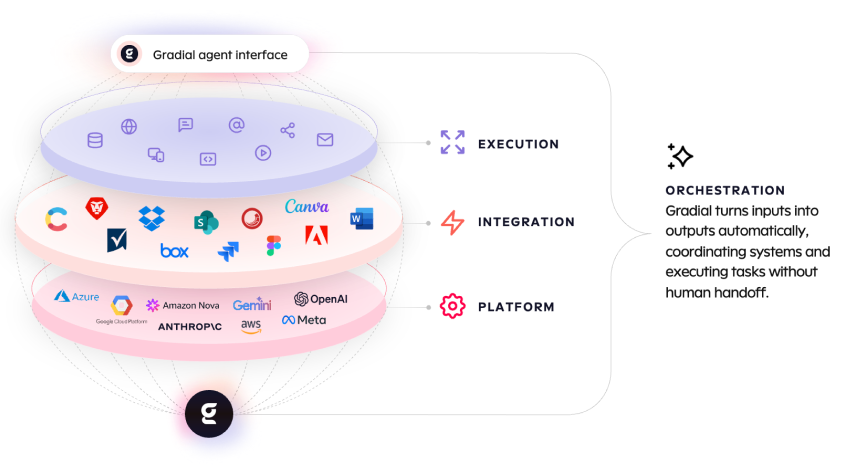
Here’s how Gradial’s agentic platform turns that progression into reality—coordinating inputs, automating outputs, and executing across tools without human handoff.
What Our Partners Are Saying
A human-centered approach matters—especially when you're automating workflows that touch teams across strategy, design, content, QA, and operations. It’s not just about software. It’s about orchestration that respects expertise, context, and brand.
Gradial’s certification process ensures partners are equipped to deliver Level 1 success from day one. But what partners value even more is how Gradial listens, adapts, and evolves alongside customer needs.
“We’ve had Gradial in production with a Fortune 100 customer for over 18 months. What made it work was starting with empathy—mapping workflows, clarifying business rules, and aligning cross-functional teams. That foundation gave us the trust and structure to move into the next phase: launching Gradial’s UX agents to assess journeys in real-time with hundreds of persona-based agents. It’s helped close the gap between brand and execution—driving sharper targeting and greater agility."
Garrick Scmitt
SVP, Digital Strategy & Experience, Revel
The Shift: From Generative to Agentic
We believe the next evolution in martech isn’t just generative—it’s agentic.
Generative AI creates the “what.” Agentic AI executes the “how.”
And in content ops, the “how” is everything. Without it, AI-generated content gets stuck—waiting in queues, spreadsheets, or the inbox of someone on vacation.
Gradial's agentic platform fills that gap. It doesn’t just create —it orchestrates, adapts, and executes. Not in isolation, but across your systems: CMS, ticketing, design tools, analytics. In real time, with real constraints.
That’s what enables companies to go from dozens of updates a month… to thousands. From static brand sites… to dynamic, data-driven experiences.
Learn more.
To learn more about how we are partnering to transform digital marketing with AI and see a demo of these capabilities in action, please reach out directly at sales@gradial.dev

Jason Michaels
Head of PartnershipsJason is a growth and marketing team leader with 25 years of experience delivering measurable business results. He leads partnerships at Gradial, working with agencies, GSIs, and ISVs to drive faster, smarter engagements with an agentic Content Supply Chain.