

Most companies talk about Generative Engine Optimization. We decided to run the playbook on ourselves.
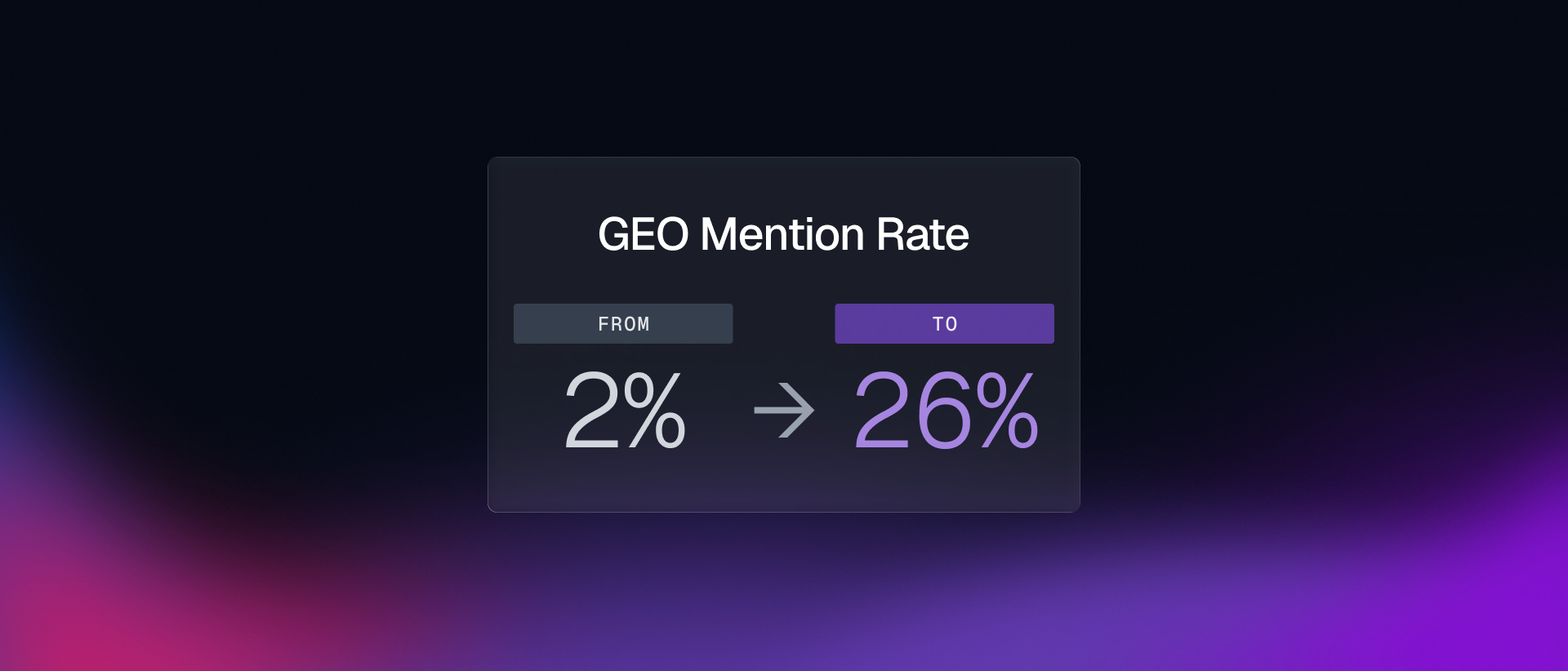
Four weeks ago, Gradial's mention rate across LLM-powered search engines was sitting between 2 and 3 percent. When buyers asked ChatGPT, Perplexity, or Claude about enterprise marketing operations platforms or content ops automation, we barely existed in the answers.
Today that number is around 26 percent.
That puts us at number four in our category, behind only Adobe, HubSpot, and Salesforce. Three companies with brand awareness budgets larger than most Series B valuations.
This isn't a product announcement. It's a case study on ourselves, and an honest account of what actually moved the metric.
Why We Ran the Experiment
We build the platform that helps enterprise teams win in generative search. If our own site couldn't show up in AI-generated answers, that'd be a credibility problem.
So we treated Gradial the way we treat any customer. We ran our own GEO report, identified the gaps, and used those insights to inform a site redesign that had been in motion.
What Actually Moved the Number
The honest answer: the site redesign we shipped two weeks ago did the heavy lifting. The GEO agent is what told us where to aim.
Here's how those two things worked together.
The GEO agent surfaced the prompts that mattered. Not vanity keywords. The actual questions enterprise buyers type into AI search engines when they're evaluating marketing operations platforms, content automation tools, and CMS orchestration layers. Prompts like "best enterprise content ops platform," "marketing automation for large teams," and "how to automate content workflows at scale."
It audited what engines were saying. For each prompt, the agent tracked which brands were being cited, which pages were used as evidence, and where Gradial was missing from the conversation entirely. In most cases, we weren't being mentioned at all. Not because our product was irrelevant, but because our site didn't give engines what they needed to reference us confidently.
It flagged the structural gaps. The issues weren't about word count or publishing cadence. They were about how our pages were built. Thin comparison content. Product positioning scattered across too many places without a single authoritative source. Components that buried definitive claims inside marketing copy. No clear structured signals for LLMs to extract.
Our design and content teams used those insights to rebuild the site. This is the part that mattered. The redesign wasn't just a visual refresh. It was a structural rebuild informed by what the GEO agent told us LLMs needed. We rewrote core pages with the specificity AI engines reward. We restructured how product positioning lives on the site so there's a single authoritative source per topic. We built components that make definitive claims scannable and quotable. We added the kind of structured trust signals that LLMs pull into answers.
Then we measured again. Every week we re-ran the same prompts and tracked movement. The agent kept telling us which changes were working and where the next gaps were.
The Results
Week one: 2 to 3 percent mention rate across target prompts. Gradial appeared in almost none of the AI-generated answers for our core category.
Week four (one week after the redesign went live): 26 percent. Gradial now appears in more than one in four LLM responses for enterprise marketing operations and content ops automation prompts.
We closed the gap to Adobe, HubSpot, and Salesforce in 28 days.
What This Tells You About GEO
A few things became clear through this process.
Insight without execution is noise. Every GEO platform on the market can tell you where you're missing. The agent is only as valuable as what you do with what it surfaces. In our case, the agent gave us a clear, prioritized map of what needed to change. The redesign was the execution.
Structure beats length. LLMs don't reward long content. They reward clear, quotable, structured content. Pages that make definitive statements, back them with specifics, and organize information in a way that's easy for a model to extract and cite. That's a design and content architecture problem as much as it is a copy problem.
Speed matters more than scale. We didn't publish hundreds of new pages. We made targeted, high-impact structural changes to a focused set of pages designed specifically to win in AI-generated answers. The volume was modest. The precision wasn't.
The execution gap is the real gap. Generative search results shift constantly. 40 to 60 percent of cited sources can change within a single month. If your optimization cycle ends at a dashboard, you're already behind. The teams that win in GEO are the ones who can act on insights fast, whether that's a site redesign, a content rebuild, or ongoing page-level updates.
What Comes Next
We're not stopping at 26 percent. The same loop keeps running. The GEO agent keeps surfacing new prompts, new gaps, and new opportunities as engines update. Our team keeps executing against what it finds.
If your GEO strategy still ends at a dashboard and a list of recommendations, ask yourself: who actually deploys the changes? And how fast?
That's the question that separates reporting from results.
If you want to see what a 2-to-26 loop looks like inside your own category, explore the GEO execution workflow.