

AI Summary
- Gradial uses agentic AI to automate content workflows, eliminating busywork and freeing marketers to focus on strategy and creativity.
- The AI content stack includes three layers: context aggregators (data ingestion), business vertical agents (role-specific reasoning), and executor tools (task automation).
- Gradial agents handle tasks like publishing, QA, and site updates, dramatically speeding up content cycles.
- The future of marketing AI is full automation, where agents will not only execute but also plan campaigns — and now is the time to build a smart, streamlined content stack.
Automate your content workflow with an AI-powered stack. Discover tools that save time, streamline ops, and supercharge your content supply chain.
The Case for an AI-Powered Content Workflow
Great content is about creativity and communication. So why does so much of the content operations process feel like pointless, box-checking busywork?
The truth is that most current models of at-scale content require humans to act like machines, with endless manual updates and QA checks that bottleneck your content supply chain and push real creative work to the side. With the dawn of agentic AI — highly capable models that can reason, act, and adapt to changes on their own — marketing tech has finally caught up to the needs of modern content delivery.
The Great Convergence in Marketing AI
Multiple vectors of AI innovation, from GPU scaling to fully autonomous AI agents, are seeing their S-curves come together at once — and Gradial’s bleeding-edge agentic AI lives at that convergence point. Gradial captures the game-changing value of these innovations and introduces transformative content automation that turns creativity-crushing busywork into a reliable automated workflow, freeing up time and headspace for the strategic work that drives everything else.
By harnessing agentic AI not just to generate content, but to automate whole marketing workflows at scale, Gradial is poised to become the centerpiece of marketing professionals’ agentic AI stack. And if “agentic AI stack” isn’t a phrase you hear every day, get ready, because it’s at the center of one of the biggest paradigm shifts in the history of content marketing — one that’s playing out as you read this.
Revolutionizing the Content Supply Chain with AI
The AI content stack is the foundation of the agentic AI deployments that will define the next era of digital marketing. AI content stacks go far beyond the LLMs and generative AI that nearly all marketers are already using, although they can integrate closely with popular genAI tools. Instead, agentic AI creates a truly smart, multi-layered system to automate the most tedious parts of content management and governance.
Behind every agentic AI content stack are several distinct breeds of AI agents that team up to automate and streamline your content ops: context aggregators, business vertical agents, and function-specific executor tools. Let’s take a look at the specialized role that each of these agent types is built to perform.

Layer 1 – Context Aggregators: The Memory Layer
To be effective, an AI agent needs to know the “why” behind every decision. That’s why an optimized AI content stack starts with context aggregators, AI tools that gather and contextualize key information.
Agentic tools like Glean and Microsoft Copilot are a great place to start. These agents can collect huge amounts of data from a wide variety of workspace sources, from Google Drive to CRM software to project management apps. Feed them brand guides, technical documentation, customer feedback, even Slack threads — they’ll digest it all and build an integrated knowledge base to inform decisions higher in the stack.
Note-taking apps like Otter.ai and Fireflies.ai also help by automatically recording and summarizing meetings, then creating searchable databases from their notes. When integrated into an AI stack, these apps give AI agents up-to-the-minute context without the need to manually update the knowledge base.
Improving Context for GenAI Tools
Generative AI tools like ChatGPT and Claude also live at this base layer of the stack. Practically all marketers today are leveraging these tools’ ability to produce content at scale — but the truth is that genAI content is the new table stakes, and off-the-shelf LLM outputs are often basic, boring, or way off-brand. Brands that want to win and grow need new ways to produce helpful, exciting, and relevant content.
To upgrade your content, upgrade your context. The tools we’ve just discussed can also connect to your genAI instances and give your LLMs the latest and most relevant context, including direction about current brand messaging and the up-and-coming trends sparking conversation in your industry. Once connected, these tools can automatically update your LLMs’ knowledge base, storing far more information than individual employees or even teams can hold in mind at once.
Layer 2 – Business Vertical Agents: The Reasoning Layer
Vertical agents take agentic AI from generalized models to role-specific execution. These agentic models are “experts in a box,” trained to perform industry-standard workflows and incorporate specific domain knowledge. Vertical agents are currently being deployed in a huge variety of fields, from e-com to logistics; we’re even seeing agentic automation in high-stakes professional fields like law through tools like Harvey.ai.
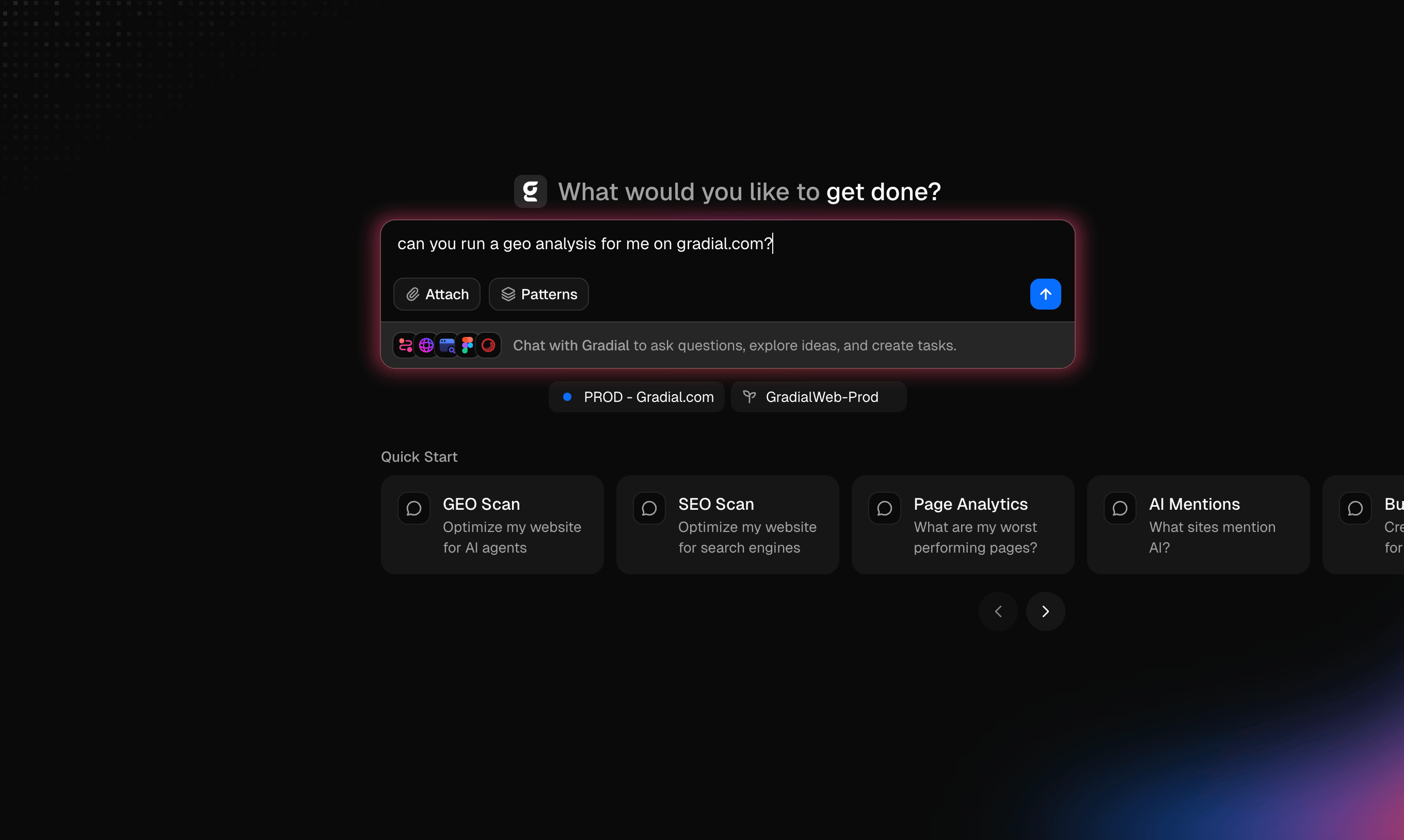
Gradial is built on a specialized suite of vertical agents tailored to the needs of digital marketers. We train our agents in everything from optimizing content for SEO and zero-click search to following web accessibility standards. Combined with context they’ve ingested at the base level of the stack, these new-breed AI agents act more like fully-trained coworkers. For a marketing team armed with Gradial’s role-specific agentic AI, everyday tasks like “Update the homepage images to match the guidelines discussed in our last meeting” can be carried out quickly, correctly, and with a fraction of the effort.
Layer 3 – Function-Specific Tools: Specialized Executors
Finally, we come to the top layer of the stack, where the doing gets done. Specialized executor agents are trained to use specific software and perform a wide variety of functions — basically, most of the things a human can do, but much faster and more efficiently. Working as a team, these agents can automate significant pieces of your content workflow.
Gradial agents are equipped with a comprehensive knowledge of popular content management platforms, including custom enterprise deployments. Among thousands of other tasks, your Gradial agents can:
- Publish and update content across multiple pages and sites
- Migrate data and content to new sites or CMS platforms
- Take a Figma sketch and turn it into a fully built-out new page
- Monitor pages for key factors like page speed and uptime
- Perform QA and accessibility checks
- Mimic persona-based user behavior to simulate customer journeys
Best of all, Gradial agents grow with you. When your team develops new workflows or incorporates new requirements, Gradial’s agents are ready to learn and operationalize. That’s going to be the key to keeping up as AI transforms the future of marketing.
Signals From the Future
With the fast and furious pace of AI innovation, forward-thinking marketers should get familiar with the technologies that will power their workflows in the future. In as little as one to two years, big moves will continue as long-running research in areas like GPU scaling, cloud computing, and agentic AI keeps producing new advances and technological S-curves converge to accelerate innovation.
Obviously, no one can call every technological curveball that’s coming to disrupt martech AI, but Gradial provides a platform that puts your brand on the frontier of everything exciting. Here’s a simplified but effective way to think about where AI has been, and where it’s going:
- Stage 1: AI answers questions and generates text. This is the stage that blew everyone’s minds in 2023, and it’s still evolving now with features like Google AI Mode. However, even powerful tools at this stage fall short of the capacity to automate a full workflow.
- Stage 2: AI performs the work for you. Here’s where agentic AI starts saving real time and effort for marketers. Rather than simply using AI to generate copy and creative for a post, you can assign every task in the authoring sequence to highly capable agents. From generation to editing to coding to QA, every step is handled for you — and in minutes or hours, not days or weeks. With Gradial, your team can do this right now.
- Stage 3: AI plans the work for you. As agentic technologies evolve, Gradial will continually expand its capacity to build fully-realized campaigns from the ground up. Your team focuses on the strategy and the creativity, while your expert agents handle the build-out. Give your customized agents brand guidelines, business goals, creative notes, and campaign parameters, then watch them construct your campaign in minutes.
Stage 3 is where the AI landscape is headed — and the pace of innovation is speeding up, not slowing down. For marketers of all kinds, whether in-house or agency, now is the critical time to get the jump on the most impactful advancements in AI, so you can be the disruptors, not the disrupted.
Building Your Content Stack
Operationalizing the concepts we’ve talked about means finding the right “model cocktail” of AI tools that fit together for your use case. For digital marketers, these are some of the principles we recommend keeping in mind when you’re assembling a content automation stack:
- Interoperability: Data should flow freely through every layer of your content stack. Look for tools with compatible APIs and integrations with software you already use, like project management platforms or content generation tools.
- Context-First Approach: Think about which contextual data is most critical for setting your AI agents up for success. (Starting with what your human team members already use is a good idea.) Identify and demo tools that can scrape this data and feed it via APIs to your vertical agents.
- Consolidation: In too many cases, introducing more tools into your stack just means more work for your marketing team. Instead, prioritize solutions that use AI to automate the functions of other tools, so your people actually get their time back.
- Role-Specific Tools: The best agentic AI tools for your content stack will have role-specific agents whose capabilities match up with your CMS, DAM, and any other key platforms.
Gradial offers game-changing functionality for content supply chains, reducing content publishing cycles from weeks to minutes and streamlining labor-intensive content ops functions like image tagging, alt text, and page QA into one-click tasks from ticket to go-live.
Ready to see the future of digital marketing in action? Discover how Gradial is partnering with teams like yours to transform the content supply chain through AI. Get a personalized demo or reach out directly at sales@gradial.com.

Doug Tallmadge
Co-Founder and CEO of GradialDoug Tallmadge is the Co-Founder and CEO of Gradial, where he uses agentic AI to free marketers from the busywork and build a future that re-centers creativity, passion, and strategy in marketing. Prior to founding Gradial, Doug led software teams at SpaceX where he helped develop Starlink’s Direct to Cell network and led the Starlink beta program through its first half-million users. Doug also has experience as an Investment Associate at Bridgewater Associates and as a Software Engineer at Lockheed Martin. Doug holds a Bachelor of Arts in Physics from Dartmouth College.
Get updates from where the work gets done
Sign up to receive product releases, execution insights, and real-world use cases from the Gradial system of work.