
What Is an Enterprise Marketing Harness? The Operating Layer for Agentic Marketing
An enterprise marketing harness is the operating environment around AI models and agents that lets them perform real marketing work correctly and repeatably. It connects the tools agents can use, authenticated access to the marketing stack, current business context, memory from prior work, a shared workspace, and guardrails that govern what can move forward.
For marketers, the distinction is practical. A model can generate an answer. An agent can complete a bounded task. A marketing harness carries approved direction across content, creative, systems, reviews, release, verification, and learning without asking people to rebuild the context at every step.
Gradial is an enterprise marketing harness. It handles the operational work between brief and live while marketers retain strategy, customer understanding, creative judgment, and consequential decisions.
Why a marketing harness matters to marketers
Most marketing teams are not short on ideas. They are constrained by the operational path required to turn an approved idea into a live customer experience.
- Less context rebuilding: The brief, brand guidance, product facts, audience decisions, designs, and prior approvals travel with the work.
- Fewer routine handoffs: Agents can prepare channel-ready work, update connected systems, run checks, and assemble review packages without sending every production step to another queue.
- Earlier governance: Brand, accessibility, legal, privacy, and market requirements shape execution before work reaches final review.
- Clearer decisions: Reviewers receive the source, proposed change, evidence, checks, and exact decision required.
- More time for marketing: People spend less time moving files, translating instructions, updating status, and reconstructing work. They spend more time understanding customers, shaping the brand, making creative choices, and improving performance.
The value is not activity for its own sake. The value is more approved marketing reaching customers with the intended quality, context, and control.
The six parts of an enterprise marketing harness
Six foundational parts have to work together. Missing any one leaves people carrying context or work across a seam.
| Part | Marketing responsibility | Example |
|---|---|---|
| Tools | Perform approved marketing actions | Author a page, tag an asset, build an audience, run checks, or prepare a release |
| Integrations | Connect to marketing systems with authenticated, least-privilege access | Work in the CMS, DAM, ESP, workflow system, analytics platform, or commerce system |
| Context | Apply the brief, brand, product facts, page patterns, campaign, audience, and market requirements | Every channel uses the same approved direction |
| Memory | Reuse approved corrections, legal phrasing, prior outcomes, and learned patterns | The next job starts from what the organization already learned |
| Workspace | Hold drafts, variants, artifacts, reviews, owners, and multi-step job state | Work remains coordinated across systems and several days |
| Guardrails | Apply permissions, QA, accessibility, regulatory checks, budgets, and approval gates | Drafting authority never silently becomes publication authority |
The eight workflow controls later in this guide operationalize these six parts from intake through learning.
Why marketing harness is emerging now
Agentic harness language moved into the technical mainstream as teams focused less on isolated prompts and more on the infrastructure that makes agents reliable. The terms agentic harness, agent harness, and AI agent harness describe the same broad concept.
Enterprise marketing harness makes the domain explicit. Marketing carries distinct constraints across brand, accessibility, regulatory language, regional inheritance, customer data, production systems, and approval paths shared by marketing, legal, IT, and security.
Gradial’s point of view is specific: a marketing harness is not another name for content generation or a single-channel agent. It is the governed operating layer that connects the whole path from approved direction to a verified customer experience.
Why an impressive AI demo is not a marketing workflow
- The brief is not executable: The goal is clear, but the audience, source, destination, protected scope, owner, or acceptance criteria are missing.
- Context is scattered: Brand guidance, product facts, prior approvals, designs, and market rules live in different systems or conversations.
- The output stops too early: An agent produces copy or a recommendation, then an operator still has to build, tag, route, check, and publish it.
- Governance arrives late: Brand, accessibility, legal, privacy, and channel checks happen after the work is assembled.
- Release authority is unclear: Drafting, approval, campaign activation, and publication are treated as one permission.
- No one verifies the experience: A system reports success, but the page, email, segment, or campaign does not match the intended result.
A marketing harness turns each of these failure points into an explicit control.
The eight controls inside a marketing harness
- Intake control: Validate the objective, audience, source, scope, destination, owner, risk, and definition of done.
- Context control: Select current brand, product, audience, design, workflow, legal, and market guidance.
- Planning control: Break the request into dependent and parallel steps across content, creative, systems, reviews, and measurement.
- System control: Give each agent only the connected tools, records, environments, and actions required for its task.
- Quality control: Run brand, factual, accessibility, link, metadata, rendering, and channel checks before review.
- Decision control: Route the exact change, evidence, exception, and requested decision to the accountable person.
- Release control: Keep draft, approval, activation, publication, verification, and recovery as distinct stages.
- Learning control: Use approved feedback and performance signals to improve future work without replacing human strategy.
How a marketing harness moves work from brief to live
| Stage | Harness action | Human responsibility |
|---|---|---|
| 1. Intake | Classify the request, find missing inputs, set scope, and identify owners | Confirm priority, audience, and intended outcome |
| 2. Plan | Create the sequence, dependencies, review gates, and system assignments | Approve strategy and protected decisions |
| 3. Produce | Prepare content, creative, variants, assets, pages, emails, segments, and metadata in connected systems | Make creative and strategic calls |
| 4. Check | Run policy, brand, factual, accessibility, technical, and experience checks | Resolve judgment-based exceptions |
| 5. Review | Present sources, changes, checks, risks, and the exact decision required | Approve, reject, or request a specific change |
| 6. Release | Advance only the approved scope through activation or publication controls | Authorize consequential live actions |
| 7. Verify | Confirm the customer-visible result and connected system state | Accept the outcome or initiate recovery |
| 8. Learn | Connect workflow, quality, cost, and audience signals to the next iteration | Change strategy, policy, and priorities |
A day without and with a marketing harness
Consider a routine webpage update. The request begins with a clear business goal, but the work quickly spreads across people, documents, messages, and systems.
Without a marketing harness
- The request is translated repeatedly: Marketing operations, content, design, web production, legal, and analytics each receive a different version of the same direction.
- Context separates from the work: Brand rules, product facts, prior decisions, page patterns, and source material live in different places.
- Production waits in queues: A content change depends on asset preparation, CMS access, metadata, links, localization, and technical checks owned by different teams.
- Governance arrives late: Reviewers find issues after the page has been assembled, which sends work back through production.
- Status replaces progress: Operators spend time asking where the work is, what changed, who owns the next step, and whether the live experience matches the approval.
- Learning disappears: Corrections remain in messages or individual memory, so the next update starts from the same operational baseline.
With a marketing harness
- One governed request starts the work: The goal, source, audience, page, owner, risk, and definition of done remain attached.
- Agents carry context into each step: The relevant brand, product, design, workflow, and market guidance applies where it matters.
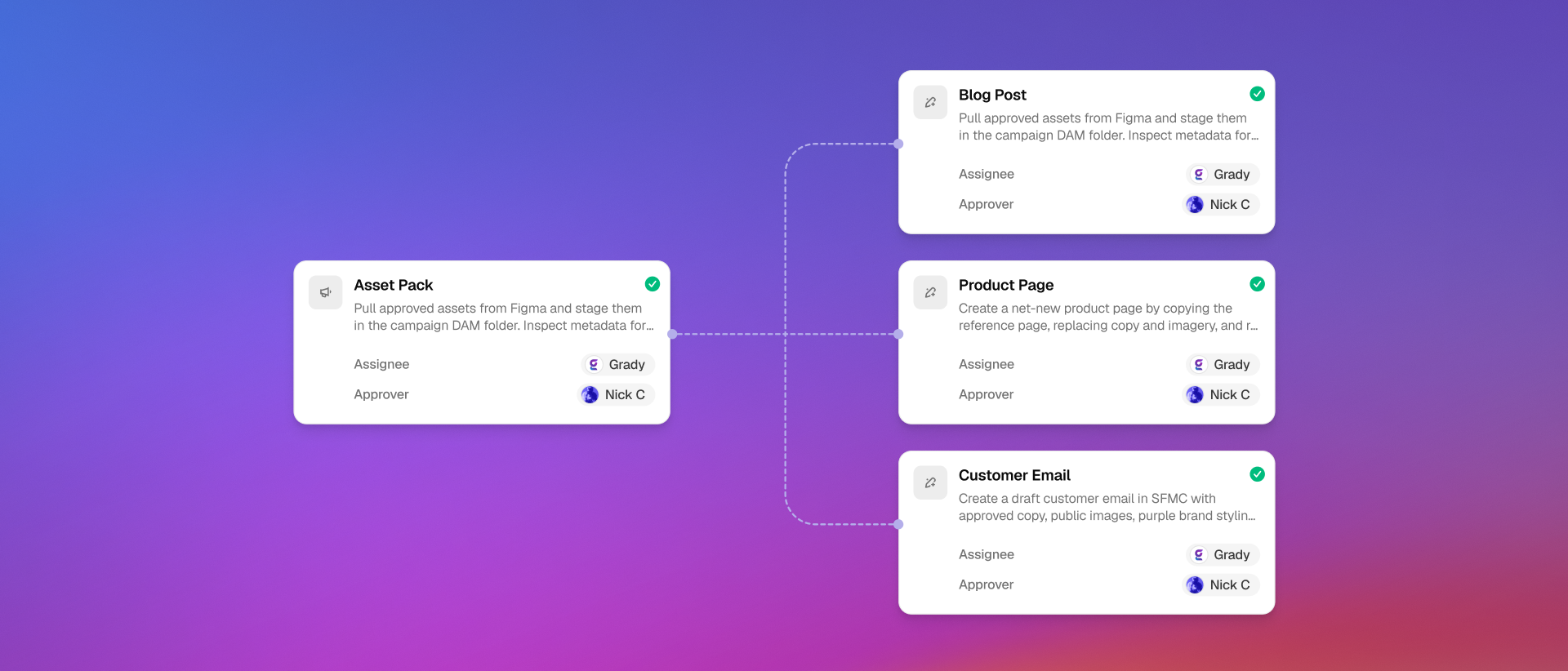
- Routine production happens in connected systems: Authorized agents prepare content, assets, metadata, page updates, checks, and previews.
- People receive decisions, not reconstruction work: Reviewers see what changed, why it changed, which checks ran, and what requires judgment.
- Release authority stays protected: Drafting, approval, publication, and activation remain separate actions.
- The result is verified: The harness confirms the customer-visible experience and carries approved learning into the next job.
A marketing harness does not remove collaboration. It removes the routine coordination required to make collaboration possible.
Where a marketing harness creates leverage
- Campaign operations: Turn an approved plan into tasks, channel assets, approvals, launch readiness, and measurement without manual status chasing.
- CMS authoring: Build and update structured pages, connect approved assets, run checks, and prepare rendered previews for review.
- DAM operations: Find the approved asset, validate rights and metadata, prepare the correct rendition, and verify placement.
- Email operations: Build channel-ready drafts from approved sources, preserve templates, run checks, and keep sending authority separate.
- Personalization: Turn audience and performance signals into the landing pages, emails, and channel variants each segment needs, with approvals and audience mapping attached.
- Search and AI visibility: Move from demand or visibility findings to governed content changes, technical updates, and measurement.
- Localization: Create structured market variants from a controlled source while preserving terminology, protected content, and local exception review.
What a marketing harness changes across the team
- Marketing executives: Gain execution capacity, clearer visibility into verified outcomes, and a way to scale ambition without scaling coordination at the same rate.
- Marketing operations leaders: Turn recurring work into governed workflows with clear ownership, review points, exception paths, and measurable outcomes.
- Martech leaders: Connect the existing stack, apply permissions by action and environment, and get more value from systems already in place.
- Web and CMS managers: Reduce repetitive page assembly, asset coordination, metadata work, QA, localization, and release preparation.
- Digital experience leaders: Carry audience and experience decisions into channel execution while preserving quality across devices, regions, and variants.
- Marketing practitioners: Spend less time chasing inputs and moving work between systems, and more time on customer insight, craft, experimentation, and performance.
The harness spans the marketing lifecycle
Point solutions usually cover one stage. An enterprise marketing harness connects planning, orchestration, creation, asset operations, channel execution, CMS work, review, release, and optimization so context and evidence do not have to be rebuilt at every handoff.
- Plan: Turn strategy into messaging, campaign direction, and an executable brief.
- Orchestrate: Break the brief into owned tasks, dependencies, timelines, and review points.
- Create and assemble: Produce copy, imagery, pages, variants, and localization from approved sources.
- Organize: Apply asset metadata, taxonomy, rights, and reusable content structure.
- Execute: Build work in web, email, social, paid, journey, and commerce systems.
- Review and release: Run quality checks, route human decisions, and advance only the approved scope.
- Measure and learn: Connect performance, search visibility, QA findings, and reviewer corrections to the next job.
Your team still owns strategy and brand judgment. The harness executes the operational stages in the middle under the controls the organization chooses.
Enterprise marketing harness vs. agents, copilots, and point solutions
| Approach | What it provides | What remains |
|---|---|---|
| AI point solution | Depth at one marketing stage | People still carry work and context between tools |
| Copilot or chat assistant | Drafting and recommendations inside one application | A person still executes the change in the system of record |
| Individual AI agent | Action within a bounded role or system | The organization still needs shared context, workspace, governance, evidence, and lifecycle coordination |
| DIY agent orchestration | Control over models and workflow logic | The team builds and maintains integrations, memory, guardrails, review, and auditability |
| System of record | The durable home for content, assets, audiences, and data | It stores the work but does not coordinate the work between brief and live |
| Enterprise marketing harness | Governed execution across the lifecycle in existing systems | People still own strategy, standards, judgment, and protected decisions |
The practical test is whether the system can execute a governed change in the marketing stack, preserve evidence, and verify the result without asking a person to carry every handoff.
How Gradial works as an enterprise marketing harness
Gradial is an enterprise marketing harness and the marketing operations system of work for enterprises. It works across the existing stack rather than replacing the systems of record that marketing already depends on.
- Tools perform the work: Gradial agents author, assemble, tag, check, route, and prepare approved marketing changes.
- Integrations reach end systems: Authorized work happens across connected CMS, DAM, ESP, analytics, collaboration, design, commerce, and workflow systems.
- Context keeps execution specific: Brand, product, campaign, audience, market, content, and workflow guidance apply to the relevant step.
- Memory carries approved learning forward: Reviewer corrections, prior decisions, and outcome signals improve reusable guidance for future work.
- Workspace keeps the job connected: Requests, tasks, dependencies, artifacts, reviews, and status stay together across the lifecycle.
- Guardrails govern the motion: Permissions, quality checks, budgets, human approvals, environment boundaries, and release controls remain visible and separate.
Because execution, governance, and learning live in the same operating layer, the next job can start from approved organizational knowledge instead of a blank prompt.
How to evaluate a marketing harness
Evaluate a marketing harness by the recurring work it can complete safely and verifiably, not by the number of agents it can launch or the quality of one generated sample.
- Can it execute in the systems where marketing work happens?
- Does approved business context persist across steps?
- Can permissions and reviews vary by risk?
- Can reviewers inspect sources, changes, checks, exceptions, and final state?
- Does it verify the customer-visible result?
- Can the team measure output, quality, cost, risk, and time to value?
Use the practical Marketing Harness Evaluation Guide to score a real workflow, compare approaches, and plan a controlled pilot.
Research basis and update scope
This guide applies the agentic harness model to enterprise marketing. It was updated on August 31, 2026 using Gradial’s current product definition in What Is an Agentic Harness?, alongside current technical explanations from Microsoft, Databricks, and LangChain.
The six-part model of tools, integrations, context, memory, workspace, and guardrails is now the shared foundation. The eight-control model in this guide explains how those parts operate across intake, planning, systems, quality, decisions, release, and learning.
Terminology and implementations continue to evolve. This page should be reviewed when Gradial product architecture, major agent platforms, enterprise governance practices, or category language materially change.
What a strong marketing harness produces
- One approved source of direction that travels through the workflow.
- One coordinated sequence across agents, people, systems, reviews, and release controls.
- Fewer manual handoffs between the approved decision and the customer experience.
- Evidence that lets reviewers decide without reconstructing the work.
- A verified result with workflow, quality, cost, and audience signals attached.
- Understand the broader agent harness: See how the architecture applies across enterprise functions.
- Explore the operating model: Learn how governed agents change marketing operations.
- Map your first workflow: Choose one recurring process and define its context, controls, systems, and human decisions.