


AI Summary
- A marketing harness connects agents, systems, context, memory, workspace, and guardrails so enterprise marketing work can move from approved direction to a verified result.
- Enterprise organizations need governance and coordination across brands, markets, systems, and risk boundaries.
- Growing enterprises need leverage that lets lean teams handle complex marketing operations without adding more handoffs.
Enterprise marketing does not have a content problem. It has an execution problem.
Most large organizations already have strategy, creative talent, customer data, and a substantial marketing technology stack. What slows them down is the distance between an approved decision and a live customer experience. A campaign still has to move through briefs, assets, page and email builds, audience mapping, accessibility checks, legal review, localization, approvals, launch, and measurement.
AI agents can help, but an agent alone is not an operating model. Enterprises need a way to connect agents to the right systems, give them current business context, control what they can do, preserve human decisions, and verify the result. That operating environment is a marketing harness.
What is a marketing harness?
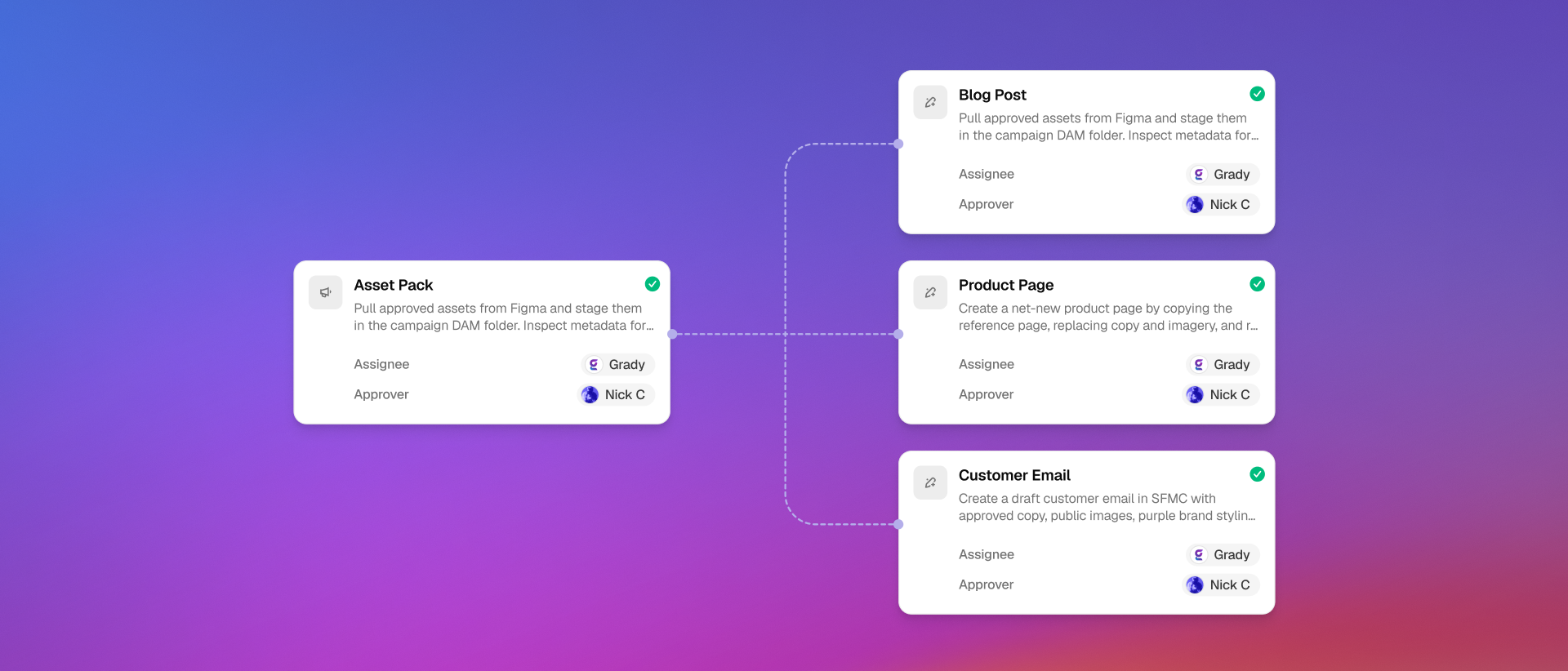
A marketing harness is the governed operating environment around AI models and agents that lets them perform real marketing work reliably and repeatably. It brings together six foundations: tools, authenticated integrations, business context, memory, a shared workspace, and guardrails.
The model reasons. The agent acts. The harness makes the work enterprise-ready. It determines which systems an agent can reach, which brand and product facts apply, where drafts and evidence live, which checks must run, when a person must decide, and what confirms that the customer-visible result is correct.
This is the difference between an impressive demonstration and a dependable marketing operation. A demo produces an answer. A harness carries approved direction through production, review, release, verification, and learning.
Why the enterprise stack needs an operating layer
Enterprise marketing stacks were built to store specialized work. The CMS stores pages. The DAM stores assets. The ESP sends email. The CDP manages audiences. Workflow tools track assignments. Each system matters, but people still carry context and work across the seams.
As AI increases the volume of possible output, those seams become more expensive. Faster creation can produce a larger review queue. More personalization can create more variants to build and govern. More agents can create more disconnected activity unless they share context, permissions, evidence, and release controls.
A marketing harness turns the stack into a coordinated system of work. It does not replace the systems of record. It connects them so a governed request can become a verified outcome without requiring a person to reconstruct the brief at every handoff.
Why the world’s largest enterprises should care
For the world’s largest enterprises, marketing complexity is structural. Multiple brands, business units, regions, agencies, languages, customer segments, and regulatory requirements all shape the same work.
- Governance has to travel with execution: Brand, accessibility, privacy, legal, and market requirements must apply while work is created, not after every variant reaches a final queue.
- Scale cannot depend on more coordination: Central teams need shared controls, while local teams need room for market context and accountable exceptions.
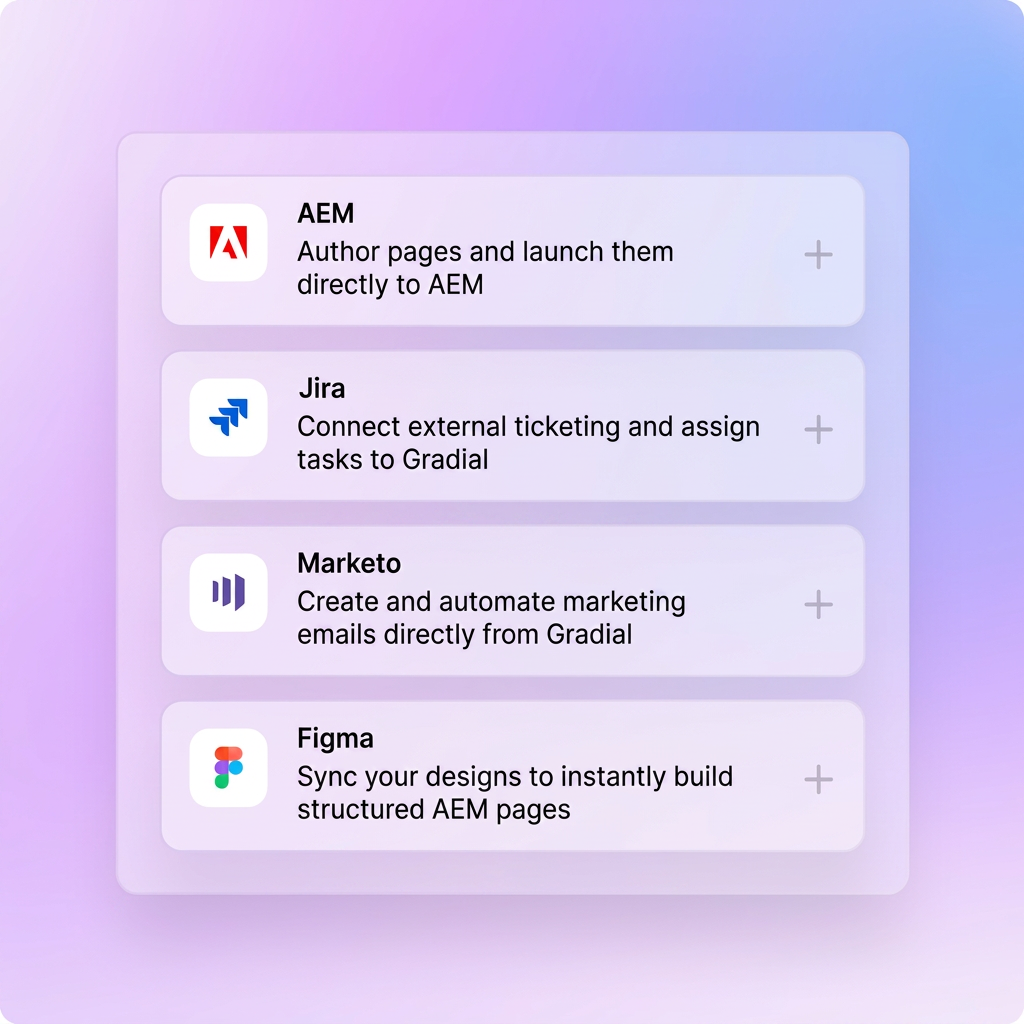
- Existing investments must keep working: A credible operating model has to connect the CMS, DAM, ESP, CDP, workflow, analytics, design, and collaboration systems already in place.
- Leadership needs evidence, not activity: The organization must see what changed, which checks ran, who approved it, what shipped, and whether the visible experience matches the decision.
The strategic value is not simply lower production effort. It is the ability to increase marketing ambition without increasing operational risk at the same rate.
Why large, growing enterprises should care
Large, growing enterprises face a different version of the same constraint. Their marketing mandate may already look global, multi-channel, and personalized, but their operations team is often smaller and their specialist capacity is thinner.
- Limited teams carry enterprise complexity: A few people may own campaign operations, web production, email, analytics, and governance across the organization.
- Backlog becomes a growth ceiling: Good ideas wait because the same operators are building pages, chasing approvals, fixing metadata, and preparing reports.
- Point tools add handoffs: Another generator or assistant can create output without reducing the work required to make it usable, compliant, and live.
- Standardization has to arrive before sprawl: A harness lets the organization encode strong operating patterns before every business unit builds its own process.
For these enterprises, the harness creates leverage. It gives a lean team a repeatable way to execute across systems while keeping people focused on strategy, creative judgment, customer understanding, and the decisions that move the business.
The business case is already visible in the work
Public Gradial customer stories show why the operating layer matters across different forms of enterprise complexity.
- T-Mobile: A large campaign that historically required 1,000 to 1,200 cumulative hours over a month was executed in 80 hours with people focused on QA. See how T-Mobile accelerated campaign execution.
- AWS: Page creation moved from roughly ten hours per page to about thirty minutes, creating more room for strategic customer experience work. Explore the AWS results.
- Prudential: Gradial supports governed personalization by connecting content authoring with evaluation for legal, regulatory, brand, and voice alignment. Learn how Prudential approaches governed personalization.
These are different workflows, but the pattern is consistent. Value appears when agents can execute inside the real operating environment with context and governance attached.
Is it actually a marketing harness?
A solution is not a marketing harness simply because it uses agents or generates marketing content. Enterprise teams can apply five practical tests.
- Can it execute in the systems where marketing work happens? It should perform controlled work in systems such as the CMS, DAM, ESP, CDP, analytics platform, and workflow system, not stop at recommendations.
- Does business context travel with the work? Brand standards, product facts, approved claims, audience decisions, market requirements, and prior corrections should apply without rebuilding the perfect prompt every time.
- Is governance part of execution? Permissions, quality checks, human approvals, environment boundaries, and release controls should shape the work from the beginning.
- Can it coordinate a complete workflow? A harness should manage steps, dependencies, owners, exceptions, and review gates across agents, people, and systems.
- Does it verify the real outcome? Completion should mean the intended page, email, asset, audience, or campaign is correct in the destination system and visible as intended.
If a solution only generates an asset, recommends a change, or performs one isolated action, it may be a useful agent or point solution. It is not yet a marketing harness.
These tests establish whether a solution qualifies as a marketing harness. Evaluating whether it is a strong enterprise harness requires a deeper look at security, context quality, observability, governance, workflow coverage, verification, and measurable value. Use the complete enterprise marketing harness evaluation framework.
Start with one workflow that matters
An enterprise does not need to transform every marketing process at once. Start with a recurring workflow where the operational path is visible and the outcome can be verified, such as campaign page production, market localization, email creation, asset operations, governed personalization, or content updates across a large web estate.
- Define the approved source of direction and the customer outcome.
- Identify the systems, context, checks, owners, and protected decisions.
- Separate drafting, approval, activation, publication, and verification.
- Measure cycle time, handoffs, first-pass approval, throughput, defects, and customer impact.
The question is no longer whether an agent can create an asset. The question is whether the enterprise can turn intent into governed, repeatable, measurable execution.
Read the enterprise marketing harness guide for the full architecture and evaluation framework, or map your first governed workflow with Gradial.
Get updates from where the work gets done
Product news, execution insights, and real-world use cases from the Gradial system of work.