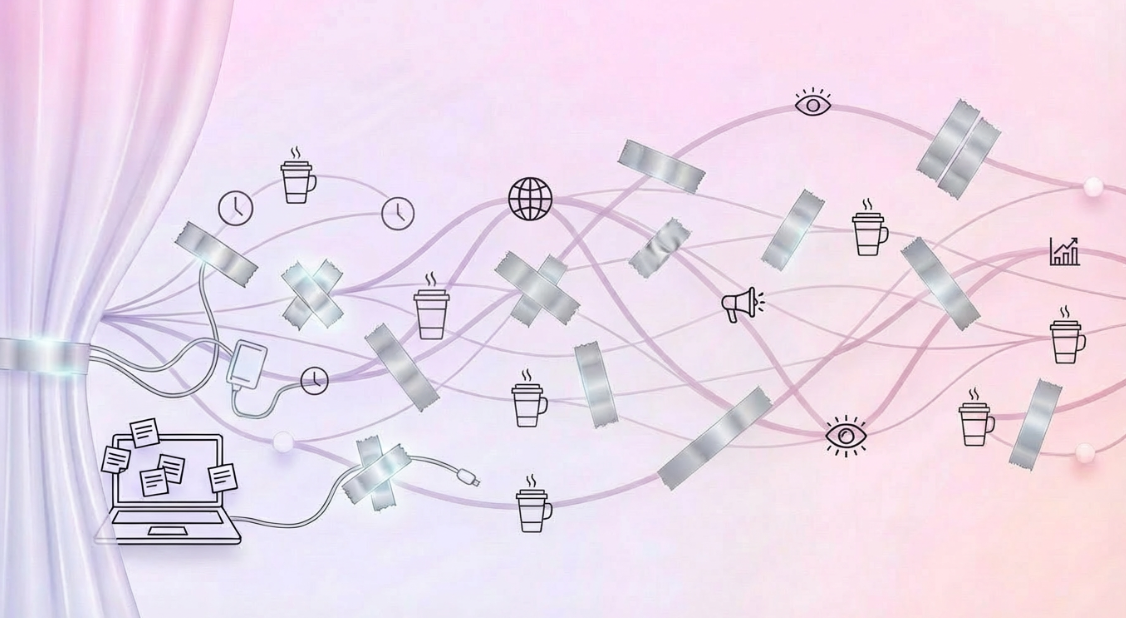

Every fall, Medicare Advantage organizations face the same reality: large-scale website updates are tied to Annual Enrollment Periods (AEP).
AI Summary
- Medicare Advantage websites reset annually under fixed Centers for Medicare & Medicaid Services (CMS) timelines, with prescriptive language requirements and county-level variation that multiplies every page change.
- The bottleneck is not the work itself. It is the operating model: manual workflows designed for incremental change, not synchronized, compliance-heavy volume.
- Smart payers are shifting from page-based work to structured control, embedding compliance into execution, and building for bulk, precise change.
- Gradial agents act as the execution layer on top of your content management system, enabling bulk updates, CMS-mandated language enforcement, county-level consistency, and embedded governance controls.
- Annuel Enrollment Period (AEP) becomes a managed release cycle, not a fire drill.
Benefits finalize late, CMS marketing requirements shift, compliance teams circulate updated disclaimer language, legal review queues back up, and digital teams start duplicating pages to manage county-level variations. And suddenly, hundreds, sometimes thousands, of updates need to go live before AEP opens.
You know what happens next: QA goes manual. Evidence of Coverage and Summary of Benefits PDFs get revised one at a time. Star ratings need refreshing across every plan page. CMS-required disclaimers have to match exact language. Provider directories have to reflect the latest network changes.
Every update carries compliance risk, and every manual touchpoint is a place where something slips. The updates themselves aren’t complex; what’s complex is the waiting: the queues, the handoffs, the serial review chains, the spreadsheet tracking, and the manual sweeps. The work isn’t slow because the work is hard, it’s slow because the work waits.
This cycle repeats every year for Medicare Part C and Part D sponsors. And while many teams treat it as a seasonal surge, the underlying problem isn’t volume, it’s structural.
The annual reset: why Medicare websites face unique pressure
Commercial health plan websites evolve gradually. Medicare Advantage resets annually, on fixed CMS timelines, with prescriptive language requirements and county-level service area complexity that multiplies every page variation.
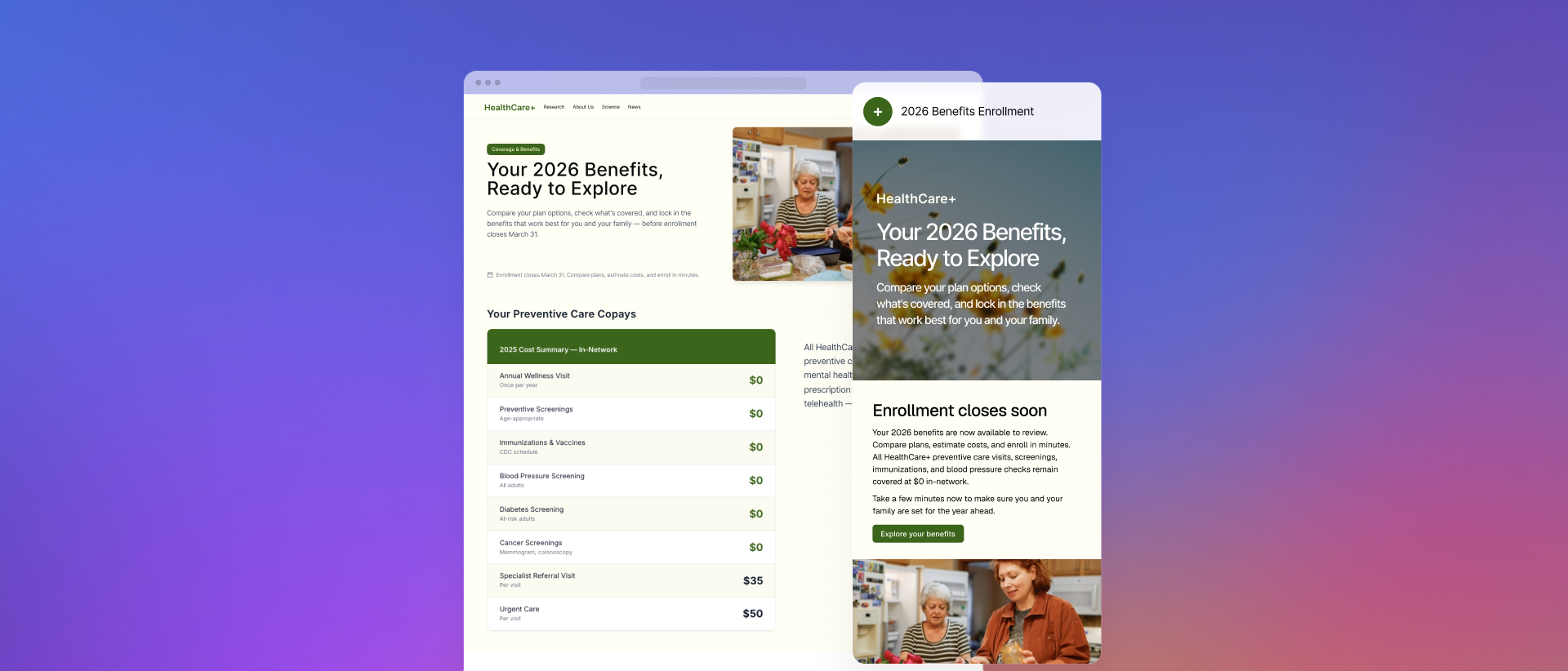
Each year, Part C and Part D sponsors have to align every page with finalized benefit designs, updated CMS marketing guidelines, ANOC and EOC documents, star ratings, and county-level service area adjustments, all under non-negotiable AEP deadlines. A single CMS memo can trigger site-wide changes across hundreds of pages.
That’s what makes this different from commercial plan publishing: the timeline is fixed, the language is prescriptive, and the blast radius of a single change is enormous.
County-level variation is where it compounds. Most Medicare Advantage plans vary by county: premiums, cost-sharing, supplemental benefits, and service areas all differ by region. What looks like one plan nationally can require dozens or hundreds of localized page variations.
Without structured content controls, teams end up duplicating pages, hard-coding benefit tables, manually updating disclaimers, and displaying star ratings inconsistently. Each variation increases the surface area for error.
CMS language requirements add another layer. Disclaimers must match exact phrasing. Star ratings must display correctly. TPMO language must follow formal guidelines. Accessibility standards continue to evolve. When CMS releases updated guidance, even mid-year, digital teams may need to revise language across every affected page.
The hidden cost: it’s not the work, it’s the operating model
At an executive level, the issue isn’t workload; it’s that most Medicare Advantage organizations still manage website updates through workflows designed for incremental change, not synchronized, compliance-heavy volume.
Content changes become page changes, and in most enterprise CMS environments, Medicare content isn’t structured for bulk control. Benefit tables are embedded in page components. Disclaimers are hard-coded. County variations are duplicated rather than dynamically managed.
So when a benefit changes, it’s not one update, it’s dozens, or hundreds. When CMS revises required language, teams run manual site sweeps instead of updating a centralized source. At smaller scale, this is manageable but at Medicare Advantage scale, it’s operational debt that accrues every year.
Review cycles multiply. Every Medicare website update often requires marketing review, compliance validation, and legal signoff. As volume increases, review queues expand. Tracking migrates to spreadsheets. Minor edits reopen previously approved content. By the time AEP approaches, publishing slows, not because teams lack effort, but because the workflow itself becomes the bottleneck.
QA becomes the last line of defense. Because updates are manual, quality assurance is manual too. Teams verify disclaimer accuracy, star ratings, benefit consistency, PDF alignment, and accessibility compliance page by page. The entire system depends on people catching discrepancies before they go live. During peak AEP periods, risk concentrates precisely when change volume is highest.
Complexity keeps scaling. Medicare Advantage enrollment continues to grow, plans expand geographically, supplemental benefits diversify, and regulatory oversight stays active.
Each new county, benefit variation, or disclosure requirement adds complexity. If execution stays manual, complexity scales faster than your ability to control it.
Even when AEP launches successfully, the infrastructure underneath is often unchanged, meaning the same strain returns next year, causing a recurring operating constraint.
What smart payers are doing differently
The payers pulling ahead aren’t working harder during AEP. They’re building differently between AEPs.
Leading hospital providers have recognized that AEP execution is an infrastructure challenge, and the organizations making the biggest gains share three shifts:
They’ve moved from page-based work to structured control. High-performing teams centralize control over disclaimers, benefit language, star ratings, and plan attributes. Instead of updating content page by page, they manage structured sources that propagate changes across all affected pages.
When CMS language changes, they update once, not hundreds of times. That reduces both labor and compliance risk simultaneously.
They’ve embedded compliance into execution, not bolted it on at the end. Rather than relying solely on end-stage review, these teams build compliance validation directly into their publishing workflows.
Required language, accessibility standards, and structured review processes are enforced systematically, not manually. Compliance becomes a guardrail, not a gate.
They’ve built for bulk, precise change. Medicare Advantage websites require synchronized updates. Smart payers have built the ability to update hundreds of pages simultaneously, apply consistent changes across county-level variations, detect and revise specific language patterns site-wide, and align on-page content with updated PDFs. AEP finally becomes a managed release cycle, not a fire drill.
Where Gradial fits
Gradial is the system of work built for exactly this kind of environment: high-volume, compliance-sensitive, and deadline-driven.
Rather than replacing your CMS, Gradial agents act as the execution layer on top of it, enabling structured, large-scale updates with embedded governance controls.
For Medicare plans, Gradial agents execute the operational work between the CMS memo and every affected page going live: bulk updates across CMS-managed sites, detection and revision of CMS-mandated language across all instances, consistency enforcement across county-level variations, brand, compliance, and accessibility guardrails before publish, reduced manual QA and repetitive review cycles, and accelerated controlled publishing during AEP.
Governance runs automatically, 100% of the time, on every output, resulting in a more resilient Medicare digital operation designed to handle regulated change at scale, without the chaos.
A starting point: audit your AEP readiness now
You don’t need to wait for the next AEP cycle to find out whether your infrastructure will hold. Here’s a quick diagnostic:
- Pick your 50 highest-traffic Medicare plan pages. Can you update the disclaimer language on all 50 in a single action, or does it require 50 separate edits?
- Trace your last CMS-mandated language change. How long did it take from the memo to every affected page being updated? How many people touched it?
- Check your county-level consistency. Pull five county variations of the same plan. Are benefit tables, star ratings, and disclaimers identical where they should be?
- Ask your QA team one question: During last year’s AEP, what percentage of their time was spent on manual verification vs. exception handling?
- How much time does it take to upload the hundreds of PDF plan pages? Can the corresponding links be updated at the same time? Can these changes be in one batch or does it take multiple tickets to be managed?
If the answers make you uncomfortable, the problem isn’t your team. It’s the operating model. And that’s exactly what Gradial is built to fix.
If you’d like to run this diagnostic with us, let’s start a conversation. Gradial works with Medicare Advantage organizations to transform high-volume, compliance-sensitive website operations into controlled, scalable systems, reducing risk while increasing execution confidence.

Cara Olson
Industry Lead, Healthcare & Life SciencesCara is an industry leader at Gradial, focused on Health and Life Sciences brands. She is partnering with payers, providers, and pharmaceutical, bio, and life sciences companies like Kaiser Permanente, GSK, and Mayo Clinic, to transform their marketing and content operations workflows. She finds it rewarding to give marketers joy back in their jobs by centering their initiatives on patients and providers rather than on tedious tasks to complete website updates.
Get updates from where the work gets done
Sign up to receive product releases, execution insights, and real-world use cases from the Gradial system of work.