Technology

From Hours to Minutes: How Agentic AI Gives Marketing Teams Their Time Back

Apr 29, 2026Gradial
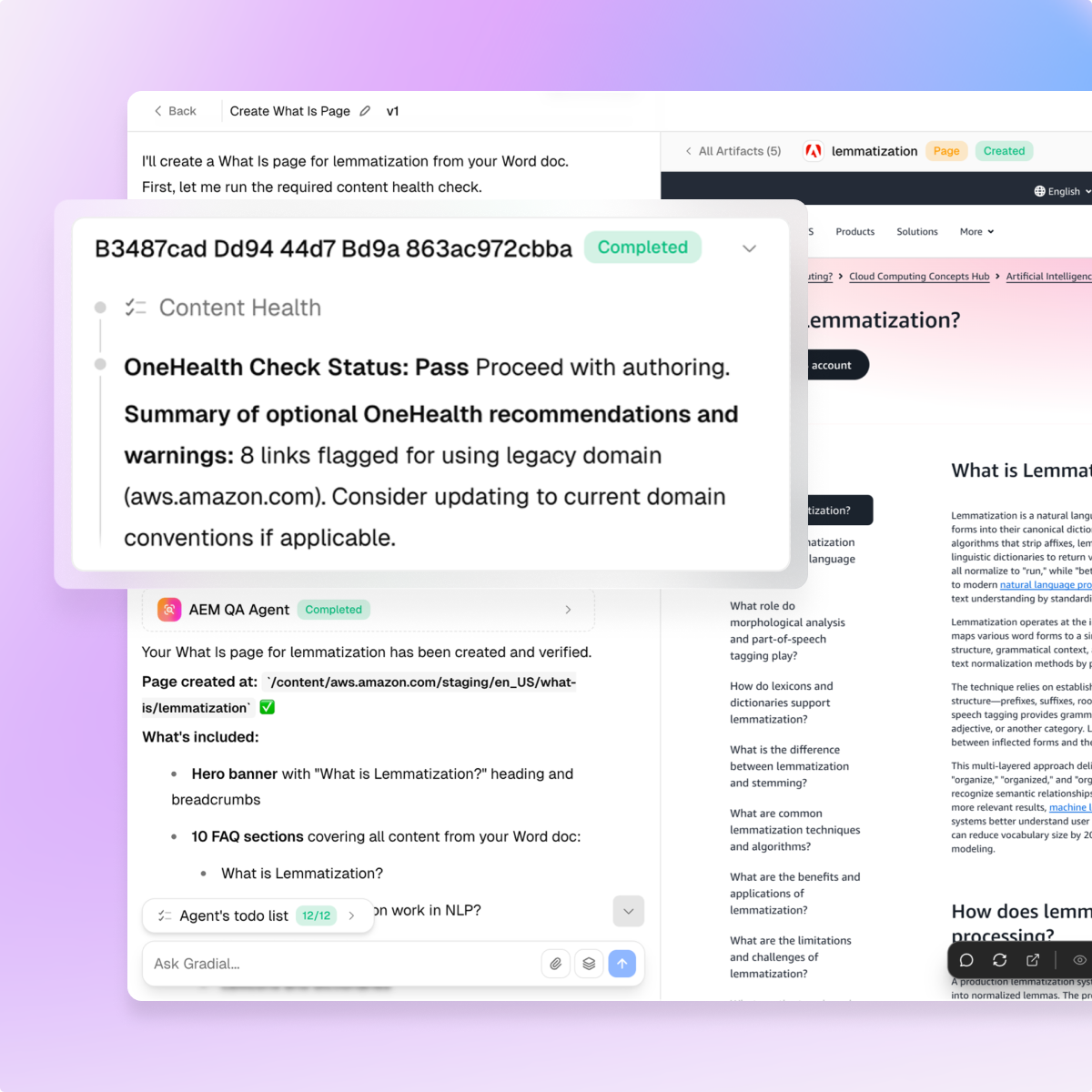
Gradial agent workflow showing content health validation and page creation for an AWS page
TechnologyAI

When one of the world’s largest cloud providers needed to fix how its marketing team publishes content, they chose Gradial. Working with AWS Marketing’s Technology, AI, and Analytics (TAA) team, we deployed an agentic AI solution, built on Amazon Bedrock, that cut webpage assembly and execution time from up to four hours to approximately ten minutes—a reduction of over 95%.

The solution handles natural language page assembly, real-time content validation, and end-to-end workflow execution in a single session.

Background: When mechanical work stalls strategic marketing execution

For Digital Marketing Managers (DMMs) and Product Marketing Managers (PMMs) at an organization like AWS, a single webpage typically moves through a campaign brief, a kickoff call, a backlog queue, a copy review, a creative review, an accessibility check, link testing, backend validation, and stakeholder sign-off before anything is live. A marketer can spend anywhere from 1 to 4 hours configuring pages inside traditional content management systems (CMS).

Within that workflow, specific challenges that create the most friction are:

  • Long page assembly: Configuring components, structuring layouts, and placing content within CMS frameworks requires deep system familiarity.
  • Cross-team coordination delays: Copy, assets, links, and integrations are typically reviewed after the page is fully assembled. Problems found at this stage mean revisions, which means another full review cycle.
  • Technical dependencies: Requirements that exceed existing components get routed to engineering, extending timelines and creating new handoff points.
  • Reactive quality control: Accessibility compliance, brand standards, and SEO requirements are evaluated at the end of the process instead of being built into the workflow or process.

The AWS TAA team recognized that they spent too much time on mechanical assembly and too little time on the strategic work to drive business impact. They needed a solution that could handle CMS complexity while enforcing brand, accessibility, and compliance standards before publication.

Solution: A different way to publish with Gradial Agents

Gradial delivers three capabilities in a single session: natural language page assembly, real-time content validation, and end-to-end workflow execution.

Natural language page assembly: Marketers describe what they need in plain language, Gradial interprets the request, identifies the required components, determines the correct layout structure, and generates the configurations automatically. Deep CMS expertise is no longer a prerequisite for publishing.

Real-time content validation: Using an MCP (Model Context Protocol) server, the solution validates content against SEO, accessibility, and brand standards during assembly. Issues are identified and resolved in the same session, eliminating the delayed review cycle that typically adds days to a publishing workflow.

Direct CMS execution: A proxy layer connects Gradial to the CMS programmatically, so assembled pages are created and configured within existing publishing workflows while the CMS retains its role as the publishing system.

The results and business impact

After deploying into production with AWS Marketing, the before-and-after is measurable:

BeforeAfter
Page assembly timeUp to 4 hours, manual~10 minutes via natural language (95%+ reduction)
Quality validationReactive, post-assemblyProactive, real-time during assembly
User experienceMulti-step, complex CMS setupNatural language interface

Marketing teams now spend their time on content strategy and campaign optimization instead of technical page configuration, content validation happens during creation, and problems get resolved in the same session so content can go live faster.

Outcomes: Speed, quality, accessibility

Gradial delivers three compounding outcomes. First, automated component configuration and natural language input enables faster production. Second, real-time validation means content meets brand, accessibility, and SEO standards before it reaches stakeholder review. Third, more team members can now build and publish pages using a natural language interface.

The combination demonstrates how Gradial agents modernize enterprise content operations while maintaining the governance and compliance standards marketing organizations require.