
Announcing GEO with execution built in

Mar 9, 2026Gradial
ProductGEO

Generative search returns answers, not links. GEO only works when you can ship updates as fast as those answers change.

Search is changing faster than most marketing organizations realize.

For more than two decades, teams optimized for a simple paradigm: traditional search engines ranking web pages.

Today, a new class of discovery engines is reshaping how buyers learn:

  • ChatGPT
  • Perplexity
  • Claude
  • Gemini
  • AI Overviews in Google

Instead of returning links, these systems return answers. And those answers are increasingly assembled from content across the web.

Welcome to Generative Engine Optimization (GEO).

GEO is about making sure your brand, products, and expertise show up accurately inside those AI-generated answers, not just in traditional search rankings.

Interest in GEO is exploding. The problem is that most teams are trying to run it with the same playbook they used for SEO.
Most GEO platforms stop at analytics

Many GEO platforms follow a familiar model:

  1. Monitor AI answers and citations
  2. Analyze your brand visibility and gaps
  3. Produce a set of recommendations

The dashboards are impressive. But they stop where the work actually begins.

From there, recommendations get handed off to SEO teams, content teams, engineering, and web operations. Briefs get written. Tickets get filed. Approvals stack up. Weeks pass.

Generative search does not wait on a quarterly cycle. Across AI answer engines, 40 to 60% of sources cited in responses can change within a single month, according to Profound.

So by the time your team ships the edits, the answer landscape has already moved.

Before you sign a GEO contract, ask this

If you are in the middle of buying a GEO platform, pause and ask one question:

Who actually deploys the changes?

If the answer is your SEO team, your content team, engineering, or your CMS backlog, then you did not buy optimization. You bought reporting.

And reporting does not win generative search. Execution does.

That is the core idea behind this release. GEO only works when insight turns into live updates fast enough to keep up with how quickly AI answers evolve.

GEO report recommendations screen

GEO needs an execution loop, not a backlog

The fix is straightforward: connect insight to action, then measure again. The loop has to be fast enough to keep pace with how quickly AI answers evolve.

1. Detect what engines actually say

  • Which prompts and questions drive demand in your category
  • Which brands are recommended and why
  • Which pages and sources engines cite as evidence
  • Where your site is missing coverage, clarity, or trust signals

2. Turn findings into shippable recommendations

Recommendations need to map cleanly to real content changes. Not just "add more content", but specific actions like:

  • Rewrite a definition so an engine can quote it
  • Add a comparison section that answers a common evaluation question
  • Create an FAQ that resolves the top objections
  • Strengthen trust signals by adding sources, dates, and clear authorship

3. Execute updates directly in your CMS, with guardrails

This is the missing piece. Gradial connects GEO insight to real execution. Instead of exporting tickets and hoping the work happens, Gradial agents can draft changes, route them through your governance, and push approved updates into the CMS where the content actually lives.

That includes the high-leverage work that drives GEO outcomes:

  • Generate and revise structured answers, definitions, and comparisons
  • Update page copy, FAQs, internal links, and metadata
  • Deploy structured content engines can reliably parse
  • Test variations and keep the winners

4. Verify impact and keep improving

Once changes are live, close the loop. Recheck the same prompts. Re-evaluate citations. Confirm engines are pulling your updated language and linking to the right pages. If the answer shifts, you iterate again.

This is how GEO becomes an always-on system: insight to execution to learning.

Announcing: GEO with execution built in

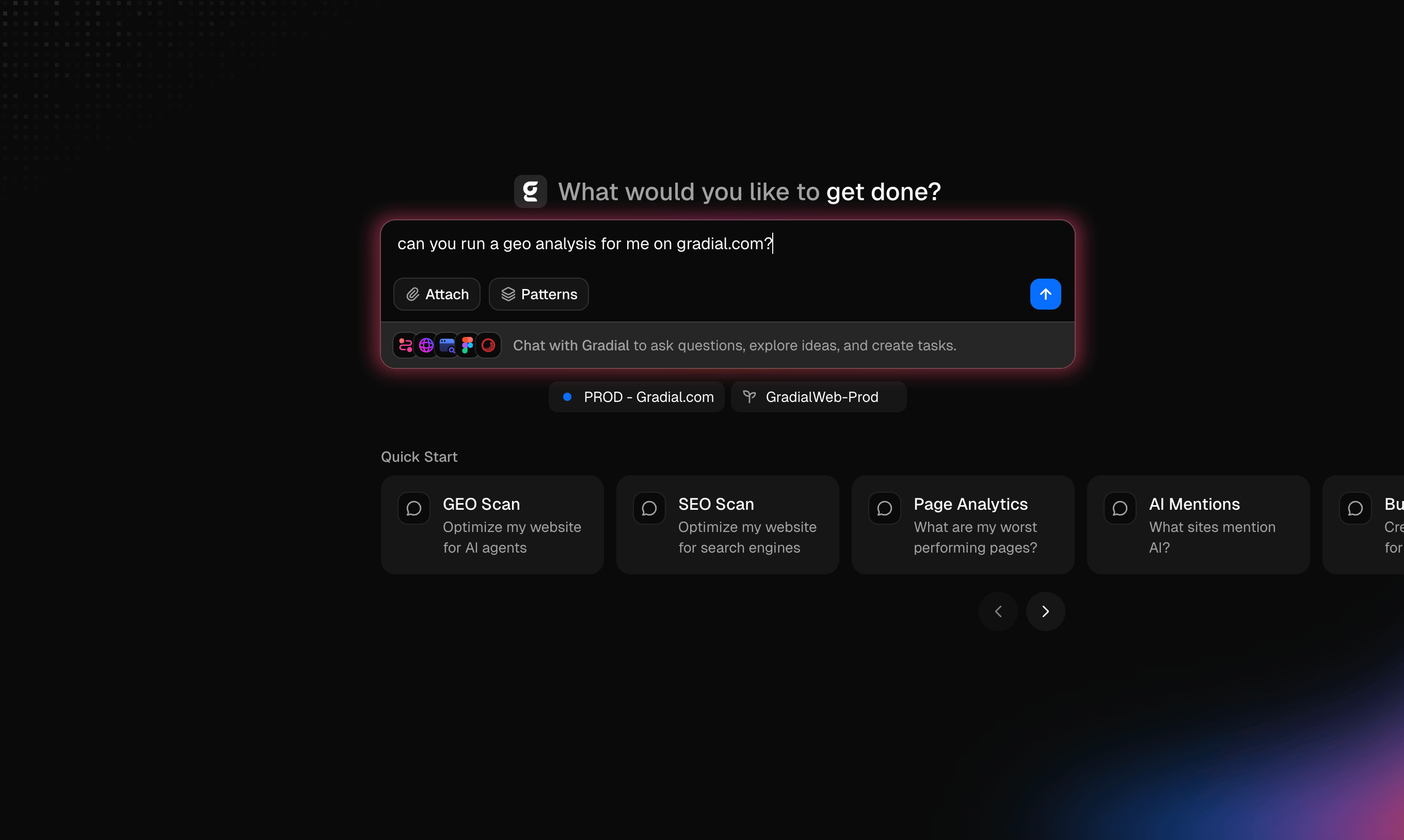
Today we are introducing GEO workflows inside Gradial designed to turn recommendations into live updates. The goal is simple: improve how engines represent your brand without turning every insight into a multi-month content project.

  • From recommendation to update: translate findings into concrete page and component edits.
  • CMS-connected execution: push approved changes into Sitecore and other systems where your content lives.
  • Governance by default: keep brand, accessibility, and review requirements in the loop.
  • Continuous verification: re-run prompts and track whether engines cite your updated sources.

How to start

  1. Pick a focused set of prompts your buyers actually use.
  2. Identify the pages that should win those answers.
  3. Run the first execution loop and ship improvements the same week.
  4. Expand coverage as you prove impact.

If you want to see the execution loop in action, request a demo.